Wilson Pickett – In the Midnight Hour (1965)

Wilson Pickett - In the Midnight Hour


Written by Pickett and Steve Cropper, this song evolved from a couple of sources. The title and theme came from Wilson’s previous work as a Gospel singer and was a frequent saying of his on his early recordings. The other inspiration was a dance, the “Jerk”, a popular dance step kids were doing across the country.

Steve Cropper wrote and co-wrote many songs, one famous recording was with Otis Redding “Sitting On The Dock Of The Bay”. Along with Steve, in the Stax Records house band/session musicians known as the M.G.’s, was Donald “Duck” Dunn (Bass) and Al Jackson (Drums). Stax keyboard player Booker T. Jones, who usually played with Dunn, Cropper and Jackson, did not play on the studio sessions with Pickett.

When Wilson Pickett was an up and coming artist, he was sent to record at Stax Records in Memphis, Tennessee. Steve Cropper went to the nearest record shop and began searching through the record bins, looking for something Pickett had done.

I found two or three things… some Spiritual things that he had sung lead on…I didn’t know what groups he’d been in or whatever. But I used to work in [a] record shop, and I found some gospel songs that Wilson Pickett had sung on. On a couple [at] the end, he goes: ‘I’ll see my Jesus in the midnight hour! Oh, in the midnight hour. I’ll see my Jesus in the midnight hour.’ In every song in the fade-out, he’d go into this ritual, ‘I’m going to wait till the midnight hour, oh in the midnight hour,’ and he’d start preaching this midnight hour thing, and I said ‘That’s it’

Cropper got the idea of using the phrase “in the midnight hour” as the basis for the song. More likely, Cropper was remembering the Falcon’s (Wilson’s previous group) 1962 song “I Found a Love,” on which Pickett sings lead and says “And sometimes I call in the midnight hour!”

The other inspiration was the popular dance “the Jerk”. Jerry Wexler, a producer at Atlantic Records, (who, to the chagrin of those present, Wexler demonstrated in the studio) said to Cropper:

Why don’t you pick up on this thing here?” He performed a dance step… This was the way the kids were dancing; they were putting the accent on two. Basically, we’d been one-beat-accenters with an afterbeat; it was like ‘boom dah,’ but here was a thing that went ‘um-chaw,’ just the reverse as far as the accent goes.

Pickett’s partnership with Steve Cropper and Atlantic Records produced a long series of hits that included, “Don’t Fight It” (1965), “634-5789”, (#13 in 1966) “Land Of 1,000 Dances”,(#6 in 1966) “Mustang Sally” (#23 in 1966) and “Funky Broadway” (#8 in 1967).

mustang sally - wilson pickett


Not the best audio but does give you a view of him and his powerful voice in his live performances, including his vocalizations that were reminiscent of James Brown. The other major hit, “Land Of 1,000 Dances”, was written and first recorded by Chris Kenner in 1962 and has been covered by many artists including Ted Nugent, the J. Geils Band, and “Fats” Domino as a co-author of the song with Kenner. Domino agreed to record the song in exchange for half of the song’s royalties. Wilson Pickett recorded the song during his first set of sessions at FAME Studios in Muscle Shoals, Alabama, backed by the Muscle Shoals Rhythm Section (known as the Swampers) and the Memphis Horns.

Wilson Pickett - Land of 1000 Dances [Full Version] [HQ Audio]


Wilson Pickett was born March 18, 1941 in Prattville, Alabama, and sang in Baptist church choirs. He was the fourth of 11 children and called his mother

The baddest woman in my book telling historian Gerri Hirshey:  I get scared of her now. She used to hit me with anything, skillets, stove wood — (one time I ran away) and cried for a week. Stayed in the woods, me and my little dog.

Pickett eventually left to live with his father in Detroit, Michigan in 1955. There, Pickett performed on street corners with other singers, under the influence of recording stars such as Little Richard, whom he referred to as “the architect of rock and roll.” In the 1950s, Pickett put together the Violinaires, a gospel group. After singing for four years in the popular gospel-harmony group, Pickett, lured by the success of gospel singers who had moved to the lucrative secular music market, joined the Falcons in 1959. The Falcons were an early vocal group bringing gospel into a popular context, thus paving the way for soul music. He co-wrote and sang lead on their 1962 hit “I Found A Love” which included the phrase “sometimes I call in the midnight hour”. His style and ad libbing were evident from the start and a foreshadowing of things to come.

The Falcons I Found A Love


Soon after recording “I Found a Love”, Pickett cut his first solo recordings, including “I’m Gonna Cry”. Pickett also recorded a demo for a song he co-wrote, “If You Need Me”, a slow-burning soul ballad featuring a spoken sermon. Pickett sent the demo to Jerry Wexler, a producer at Atlantic Records. Wexler gave it to the label’s recording artist Solomon Burke, Atlantic’s biggest star at the time. Burke admired Pickett’s performance of the song, but his own recording of “If You Need Me” became one of his biggest hits (#2 R&B, #37 pop) and is considered a soul standard. Pickett was crushed when he discovered that Atlantic had given away his song. When Pickett—with a demo tape under his arm—returned to Wexler’s studio, Wexler asked whether he was angry about this loss, but denied it saying “It’s over”. Pickett’s version was released on Double L Records and was a moderate hit, peaking at #30 R&B and #64 pop.

Pickett’s first significant success as a solo artist came with “It’s Too Late,” an original composition (not to be confused with the Chuck Willis standard, or the Carole King song, of the same name). Entering the charts on July 27, 1963, it peaked at #7 on the R&B chart (#49 pop); the same title was used for Pickett’s debut album, released in the same year. Compiling several of Pickett’s single releases for Double L, “It’s Too Late” showcased a raw soulful sound that foreshadowed the singer’s performances throughout the coming decade. The single’s success persuaded Wexler and Atlantic to buy Pickett’s recording contract from Double L in 1964.

WILSON PICKETT It's Too Late 1963


After “In The Midnight Hour” and his string of other hits Pickett didn’t confine himself to the environs of Stax for long; soon he was also cutting tracks at Muscle Shoals. He recorded several early songs by Bobby Womack. He used Duane Allman as a session guitarist on a hit cover of the Beatles’ “Hey Jude.” He cut some hits in Philadelphia with Gamble & Huff Productions in the early ’70s. He even did a hit version of the Archies’ “Sugar, Sugar.” The hits kept rolling through the early ’70s, including “Don’t Knock My Love” and “Get Me Back on Time, Engine Number 9.”

One of the corollaries of ’60s soul is that if a performer rose to fame with Motown or Atlantic (who was the parent company for Stax Records), he or she would produce little of note after leaving the label. Pickett, unfortunately, did not prove an exception to the rule. Pickett continued to record sporadically with several labels over the following decades (including Motown), occasionally making the lower to mid-range of the R&B charts, but he had no pop hit after 1974. After his last record to chart, “Fire And Water”, he remained fairly active on the touring front until falling ill in 2004.

By the time disco took hold in the 1970s and popular music continued to change in the 1980s, Pickett’s star faded, though he continued to tour and record on occasion. He also became more unstable in his personal life and developed a drinking problem. In 1974, he was arrested for brandishing a gun during an argument in New York. Thirteen years later, Pickett was arrested and sentenced to probation for possession of a loaded shotgun in his car.

The 1990s saw a revival in Pickett’s career. In 1991 attention was brought to his importance as an artist when the hit film “The Commitments” was released. The film focused on a young Irish band obsessed with American soul music and a desire to meet Pickett himself, although he did not appear in the film. While his career was revived, Pickett had a series of run-ins with the law. While living in Englewood, New Jersey, in 1991, he drove his car onto the mayor’s lawn, spewed death threats, and was arrested. Pickett was convicted of drunk driving in 1993. The conviction resulted in a sentence of a year in jail and five years probation. During his time in jail, he got into a fight with another inmate and injured his eye. Pickett had to have a number of surgeries to fix the damage. Pickett was also arrested for cocaine possession several times and went to rehab.

In 1999, Pickett moved to Ashburn, Virginia, and recorded his first album in more than a decade “It’s Harder Now”. That album was nominated for a Grammy Award for “Traditional rhythm and blues vocal performance” as well as three W.C. Handy Awards, given by the Blues Foundation, in 2000.

He continued to tour until the end of 2004, when he decided to take a year off from performing. He planned on recording and touring again, but his health began to decline. On January 19th, 2006, he suffered a fatal heart attack at the age of 64. He was laid to rest at the Evergreen Cemetery in Louisville, Kentucky. Pickett was honored on March 20th, 2006, at New York’s B.B. King Blues Club with performances by his long-term backing band The Midnight Movers, The Commitments, Ben E. King, Bruce ‘Big Daddy’ Wayne, and Southside Johnny in front of an audience that included members of his family, including two brothers. In the final analysis, he will be remembered as a major force in Soul music who placed over fifty songs on the Billboard R&B chart and sixteen more on the Hot 100.

“In the Midnight Hour” has also been recorded by Ace Cannon (instrumental), Archie Bell & the Drells, Tom Jones, the Chambers Brothers, Chris Farlowe, the Jam, Bob Kuban and the In-Men, Roxy Music, Delbert McClinton, the Righteous Brothers, Johnny Rivers, Mitch Ryder and the Detroit Wheels, Guy Sebastian, James Taylor, Them, Tina Turner, Mary Wells, and the Young Rascals. The Grateful Dead also did a rendition of “In The Midnight Hour” at the Fillmore East on April 29th 1971, among other performances.

“In the Midnight Hour” reached number one on the R&B chart in Billboard magazine dated August 7, 1965 and crossed over to the Top 40 of the Billboard Hot 100 reaching number 21: however according to Stax owner Jim Stewart the domestic sales total of the single in its original release was a moderate 300,000 units. However “In the Midnight Hour” by Wilson Pickett has become an iconic R&B track, placing at number 134 on Rolling Stone’s list of the 500 Greatest Songs of All-Time, Wilson Pickett’s first of two entries on the list (the other being “Mustang Sally” at number 434). It is also one of The Rock and Roll Hall of Fame’s 500 Songs that Shaped Rock and Roll, Pickett’s only such entry. The song is currently ranked as the 175th greatest song of all time, as well as the eleventh best song of 1965, by Acclaimed Music.

Hits: 18

[Total: 1   Average: 5/5]

Roy Clark, country music star, has passed away at 85.

It has been brought to our attention that Roy Clark has passed away. He reached the ripe old age of 85. His death was in his home and due to complications from pneumonia.

He is best known for his work on “Hee-Haw”, a show that aired for 24 years and he was either the host or co-host for the entire series.

He is best known as a guitar virtuoso, but he also played banjo, fiddle, mandolin, and even played a harmonica. He was not just a talented guitarist, he was a talented multi-instrumentalist, which is quite a rarity and exceptional.

He had worked with such institutes as the Boston Pops and, even more strikingly, helped to cool down the “Cold War” when he performed, in 1976 in the USSR. He was also a respected member of the Grand Ole Opry.

In 2009, he was inducted into the Country Music Hall of Fame. This was an emotional experience for him and this is what he had to say during the induction ceremony:

“… just to be associated yourself with the members of the Country Music Hall of Fame and imagine that your name will be said right along with all the list.”

Clark was even a guest on The Tonight Show, which is exceptional because they seldom have country music guests. He had fans across all genres of music and was a favorite among listeners and musicians alike.

He was fond of corny jokes, one-liners, and making music, having begun his music career in his father’s square dancing band at the age of 15. He will surely be missed and mourned by many and we’d like to take a moment to recognize his accomplishments in the industry.

Let’s examine some of his work, shall we?

If you thought he was “just” a country music player, a genre that isn’t known for fancy guitar playing, this is Roy Clark playing flamenco in a song called Malaguena.

Roy Clark - Malaguena


Next, this is a more traditional Country & Western tune called Ghost Riders in The Sky. However, in this video you can see his traditional corny jokes and hear the twist he could put on a song like nobody else.

Roy Clark "Ghost Riders in the Sky" ~ smoking on fire hot!!! (Branson 1990s)


And, finally, you can hear him back in his early days when he really accentuated his comedy routine and examined the boundaries of the tones you can make with an amplified guitar.

Roy Clark - Folsum Prison Blues


It’s not just the death of a country star, it’s the death of a guitar legend. As you can hear from that last track, he’s very much doing what all guitarists do -and that is chasing sound. You’ll have heard him make guitar sounds you may have not known were possible, and surely they weren’t recorded before by anyone else but have now entered our lexicon of techniques.

So, let us pay homage to a guitar legend. Let us spend a moment thanking him for the influence he has had on the music we all know and love, as well as to thank him for the examples he gave us when we too chased sound. The world is a slightly lesser place today, as another legend passes.

Hits: 781

[Total: 2   Average: 5/5]

Carl Perkins – Blue Suede Shoes (1955)

In the history of popular music over the 20th century there have been very few examples of a definitive song that can be identified as changing music for all time since. This is one. The significance of this song cannot be understated and exemplifies a major turning point in music, which in itself is a personification of societies culture at that time. While the “first rock and roll song” is still a debate to be had (we covered that subject here), there can be little debate in regards to the impact this song had. Here’s two and a half minutes that changed the world.

Carl Perkins - Blue Suede Shoes - Perry Como Show -1956


In fact, that appearance almost didn’t happen. Notice Carl’s older brother Jay, on rhythm guitar, has a neck brace on. They were initially supposed to appear on the Perry Como Show in March 1956, just a few months after the song was released. On the way there, they were involved in an accident which left a truck driver dead, Jay Perkins broke his neck and sustained internal injuries, while Carl fractured his shoulder and skull. His younger brother Clayton, playing the upright bass, was not injured. Clayton was always a very difficult person to deal with from the time he was a teenager up until the time Carl threw him out of the band in the early 60’s. Clayton was out of control and unable to get along with anyone at that point. He later became a bum living at the local railroad yards in Jackson, Tennessee. Alcohol might have also played a role in his later suicide.

While researching for this article, I came across a much better writer than myself, Sharon Lacey, who wrote a very good synopsis of this song for Rebeat.com. I’m going to turn this story over to her:

Picture the scene: It’s late 1955, and Elvis Presley is onstage wowing the small crowd in Amory, Mississippi. He’s been on tour with Johnny Cash, but this night is special because another Sun Records artist, Carl Perkins, is also on the bill.

Cash and Perkins, both in their early 20s, their hair slicked and quiffed and looking cooly handsome are backstage hanging out, chatting about songwriting, when Cash tells Perkins a little story that will change rock ‘n’ roll history.

The country legend years later described just what he said to Perkins:

I was in the Air Force in Germany, and I had a black friend named C.V. White from Virginia. He’d get dressed up for a three-day pass, and in his mind, when he put on his clothes to go out, his black shoes were blue suede shoes. He would say, ‘Man! Don’t step on my blue suede shoes; I’m goin’ out tonight.’ Carl Perkins and I were in Amory, Mississippi, with Elvis. Now Elvis, of course, was hotter than a pistol… and Carl hadn’t had a hit. He’d had two country records. He asked me to write a song with him. I said, ‘You take this idea, and write it yourself.’ This ‘blue suede shoes’ line that my buddy used to say had been in my mind ever since I went to Sun. I told Carl about it, and he said, ‘That’s the one I’m looking for,’ and he wrote it that night. He started it backstage, but he went home and finished it.

Perkins himself recalled things a little differently. In his 1996 autobiography, “Go, Cat, Go!”, he claims he was unconvinced by the idea, telling Cash, “I don’t know nothin’ about them shoes.”

But just days after Cash told him the story, Perkins was onstage playing a dance in Jackson and heard a kid dancing at the front of the stage warning his girlfriend, “Don’t step on my suedes!” The idea resurfaced in Perkins’ mind and, later that night, inspired by this incident, he sat down and wrote “Blue Suede Shoes.”

Perkins was only 23 when he wrote what would become one of the most important rock ‘n’ roll songs of all time, but already he had come far from his impoverished start.

Born in April 1932 in Tiptonville, Tennessee, to share-croppers, it was while working the fields as a child that he heard the workers singing the gospel songs that gave him his love of music. That, along with the country music he heard on the radio, influenced him to learn guitar, taught by an older African-American bluesman, “Uncle” John Westbrook. At a young age, Perkins already had gospel, country, and blues in his life, and all would prove a major influence on his later music.

He began writing songs at 14 while working during the day at a dairy. At night, he and his older brother, Jay, began playing in honky-tonks and taverns, with his younger brother Lloyd later joining the group on bass.

Eventually, Perkins was able to give up his day job and become a full-time musician, but it wasn’t until 1954 when he heard Elvis on the radio singing a song the Perkins brothers had also been performing — Bill Monroe’s “Blue Moon of Kentucky” — that he was inspired to travel to Memphis where he successfully auditioned for Sam Phillips and became a part of the Sun Records roster along with Johnny Cash and, of course, Elvis himself.

Perkins had a few minor hits, but everything changed that fateful night on December 17, 1955, when he wrote “Blue Suede Shoes.” After writing the lyrics on a brown paper bag, he went into the studio just two days later and recorded it in two takes.

Phillips, at the helm, wouldn’t let Perkins record any more, telling him, “Do you hear that? You burnt it! We’re not changing anything; this record’s a smash!”

They also didn’t wait to release it: The vinyl hit shop shelves on January 1, 1956, backed with “Honey Don’t” (a song the Beatles would later cover). It took a couple of months for the track to catch on, but by March 3, it had entered the Billboard Charts and quickly gained momentum, becoming one of rock ‘n’ roll’s first big crossover hits topping the country charts and making it to #2 on both the R&B and pop charts. (There, it was held off by Elvis’ first hit for RCA, “Heartbreak Hotel,” proving once again all roads lead back to Elvis.)

“Blue Suede Shoes” not only defied genres, it also tapped into the rise of youth culture in the 1950s: the new wave of teenagers looking for their own fashion and music in the post-war years. The lyrics, “You can do anything, but lay off of my blue suede shoes” may well have been poking fun at that self-obsessed kid at the dance, but it was probably true that looking cool was at the center of a lot of teens’ lives (just as it is today).

While obviously humorous, the rebellious lyrics that put a pair of swish shoes over stolen cars, slander, and even liquor, were still undeniably appealing to the new generation of rock ‘n’ roll-loving kids. Plus, imagine in 1956, turning on the radio and hearing those opening lines, “Well, it’s one for the money, two for the show, three to get ready, now go, cat, go” followed by those distinctive guitar strums and, even then, it must have been clear that this song was a game-changer.

Not surprisingly, with its success, Perkins was suddenly in huge demand, and he was booked to make his big TV debut on The Perry Como Show. Unfortunately, while driving to New York to appear on the show, Perkins and his band were involved in a terrible car accident, which left him and his brother Jay with serious injuries. (Jay would tragically die a few years later in 1959 of a brain tumor.)

The band did eventually make it onto the show months later, but there’s no doubt that, by taking Perkins out of the limelight and leaving him unable to promote his hit single just as it was gaining momentum, the accident hampered the song’s success. That said, it still managed to spend 21 weeks on the charts and, by April, Sam Phillips rewarded him with a new Cadillac for being the first Sun Records artist to sell over a million copies.

Meanwhile, Elvis had also recorded his own more upbeat version of “Blue Suede Shoes” (leaving out the pauses in the intro) just weeks after Perkins’ record was released. It became the first track on his classic self-titled debut album, released in March 1956. He held off releasing it as a single, however, until September of that year due to his friendship with Perkins, waiting until the original had peaked in the charts.

Surprisingly, given its fame today, at the time, Elvis’ version only managed to reach #20 on the pop charts. Elvis did sing “Blue Suede Shoes” on TV three times that year, though, including a fantastic, raucous version on The Milton Berle Show, and it became a staple of his stage shows. He also re-recorded the song for the soundtrack of his 1960 film, “G.I. Blues”. All of which helped put the Elvis version at the forefront of the public’s consciousness and, to this day, many people associate it only with Elvis.

After the success of “Blue Suede Shoes,” Perkins turned down offers from other labels and went back to Sun to record many great rockabilly favorites such as “Boppin’ the Blues,” “Dixie Fried,” and “Matchbox” but never managed to have another big pop hit.

He still had many more legendary moments though. On the day he recorded “Matchbox,” Elvis, Jerry Lee Lewis, and Johnny Cash visited him in the studio, and the infamous “Million Dollar Quartet” session was born.

Then, in 1964, while touring in the UK with Chuck Berry, the Beatles invited Perkins to a recording session at Abbey Road. George Harrison, in particular, was a huge fan; Perkins’ 1958 debut LP “Dance Album of Carl Perkins” was a huge influence on the young guitarist. But the whole band was excited to meet him, so excited they decided to record some of his songs that day, including “Matchbox,” “Honey Don’t,” and “Everybody’s Trying to Be My Baby,” as well as (according to Perkins) a cover of “Blue Suede Shoes” that has never been released. He remained friends with the whole band, and Paul McCartney later asked Perkins to duet with him on the track “Get It” from his 1982 album “Tug Of War”.

Funnily enough, Perkins himself never owned a pair of blue suede shoes, but Elvis did have a pair specially made for himself in 1956 after his version of the song shot up the charts. Elvis wore them regularly onstage for a few years. When he returned home after his service in the Army, he kindly gifted the shoes to his road manager, Joe Esposito. Decades later, they ended up in a Las Vegas Elvis museum until, in 2013, the blue brogues sold for an incredible $76,800 at auction. With shoes as expensive as that, you certainly wouldn’t want anyone stepping on them!

As for Perkins, despite pretty much saving Sun Records after Elvis left for RCA, he had to sue Sam Phillips in the 1970s after belatedly discovering that he had cheated him on the royalties for “Blue Suede Shoes” as well as his many other songs. Thankfully, the case was eventually settled, and Perkins was finally and rightfully given control of his own songs, including his most enduring hit.

Johnny Cash remained a faithful friend for years after, recording Perkins’ song “Daddy Sang Bass” in 1968 and taking him on the road with him for over a decade. (Perkins was the opening act for Cash’s legendary Folsom Prison and San Quentin shows.)

During the ‘80s and ‘90s, though, Perkins began getting the recognition he deserved for his contribution to rock music. In 1986, a televised concert featuring George Harrison (in his first public performance in over 10 years), Ringo Starr, Eric Clapton, Dave Edmunds, and of course, Carl Perkins himself celebrated the 30th anniversary of “Blue Suede Shoes.” There’s also Olivia Harrison (George’s wife), Barbara Bach (Ringo’s wife), and Pattie Boyd (Clapton’s wife and George’s ex-wife).

Carl Perkins w/ Eric Clapton, George Harrison - Blue Suede Shoes 9/9/1985 Capitol Theatre (Official)


The same year, the song was inducted into the Grammy Hall of Fame. In 1987, Perkins was inducted into the Rock and Roll Hall of Fame as one of the500 Songs That Shaped Rock and Roll.  It was included by the National Recording Preservation Board in the National Recording Registry of the Library of Congress in 2006. The board annually selects songs that are “culturally, historically, or aesthetically significant.” In 2004, Perkins’s version was ranked number 95 on Rolling Stones list of “The 500 Greatest Songs of All Time.”

He continued to record and perform live, continuing the tradition of playing with his family when his sons Greg and Stan joined his band. Sadly, Perkins battled ill health for much of his final years and died of cancer in 1998, aged just 65 years old.

Of course, Carl Perkins was far more than his most famous song, but its influence and power is undeniable. Without “Blue Suede Shoes” and its phenomenal success, the history of rock ‘n’ roll may well have been very different. Now, go, cat, go!

Hits: 22

[Total: 1   Average: 5/5]

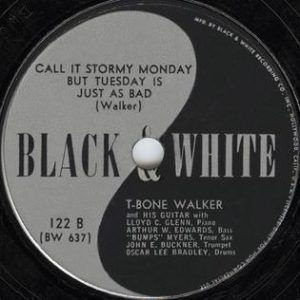
T-Bone Walker – Call It Stormy Monday But Tuesday Is Just as Bad (1947)

T-Bone Walker - Call It Stormy Monday


The importance and influence of Aaron Thibeaux “T-Bone” Walker cannot be understated. If you listen to the Blues, Rock and Roll, Rock, or even Jazz, this man has had a major influence since the late 1940’s. And this song of his is one reason most of us know about him. Since one of us here at MusicFor.us, who is also an extremely accomplished guitarist and performing artist, has already written an article about T-Bone I will refer you to that article to learn about him. The information about T-Bone starts part-way down the page at his Play Guitar website. Go ahead and read that, I’ll wait.

Now that you know a little about T-Bone, let’s take a look at this classic that has influenced many artists and the music you’ve listened to since then. Let’s start with just the name of the song. “Call It Stormy Monday But Tuesday Is Just As Bad” is what was printed on the label of his original release. No parenthesis, as many articles submit.


Black & White Records released “Call It Stormy Monday But Tuesday Is Just As Bad” in November 1947. Due to its length, and the first change to the title, “Call It Stormy Monday (But Tuesday Is Just as Bad)” is shortened to “Call It Stormy Monday” or most often “Stormy Monday”. Confusingly, it is also sometimes referred to as “Stormy Monday Blues”, the same title but different song, as the 1942 song by Billy Eckstine and Earl Hines. According to T-Bone Walker, he specifically gave his song the longer name to set it apart. However, trouble ensued when other artists began recording it using these shortened names. Walker blamed Duke Records owner Don Robey for giving it the wrong title for his artists, including Bobby “Blue” Bland’s 1962 rendition, which appeared as “Stormy Monday Blues”. Bland’s version, which was an R&B and pop chart hit, was subsequently copied by other artists, who also used the incorrect title. Bland introduced a new arrangement with chord substitutions, which was later used in many subsequent renditions. His version incorrectly used the title “Stormy Monday Blues” and as a result, Walker lost out on royalties when his song was misnamed  and the payments were forwarded to Eckstine, Hines, and Crowder.

Stormy Monday Blues by Bobby Blue Bland 1962


Walkers original composition and recording took place in Hollywood, California, and was produced by Black & White’s Ralph Bass. There are conflicting accounts about the recording date for “Call It Stormy Monday But Tuesday Is Just as Bad”. In an interview, Walker claimed that he recorded the song in 1940 “just before the war” (the U.S. entered World War II December 7, 1941), but that it was not released because of war-time material restrictions. Journalist Dave Dexter, who worked for Capitol Records in the early 1940s, believed that Walker recorded it for Capitol before the Eckstine/Hines song (March 1942), but that it was not released because of the unavailability of shellac and the recording ban. However, Walker’s first single as a band leader, “Mean Old World”, which was recorded in July 1942, was released in 1945 by Capitol. One sessionography places the recording of “Stormy Monday” on September 13, 1947, during his third session for Black & White Records. Blues writer Jim O’Neal noted that blues discographies do not show a recording date before 1947.

“Stormy Monday” was performed in a “club combo” or West Coast-blues style with a small back-up band. The style, as heard in “Driftin’ Blues” (one of the biggest hits of the 1940s), evokes a more intimate musical setting than the prevailing jump-blues dance-hall style. Accompanying Walker is pianist Lloyd Glenn, bassist Arthur Edwards, drummer Oscar Lee Bradley, and horn players John “Teddy” Bruckner (trumpet) and Hubert “Bumps” Myers (tenor saxophone).

A key feature of the song’s instrumentation is Walker’s prominent guitar parts, including the extensive use of ninth chords, which gives the song its distinctive sound.

Author Aaron Stang explained:

The real sound of this riff is based on starting each 9th chord a whole step (2 frets) above and sliding down. If we were to analyze this movement, the first chord is technically a 13th chord resolving down to a 9th chord.

Guitarist Duke Robillard (founded the band Roomful of Blues and was a member of the Fabulous Thunderbirds) added:

The guitar chord line, it’s a little guitar ninth chord figure. That was a unique thing and it became T-Bone’s signature. And that chord line seems to have grabbed everybody because everybody plays it with that line in it. And it’s almost like a law, that you have to, when you play ‘Stormy Monday.’

Walker also plays twelve bars of single-string guitar solo, which writer Lenny Carlson has described as “remain[ing] largely in the middle register, but it contains some gems, particularly in the use of space, phrasing, and melodic development”. The placement of a guitar as the prominent, lead instrument was also a notable “first”, primarily due to T-Bone pioneering the use of an electric guitar and amplification which allowed the guitar to take center-stage when it had been previously relegated to only a rhythm instrument in the backing instrumentation.

The song is also significant in that it opened up, and crossed over, the traditional Blues of Black artists (commonly called “race records” at the time) and exposed and invited White audiences into the genre. The lyrics perfectly capture the essence of the blues and what it strives to portray. “They call it stormy Monday, but Tuesday’s just as bad. Wednesday’s worse, and Thursday’s also sad.” These lyrics outline what every working-class individual, regardless of race, has to deal with week after week.

Walker’s legacy spans many years and he influenced some of our favorite players like Hendrix, Chuck Berry, the Allman Brothers, Stevie Ray Vaughan, and B.B. King, who said that “Stormy Monday was his inspiration for getting an electric guitar.” He “thought Jesus Himself had returned to Earth playing electric guitar”.

B.B. King - Stormy Monday (Live)


Later audiences were probably made aware of this song in 1971 when the Allman Brothers released their famed 1971 album “At Fillmore East”. As the title indicates, the recording took place at the New York City music venue Fillmore East, which was run by concert promoter Bill Graham. It was recorded over the course of three nights in March 1971 and features the band performing extended jam versions of songs, and this was one of them. “At Fillmore East” was the band’s artistic and commercial breakthrough, and has been considered by some critics to be one of the greatest live albums in rock music. At 10 minutes and 39 seconds, it takes T-Bones original, adds the arrangement of Bobby “Blue” Bland’s version, to another new height.

The Allman Brothers Band - Stormy Monday ( At Fillmore East, 1971 )


Other great blues versions include Albert King with Stevie Ray Vaughan (“In Session” 1983, a must listen blues album), John Mayall and the Blues Breakers on their album featuring Eric Clapton, and played by Cream at their ‘Reunion Concert’ in 2005 released as “Live At Royal Albert Hall”.


In 1983, T-Bone Walker’s original “Call It Stormy Monday But Tuesday Is Just As Bad” was inducted into the Blues Foundation Blues Hall of Fame in the “Classic of Blues Recording — Single or Album Track” category. Writing for the foundation, Jim O’Neal called it “one of the most influential records not only in blues history, but in guitar history”. In 1991, it was inducted into the Grammy Hall of Fame which “honor recordings of lasting qualitative or historical significance”. The song was included as one of the 500 Songs That Shaped Rock and Roll by the Rock and Roll Hall of Fame in 1995. The U.S. National Recording Preservation Board selected the song in 2007 for inclusion in the Library of Congress’ National Recording Registry of “sound recordings that are culturally, historically or aesthetically significant”. T-Bone is also included on Rolling Stone’s 100 Greatest Guitarists list at number 67.

Hits: 47

[Total: 1   Average: 5/5]

The Beach Boys – God Only Knows (1966)

The Beach Boys- God Only Knows (HQ)


Brian Wilson wrote this song with Tony Asher, who was an advertising copywriter and lyricist that Wilson worked with on songs for the “Pet Sounds” album (considered Brian’s Magnum Opus). This song reflects Wilson’s interest in spirituality, and it was a big departure from previous Beach Boys songs that dealt with girls, cars and surfing. Wilson explained to Goldmine in 2011:

Tony Asher and I tried to write something very spiritually. It’s got a melody similar to the song (recites lyric to ‘The Sound Of Music’), ‘I hear the sound of music…’ (Sings lyrics to ‘God Only Knows’) ‘I may not always love you…’ It was similar to it. Tony came up with the title ‘God Only Knows.’ I was scared they’d ban playing it on the radio because of the title but they didn’t.

Brian Wilson was fascinated by spirituality and said this song came out of prayer sessions in the studio. “We made it a religious ceremony,” he said of recording “Pet Sounds”.

The song names God in its title and lyrics, unusual for a pop single of its time. “God Only Knows” is frequently cited for referencing “God” in its title, a decision that Wilson and Asher agonized over, fearing it would not get airplay as a result. As Wilson’s then-wife Marilyn describes:

The first time I heard it, Brian played it for me at the piano. And I went, ‘Oh my God, he’s talking about God in a record.’ It was pretty daring to me. And it was another time I thought to myself, ‘Oh, boy, he’s really taking a chance.’ I thought it was almost too religious. Too square. At that time. Yes, it was so great that he would say it and not be intimidated by what anybody else would think of the words or what he meant.

Tony Asher recalled:

Unless you were Kate Smith and you were singing ‘God Bless America’, no one [in 1966] thought you could say ‘God’ in a song.” The sentiments expressed in its lyric were not specific to any God, and could be addressed to any higher force, being a song about moving forward after loss.

No one thought you could say ‘God’ in a song. No one had done it, and Brian didn’t want to be the first person to try it. He said, ‘We’ll just never get any air play.’ Isn’t it amazing that we thought that? But it worked.

Wilson added that although he feared putting the word “God” in the title of the song, he eventually agreed to keep it, firstly, “because God was a spiritual word”, and secondly, because the Beach Boys would “be breaking ground”.

Wilson explained that his and Asher’s intention was to create the feeling of “being blind but in being blind, you can see more, You close your eyes; you’re able to see a place or something that’s happening.”

The song is told from the point of view of someone contemplating life after death to their lover, as Asher describes, “‘I’ll love you till the sun burns out, then I’m gone,’ ergo ‘I’m gonna love you forever.'”

Brian initially hated the opening line of the song as “it was too negative.” He eventually gave in after hearing the subsequent lyrics. In 1976, Brian said there was no one particular that the song was written for. Author Jim Fusilli (who once described “Pet Sounds” as “Despite the sunny singles, the achingly beautiful album is composer Brian Wilson’s cry for understanding and a sense of place in a tumultuous period that would lead to a psychological breakdown that would remove him from his gifts for decades), extrapolated that the song was:

A mature proclamation of love and a desperate plea. And it’s a distillation of what much of “Pet Sounds” is about: the sense that if we surrender to an all-consuming love, we will never be able to live without it. And, though we’re uncertain that the reward is worth the risk, we yearn to surrender.

Fusilli also noted a closing phrase Wilson had once written to his wife in 1964: “Yours ’til God wants us apart.” Co-writer Tony Asher denied that the song alluded to suicide. He describes his interpretation:

This is the one [song] that I thought would be a hit record because it was so incredibly beautiful. I was concerned that maybe the lyrics weren’t up to the same level as the music; how many love songs start off with the line, ‘I may not always love you’? I liked that twist, and fought to start the song that way. Working with Brian, I didn’t have a whole lot of fighting to do, but I was certainly willing to fight to the end for that. … ‘God Only Knows’ is, to me, one of the great songs of our time. I mean the great songs. Not because I wrote the lyrics, but because it is an amazing piece of music that we were able to write a very compelling lyric to. It’s the simplicity -- the inference that “I am who I am because of you” — that makes it very personal and tender.

Sung by his younger brother Carl Wilson, Brian originally intended to sing lead vocal on “God Only Knows” but after the instrumental portions of the song had been recorded, Brian thought Carl could impart the message better than he could. Brian reflected in October 1966:

I gave the song to Carl because I was looking for a tenderness and a sweetness which I knew Carl had in himself as well as in his voice. He brought dignity to the song and the words, through him, became not a lyric, but words.

At the time, it was rare for Carl to sing lead on a Beach Boys song. Beach Boy Bruce Johnston explains that:

Brian really worked a lot on ‘God Only Knows’, and at one point, he had all the Beach Boys, Terry Melcher and two of the Rovell sisters [Brian’s wife Marilyn and her sister Diane] on it. It just got so overloaded; it was nuts. So he was smart enough to peel it all back, and he held voices back to the bridge, me at the top end, Carl in the middle and Brian on the bottom. At that point, Brian’s right move was to get subtler. He had a very tender track here. ‘God Only Knows’ is a very small masterpiece with a major heartbeat, and he was right to peel everybody back and wind up with the three parts. In fact, it’s probably the only well-known Beach Boys track that has just three voices on it.

Carl Wilson:

I was honored to be able to sing that one. It is so beautifully written, it sings itself. Brian said something like, ‘Don’t do anything with it. Just sing it real straight. No effort. Take in a breath. Let it go real easy.’ I was really grateful to be the one to sing that song. I felt extremely lucky.

At present our influences are of a religious nature. Not any specific religion but an idea based upon that of Universal Consciousness. The concept of spreading goodwill, good thoughts and happiness is nothing new. It is an idea which religious teachers and philosophers have been handing down for centuries, but it is also our hope. The spiritual concept of happiness and doing good to others is extremely important to the lyric of our songs, and the religious element of some of the better church music is also contained within some of our new work.

The instrumental part of the song took 20 takes to achieve what is the master take of the song. Present on the day of the instrumental recording was Carl on twelve-string guitar among other session musicians collectively known as The Wrecking Crew. A strip of masking tape was placed over the strings of a piano while the bottoms of two plastic orange juice bottles were used for percussion. According to Brian, many of the musicians who were present at the “God Only Knows” sessions claim that those sessions were some of “the most magical, beautiful musical experiences they’ve ever heard”. He added that there were 23 musicians present during the “God Only Knows” sessions, though only 16 are credited as being present on the actual take that was used for the final song. At the time, 23 musicians was an astounding number of musicians for a pop record. All the musicians played simultaneously, creating “a rich, heavenly blanket of music”. A string section was overdubbed thereafter.

The final vocal track was recorded between March and April 1966 at CBS Columbia Square, Hollywood, with the session engineered by Ralph Balantin and produced by Brian. The song features three voices on the track. Carl is featured on lead vocals, with Brian and Johnston backing him. Johnston explained that

The really cute thing is that at the end of the session, Carl was really tired, and he went home. So Brian … remember, this was 8-track, so, he now has these extra tracks at his disposal. But there were just the two of us. So in the fade, he’s singing two of the three parts. He sang the top and the bottom part and I sang in the middle.” Brian used the production technique of double-tracking Carl’s voice, so that his voice is simultaneously singing the same part twice, to give the vocal a fuller and richer sound; Brian used this technique often during the recording of “Pet Sounds”.

Acclaim and awards for “Pet Sounds” and “God Only Knows” are almost universal among critics and fellow artists. “God Only Knows” was voted 25th in Rolling Stone magazine’s 500 Greatest Songs of All Time, the second of seven Beach Boys songs to feature (the first being “Good Vibrations” at 6), and was ranked by Pitchfork Media as the greatest song of the 1960s. The Rock and Roll Hall of Fame included it as one of 500 Songs That Shaped Rock and Roll. Mojo magazine ranked the song as the 13th greatest song of all time. In a poll on the MTV station, VH1, it placed at number 28 on the UK’s Nation’s Favourite Lyric. It was voted by listeners of BBC Radio 2 as one of the three songs that changes people’s lives. In its list of the 100 best singles of the last 50 years, Popdose ranked “God Only Knows” at number 1, saying: “It is simply one of the most beautifully composed and arranged songs in the history of not just pop music, but Western music. To place ‘God Only Knows’ in its proper context is to compare it not just to 1966 Paul McCartney, but 1836 Frédéric Chopin.”

McCartney has called it his favorite song of all time. In an interview with David Leaf in 1990 he stated,

I was asked recently to give my top 10 favorite songs for a Japanese radio station … I didn’t think long and hard on it but I popped that [God Only Knows] on the top of my list. It’s very deep. Very emotional, always a bit of a choker for me, that one.

Speaking again in 2007, McCartney said:

‘God Only Knows’ is one of the few songs that reduces me to tears every time I hear it. It’s really just a love song, but it’s brilliantly done. It shows the genius of Brian. I’ve actually performed it with him and I’m afraid to say that during the sound check I broke down. It was just too much to stand there singing this song that does my head in and to stand there singing it with Brian.

Brian responded apprehensively to McCartney’s admiration of the song in the 1970s:

Like, if ‘God Only Knows’ is the greatest song ever written, then I’ll never write anything as good again! And if I never write anything as good, then I’m finished.

I think there are many that don’t agree with Brian on that. He is truly a legendary lyricist, composer, musician, and producer that advanced the art of music to a degree only very few have done.

To take a look at the recording process and the artists who performed it, here are three videos that documents that and shows the genius of Brian Wilson as a producer.

Behind The Sounds: God Only Knows Part 1


Behind The Sounds: God Only Knows Part 2


The Beach Boys - God Only Knows (Tracking Session)

Hits: 32

[Total: 2   Average: 5/5]

Booker T. & the M.G.’s – Green Onions (1962)

Booker T. And The M.G.'s - Green Onions


That was an extended, live version from April 1967 in Norway while they were touring Europe. Here’s the original recording from 1962:

Booker T & the M G 's - Green Onions (Original / HQ audio)


As the house band for the Stax/Volt labels, Booker T. and the MG’s helped define the spare, punchy sound of “Memphis Soul” music. By contrast to Motown’s orchestrated, pop-soul records, the Stax approach was lean, economical and deeply groove-oriented. Between 1963 and 1968, Booker T. and the MGs appeared on more than six hundred Stax/Volt recordings, including classics by such artists as Otis Redding, Eddie Floyd, Rufus Thomas, Carla Thomas, Johnnie Taylor and William Bell. As a result of Stax’s affiliation with Atlantic Records, the group also worked with Wilson Pickett, Sam and Dave, and Albert King. Moreover, Booker T. and the M.G.’s were a successful recording group in their own right, cutting ten albums and fourteen instrumental hits.

In summer 1962, 17-year-old keyboardist Booker T. Jones, 20-year-old guitarist Steve Cropper, and two seasoned players, bassist Lewie Steinberg and drummer Al Jackson Jr. were in the Memphis studio to back the former Sun Records star Billy Lee Riley. During downtime, the four started playing around with a bluesy organ riff. Jim Stewart, the president of Stax Records, was in the control booth. He liked what he heard, and he recorded it. Cropper remembered a riff that Jones had come up with weeks earlier, and before long they had a second track. Stewart wanted to release the single with the first track, “Behave Yourself”, as the A-side and the second track as the B-side. Cropper and radio disc jockeys thought otherwise; soon, Stax released Booker T. & the M.G.’s’ “Green Onions” backed with “Behave Yourself”. Booker T. Jones said:

That happened as something of an accident. We used the time to record a blues which we called ‘Behave Yourself,’ and I played it on a Hammond M3 organ. Jim Stewart, the owner, was the engineer and he really liked it and wanted to put it out as a record. We all agreed on that and Jim told us that we needed something to record as a B-side, since we couldn’t have a one-sided record. One of the tunes I had been playing on piano we tried on the Hammond organ so that the record would have organ on both sides and that turned out to be “Green Onions.”

The group’s guitarist Steve Cropper brought a copy of this song to the Memphis radio station WLOK the day after they recorded it. The morning DJ, Rueben Washington, was a friend of Cropper’s, and put the song on his turntable to hear off-air. After listening to just part of the song, he cut off the record that was on air and started playing “Green Onions” for his listeners. Says Cropper:

He played it four or five times in a row. We were dancing around the control room and believe it or not, the phone lines lit up. I guess we had the whole town dancing that morning.

As for the name of the song, this is another example of Rock stories, fables, and myths that often occur. Booker T. is quoted as saying:

Because that is the nastiest thing I can think of and it’s something you throw away.

But later, on a broadcast of the radio program “Wait Wait… Don’t Tell Me!” on June 24, 2013, Jones was asked about the title and said,

The bass player thought it was so funky, he wanted to call it ‘Funky Onions’, but they thought that was too low-class, so we used ‘Green Onions’ instead.

But according to Steve Cropper, the title is not a marijuana reference; rather, the track is named after the Green Badger’s cat, “Green Onions”, whose way of walking inspired the riff.

The exact origin of the band’s name is a matter of dispute. Jones has stated that it was Jackson who named the group after its youngest member, while “M.G.” is supposed by many to refer to “Memphis Group”, not the sports car of the same name (reportedly when the car company expressed disapproval, they claimed the initials as “Memphis Group.”). However, musician and record producer Chips Moman, then working with Stax, claims that they were named after his car, and that the label that Stax‘s publicity department declared that “M.G.” stood for “Memphis Group” only after he left the label. Tending to confirm this story is the fact that Moman had played with Jones in an earlier Stax backing group named the Triumphs, named
after his car.

The anchors of the Booker T. sound were Steve Cropper, whose slicing, economic riffs influenced many other guitar players, and Booker T. Jones himself, who provided much of the groove with his floating organ lines. In 1960, Jones started working as a session man for Stax, where he met Steve Cropper. Cropper had been in the Mar-Keys, famous for the 1961 instrumental hit “Last Night,” which laid out the prototype for much of the MG’s (and indeed Memphis soul’s) sound with its organ-sax-guitar combo. With the addition of drummer Al Jackson and bassist Lewis Steinberg, they became  Booker T. & the MG’s. Within a couple years, Steinberg was replaced permanently by Donald “Duck” Dunn, who, like Cropper, had also played with the Mar-Keys.

THE MAR-KEYS - Last Night


Members of Booker T. & The M.G.’s, often performing as a unit, performed as the studio backing band for Otis Redding, Sam & Dave, Albert King, Carla Thomas, Johnnie Taylor, Eddie Floyd, Rufus Thomas, The Staple Singers, Wilson Pickett, Delaney & Bonnie and many others in the 60s. They played on and produced hundreds of records, including classics like “Walking the Dog”, “Hold On (I’m Comin’)”, “Soul Man”, “I’ve Been Loving You Too Long (To Stop Now)”, “Midnight Hour”, and “Try a Little Tenderness”. Cropper co-wrote “Knock On Wood” with Eddie Floyd, “In the Midnight Hour” with Wilson Pickett, and “(Sittin’ On) The Dock of the Bay” with Otis Redding, among other songs.

Because Jones was studying music full time, Stax writer/producer Isaac Hayes often stepped in on the occasions when Jones was unavailable for session work. On several sessions Jones and Hayes played together, with one playing organ and the other on piano. However, Jones played on all the records credited to “Booker T. & The M.G.’s,” and Hayes was never an official member of the group.

Booker T. & the M.G.’s consistently issued singles from 1963 to 1965, but only a few made the charts, and none was as successful as “Green Onions”. Their second album, “Soul Dressing”, was released in 1965. Whereas the “Green Onions” album contained mostly covers, every composition but one on “Soul Dressing” was an original. After a period of commercial decline, Booker T. & the M.G.’s finally returned to the Top 40 with the 1967 instrumental “Hip Hug-Her”. It was the first single on which Jones played a Hammond B-3 organ, the instrument with which he is most closely associated (he used a Hammond M-3 on all of the earlier recordings, including “Green Onions”). The group also had a substantial hit with their cover of the Rascals’ “Groovin'”. Both tracks are included on their album “Hip Hug-Her”, released in the same year.

Hip Hug-Her - Booker T. & The MG's (1967) (HD Quality)


In the spring of 1967, they joined a group of Stax artists billed as the “Stax/Volt Revue” on a European tour, in which they performed in their own right and backed the other acts. In June of that year, they appeared at the Monterey Pop Festival. They were invited to perform at the Woodstock Festival in 1969, but drummer Jackson was worried about the helicopter needed to deliver them to the site, and so they decided not to play.

In 1969, Dunn and Jones, in particular, had become admirers of the Beatles, especially their work on their album “Abbey Road”. The appreciation was mutual, as the Beatles had been musically influenced by the M.G.’s. John Lennon was a Stax fan, who fondly called the group “Book a Table and the Maitre d’s” (in 1974, Lennon facetiously credited himself and his studio band as “Dr. Winston and Booker Table and the Maitre d’s” on his original R&B-inspired instrumental, “Beef Jerky”). Paul McCartney, like Dunn, played bass melodically, without straying from the rhythm or the groove.

In 1970, Lennon’s wish was granted, in a sense, when Booker T. and the M.G.’s recorded “McLemore Avenue” (named for the street where Stax Records was located), on which they performed instrumental cover versions of thirteen of the songs on “Abbey Road”, condensing twelve of them into three medleys, and also included a cover of George Harrison’s “Something”. The album’s front cover is a parody of the front cover of “Abbey Road”; the back cover, with the blurred image of a mini-skirted woman at the edge of the photo, also mirrors that of “Abbey Road”.

In 1970 Booker T. & the M.G.’s also sat in with Creedence  Clearwater Revival for a jam, and they were the opening act for that band’s January 31 performance at the Oakland Coliseum, which was recorded for the CCR album “The Concert”. It has been suggested that John Fogerty’s interest in putting a Hammond B-3 on the album “Pendulum” was an acknowledgement of Jones and the admiration the two bands had for each other.

The group gradually disintegrated after the sale of Stax in 1968, although the rhythm section of Dunn and Jackson continued to play on many subsequent Stax recordings. Booker T. and the M.G.’s released what would be their last Stax single, “Melting Pot”, and their last Stax album, also called “Melting Pot”, in 1971. Before “Melting Pot” was recorded, Jones had already left Stax and moved to California, because he disliked the changes that had occurred under the label’s new chairman Al Bell. Booker T. Jones branched out into record production and worked on a music degree at Indiana University. Cropper opened a studio in Memphis in 1969 and moved to Los Angeles to do session work in the mid-1970s. Jackson went on to provide a solid backbeat for Al Green. All the while, Booker T. and the M.G.’s remained an ongoing entity, albeit an intermittent and casual one -- that is, until the senseless murder of Jackson by a home intruder in 1975. In 1993 the remaining members came together to back Neil Young on a tour. In 1994 they released “That’s the Way It Should Be”, their first album in more than twenty years, with Steve Jordan as drummer on most tracks.

“Green Onions” has been covered by a variety of big names over the years. Tom Petty and the Heart Breakers performed a live version in 1997, Pink Floyd played it for the BBC in 1968, Roy Buchanan created an extended version for his album Loading Zone in 1977.

“Green Onions” was ranked No. 181 on Rolling Stone‘s list of the 500 Greatest Songs of All Time; it is the only instrumental on the list. The track is currently ranked as the 137th Greatest Track of All Time, as well as the best track of 1962, by Acclaimed Music. In 1999, “Green Onions” was given a Grammy Hall of Fame Award. In 2012, it was added to the National Recording Registry of the Library of Congress, a list of “culturally, historically, or aesthetically important” American sound recordings. “Green Onions” was inducted into the Blues Hall of Fame in 2018, as one of the five new entrants in the Classic of Blues Recording (Song) category.

Hits: 32

[Total: 1   Average: 5/5]

Special Holiday Article: Billy Joel – Goodnight Saigon (1982)

Happy Veteran’s Day! We here at Music For Us hope you are having a safe holiday and are remembering why this day is a holiday.

There are two things which you may notice. The first is that this one isn’t being written by COF and the second is that this appears to be a timely article.

To address those issues, I’ll simply note that I do actually write and that this plan to write timely articles (to do things such as make holiday posts) has been in the works for some time. We tested the waters back on the 4th of July and this is a continuation of that test.

We will gauge the responses and make our decisions based on what data we have. We will absolutely not be writing one of these for every single holiday. First, there’s just too many holidays and not enough time. Second, we get visitors from across the globe -- meaning we all have different holidays and celebrate holidays on entirely different days.

So, we must be pragmatic.

Also, for those unfamiliar with my writing style, I’m pretty verbose.

That means this will not be like the articles you see daily. The daily articles are (usually) written by COF. This was written by me. I am not COF. I will write like I am me. I also swear like a trooper. I will abstain as this site is not my guitar site and the audiences are quite different.

Now that we’ve established that, let’s get on with the music!

Billy Joel - Goodnight Saigon (Official Video)

This song is very near and dear to me, even though it came out after my period of enlistment. First and foremost, it’s about the United States Marine Corps, a service to which I gave a portion of my life. More specifically, it’s mostly about the individual Marines and not about the Corps itself.

It’s notable that Billy Joel, contrary to popular opinion, neither served in the USMC nor did he fight in Vietnam. However, he lived through the era and he wrote the song at the behest of a number of his Marine friends. Friends who told him their experiences, as they did fight in the war.

This song is about the Vietnam War but is about the people who fought it, which is a key difference and why this song is exceptional. Unlike many such songs, this song makes no attempt to make a statement about the war itself. This song is not a war protest song. It makes no political statement.

Goodnight Saigon doesn’t try to moralize about the war, or even about war in general. This song is about the people who fought, specifically about the Marines who fought in Vietnam -- but it makes many positive references to their opponents.

To understand the song, it’s important to understand why it was written. In Joel’s own words, on the Howard Stern show in 2014, Joel said:

“I wanted to do that for my friends who did go to ‘Nam. A lot of them came back from being in country and really had a hard time getting over it, and still to this day I think a lot of them are having a hard time. They were never really welcomed back, and whether you agreed with the war or not, these guys really took it on the chin. They went over there and they served, and they never really got their due.

“It was all about them depending on each other. When they were over there, they weren’t thinking about mom, apple pie and the flag, they were doing it for each other -- to try to help and save each other and protect each other. That really hit me.”

The song begins with the sound of helicopter rotors and the lyrics start with the Marines arriving on Paris Island, which is where people born on the eastern side of the Mississippi River are molded into Marines.

It explains how they left Paris Island in peak physical condition. It also introduces you to the fact that he never says, “I.” First, he was not himself a Marine but, more importantly, it was never about the fictional individual -- but was about the soldiers, plural. At never about a single soldier. It’s not even strictly about a specific side of the conflict.

The song continues and tells you about their arrival in that country and how many young Marines had that experience as their entire life experience -- that they died and wouldn’t be returning home to their loved ones and to resume their life as a civilian.

Joel goes on to tell you, as best as he can, about the experiences that the Marine friends shared with him. He tells you how it was boredom and doing without, with lots of hard labor, that was punctuated with periods of terror.

He tells you that the enemy was also adept at war fighting and that, in the midst of it all, it doesn’t matter who is wrong or who is right -- and that you’re not fighting for for a cause or the people back home, but are fighting for the brother who stands beside you.

It’s in those times of terror, when your very normal and human instinct is to run away, that you fight -- not because of any flag or country, but because the person next to you is fighting and because you’re closer than even brothers. You’re close enough to be willing to die together.

The song is not about those who died. It mentions the people who died, but it is about the warriors who survived. It’s about them, about them remembering back to their wartime experiences and about them remembering those they fought with.

That’s why it’s posted today. Veteran’s Day isn’t really about the men and women who died in war. That’s what Memorial Day is for. Today is for the warriors who survived, maybe never even having seen combat but had been willing to serve and take those risks.

Today is about service and those willing to provide it.

Billy Joel felt that the veterans had been given unfair treatment and that they’d returned home without recognition. He felt, and still does, that it doesn’t matter how one personally feels about the Vietnam War, or any war. That, regardless of one’s own opinion, it’s important to give recognition to those who provided service.

Which is exactly what today is about. Because this article is not about me, I won’t go into details. I will say that it doesn’t matter if you saw combat, you’re still a veteran and you still deserve recognition for your service -- regardless of anyone’s opinions on the validity of conflict.

Which is why this is written. Today, we extend our thanks to the people who have served in the Army, Air Force, Navy, Marines, or Coast Guard. Today, we recognize you and we serve you (even if it’s just this article) as a way of thanking you for having the fortitude to serve in our armed forces, both in times of peace and in times of violent conflict.

Thank you for your service. How can we help?

In closing, if you think that this sort of posting of articles for special holidays is a good idea, please do leave a comment. We’d prefer it if you left the comment here, so that we can get a good record of the responses, but you’re free to leave them elsewhere and we’ll try to collect the data as well as we can.

If it’s something that people are interested in, we’ll consider making this a regular feature for key holidays or other meaningful days. If you have a holiday and a recommendation, please feel free to share them. If you’re interested in contributing, we welcome submissions of all topical material.

Please have a safe, happy, and respectful holiday. If you see a vet, please consider offering them a beer!

Hits: 38

[Total: 1   Average: 5/5]

The Standells – Dirty Water (1965)

The Standells - Dirty Water


In an obviously lip-synced unknown television version, this is the group at that time that recorded this song. I said “at this time” as the members of the Standells changed many times over the years. The original Standells band was formed in 1962 by lead vocalist and keyboard player Larry Tamblyn with guitarist Tony Valentino, bass guitarist Jody Rich, and drummer Benny King (aka Hernandez). Tamblyn had previously been a solo performer and is the brother of actor Russ Tamblyn and the uncle of actor Amber Tamblyn.

Despite being from Los Angeles and having never been to Boston before they recorded this song, the song is a loving tribute to Beantown, even though it references the Boston Strangler, muggers and “frustrated women” that have midnight curfews at their college dorms. It was written by their producer Ed Cobb and is reportedly based on an experience of Cobb and his girlfriend with a mugger in Boston in the mid-1960s.

The Standells were a Los Angeles garage rock band and are sometimes listed among others such as with late ’50s/early ’60s bands like The Wailers, The Kingsmen, The Trashmen (“Surfin’ Bird”), The Shondells, Shadows of Knight, ? & the Mysterians (“96 Tears”), and Patti Smith. The Standells band name was created by Larry Tamblyn, derived from standing around booking agents’ offices trying to get work. In early 1962, drummer Benny King joined the group, and as “the Standels”, their first major performance was in Honolulu at the Oasis Club. After several months, Rich and King departed. Tamblyn then assumed leadership of the group. He and Valentino re-formed the Standels, adding bass guitarist Gary Lane and drummer Gary Leeds. Later that year, the band lengthened its name to “Larry Tamblyn & the Standels”. In 1963 an extra “L” was added, and as “Larry Tamblyn and the Standells” the group made its first recording “You’ll Be Mine Someday/Girl In My Heart” for Linda Records (released in 1964). In the latter part of the year, the band permanently shortened its name to “The Standells” and after the Standells signed with Liberty in 1964, Leeds left the group, and was replaced by lead vocalist and drummer Dick Dodd. Dodd was a former Mouseketeer who had been the original drummer for The Bel-Airs and eventually became the singer who sang lead on all of the Standells hit songs. He reportedly bought his first snare drum from fellow Mouseketeer Annette Funicello for $20.

Although they never had much success other than this song, they also appeared in several low-budget films of the 1960s, including “Get Yourself a College Girl” (1964) and cult classic “Riot on Sunset Strip” (1967). The Standells performed incidental music in the 1963 Connie Francis movie “Follow the Boys”, which coincidentally co-starred Larry Tamblyn’s brother, Russ Tamblyn. The Standells played the part of the fictional rock group the “Love Bugs” on the television sitcom Bing Crosby Show in the January 18, 1965 episode “Bugged by the Love Bugs”. The band also appeared on The Munsters TV show, as themselves in the episode “Far Out Munster,” performing “Come On and Ringo” and a version of The Beatles’ “I Want to Hold Your Hand”.

In early 1966, after recording “Dirty Water”, Dodd briefly left the Standells, and was replaced by Dewey Martin, who became a member of Buffalo Springfield. Dodd returned to the group several months later, as the song began to climb the charts. “Dirty Water” reached No. 11 on the Billboard charts on June 11, 1966, No. 8 on the Cashbox charts on July 9, 1966 and No. 1 on the Record World charts. The song might have cracked the Top 10 if it wasn’t up against heavy hitters like “Paperback Writer” by the Beatles, “Wild Thing” by the Troggs and “Paint It Black” by the Rolling Stones. “Dirty Water” was on the WLS playlist for 17 total weeks, tied only by the Mamas and Papas’ “California Dreamin'” for most weeks on that playlist during the 1960s. Though the song is credited solely to Cobb, band members Dodd, Valentino and Tamblyn have claimed substantial material-of-fact song composition copyright contributions to it as well as contributing to its arrangement.

In 1997, “Dirty Water” was decreed the “official victory anthem” of the Red Sox, and is played after every home victory won by the Boston Red Sox. In 2007, “Dirty Water, as sung by the Standells” was honored by official decree of The Massachusetts General Court. The song is now played not only at Red Sox games, but also those of the Boston Celtics, the Boston Bruins, and the Northeastern Huskies’ hockey games.

In 1968, Dick Dodd left the band to pursue a solo career, and the Standells continued to perform with a varying line-up thereafter, briefly including guitarist Lowell George who went on to play with Little Feat. Dick Dodd died on November 29, 2013 and as of 2014, some version using the name “Standells” continue to tour.

“Dirty Water” is listed in the Rock and Roll Hall of Fame’s “500 Songs that Shaped Rock and Roll.”

Hits: 45

[Total: 2   Average: 5/5]

Three Dog Night – One (1969)

Three Dog Night "One"


Three Dog Night earned 12 gold albums and recorded 21 consecutive Billboard Top 40 hits, 7 of which went gold. Their first gold record was “One” (number 5 on the U.S. Billboard Hot 100 and spent three weeks at number 2 on the Cash Box Top 100), which had been written and recorded by Harry Nilsson. Nilsson wrote the song after calling someone and getting a busy signal. He stayed on the line listening to the “beep, beep, beep, beep…” tone, writing the song. The busy signal became the opening notes of the song. Nilsson released his original version in 1968, one year before “Three Dog Night” released their cover.

Harry Nilsson- One (Best Quality)


The song was also released by Al Kooper on his “I Stand Alone” album in February 1969. His version added orchestration which made it stand apart from other covers.


Three Dog Night made its official debut in 1968 at the Whiskey a Go Go, at a 5 p.m. press party hosted by Dunhill Records. They were still in the process of making their first album “Three Dog Night” when they heard the favorable reactions from the hypercritical audience. The album “Three Dog Night” was a success with its hit songs “One” and “Nobody” and helped the band gain recognition and become one of the top drawing concert acts of their time.

“Three Dog Night” was based around the vocal skills of Danny Hutton, Chuck Negron and Cory Wells. In 1967, Hutton conceived the idea of a three-vocalist group, and he and Wells enlisted mutual friend Negron.

Cory Wells (born Emil Lewandowski) came from a musical family and began playing in Buffalo, New York-area bands in his teens. His biological father, who was married to someone other than his mother, died when Cory was a small child, leaving his mother to struggle financially until she eventually remarried. She gave Cory her maiden last name although Cory eventually changed his surname to Wells (which is a shortened version of his birth father’s last name, Wellsley). Wells joined the United States Air Force directly out of high school. While in the Air Force, he formed a band inspired by his boyhood love of a similar popular band called The Del-Vikings. Following his military tour of duty, Wells returned to Buffalo and was asked to join a band named the “Vibratos”. Gene Jacobs, the brother-in-law of the “Vibratos” guitar player, Mike Lustan, suggested to him that the “Vibratos” travel to California if they were serious about making it in music. They took his advice and changed the name of the band to “The Enemys.” They soon began working the clubs in Los Angeles, San Diego, Las Vegas and Sacramento, and they became the house band at the Whisky a Go Go.

While at the Whisky a Go Go, Cher asked the band to tour with Sonny & Cher. It was on this tour that Wells met Danny Hutton. Hutton was a songwriter and singer for Hanna Barbera Records from 1965–66. Hutton had a modest national hit, “Roses and Rainbows” during his tenure as a recording artist for Hanna-Barbera Records. Hutton and Wells officially formed “Three Dog Night” in 1968. They found a third lead singer in Chuck Negron, whom Hutton had met at a Hollywood party. Hutton, Wells, and Negron met The Beach Boys’ Brian Wilson, and they recorded demos under the name “Redwood” with Wilson as producer. The sessions produced a potential single, “Time to Get Alone,” but Beach Boy member Mike Love wanted to save the song for the next Beach Boys album. Having perfected their three-part harmony sound, Wells, Hutton and Negron added a four-piece backing group consisting of guitarist Michael Allsup, organist Jimmy Greenspoon, bassist Joe Schermie, and drummer Floyd Sneed.

Charles “Chuck” Negron II was born in Manhattan to Charles Negron and Elizabeth Rooke. At 5 years old, his father, a nightclub singer, and his mother divorced. Negron and his twin sister, Nancy, were placed in an orphanage by their mother. Two years later, she took them back. Negron grew up in The Bronx, where he sang in local doo-wop groups and played basketball both in schoolyard pick-up games and at William Howard Taft High School. The latter talent led to his being recruited to play basketball at Allan Hancock College, a small community college in Santa Maria, California; later, he played at California State University, Los Angeles. The rock and roll lifestyle took its toll on Negron, and by the time “Three Dog Night” disbanded in 1976, Negron had a serious heroin addiction which began in the early 1970s. In July 1975, the British music magazine, NME, reported that Negron had been arrested for cocaine possession in Kentucky. He overcame his addiction in September 1991 and embarked on a solo career.

As for how they got their name, the official commentary included in the CD set “Celebrate: The Three Dog Night Story, 1964–1975”, and their own website, states that vocalist Danny Hutton’s girlfriend, actress June Fairchild (best known as the “Ajax Lady” from the Cheech and Chong movie “Up In Smoke”) suggested the name after reading a magazine article about indigenous Australians, in which it was explained that on cold nights they would customarily sleep in a hole in the ground while embracing a dingo, a native species of feral dog. On colder nights they would sleep with two dogs and, if the night were freezing, it was a “three dog night”.

As its members wrote just a handful of songs on the albums, most songs “Three Dog Night” recorded were written by outside songwriters. Notable hits by outside writers include Harry Nilsson’s “One” (US #5), the Gerome Ragni-James Rado-Galt MacDermot composition “Easy to Be Hard” (US #4) from the musical “Hair”, Laura Nyro’s “Eli’s Comin'” (US #10), Randy Newman’s “Mama Told Me Not to Come” (US #1), Paul Williams’ “Out in the Country” (US #15), “The Family Of Man” (US #12), and “An Old Fashioned Love Song” (US #4), Hoyt Axton’s “Joy to the World” (US #1) and “Never Been to Spain” (US #5), Arkin & Robinson’s “Black and White” (US #1), Argent’s Russ Ballard’s “Liar” (US #7), Elton John and Bernie Taupin’s “Lady Samantha” and “Your Song”, Daniel Moore’s “Shambala” (#3), Leo Sayer’s “The Show Must Go On” (US #4), John Hiatt’s “Sure As I’m Sittin’ Here” (US #16), Bush’s “I Can Hear You Calling”, and Allen Toussaint’s “Play Something Sweet” (US #33).

Even with all that success, by 1976, internal dissent arose in the group and “Three Dog Night” officially disbanded a year later. There was a reunion in the early ’80s, but by December 1985, after a relapse into his drug habit, Negron was let go, and the group continued with Wells and Hutton fronting the band and Paul Kingery was brought back on guitar to cover Chuck’s vocal harmonies.

Hutton and Wells have since taken “Three Dog Night” out on the international touring circuit. They continued to tour over the next few years, though Cory Wells eventually left the group in September 2015 due to medical complications. Just one month later he succumbed to myeloma, a form of blood cancer.

With Danny Hutton fronting a new line-up now, as they mark more than 40 years on the road, “Three Dog Night” continue to grow their fan base and develop new ways of doing business. In 2014 they are pursuing an extensive schedule of concerts at theatres, performing arts centers, fairs, festivals, corporate events, and casinos. Since 1986, they have performed over 2,200 shows including two Super Bowls.

Hits: 30

[Total: 1   Average: 5/5]

The Saga Of Sleazy: Part 4 – (by Guest Author @Crazy_Eyes)

Editors Note: This is a user-supplied article, which we are grateful for. Music plays such an important place in our lives. Listening to it, playing it, making lyrics a personal memory. If you have a story of how it has affected you, please use the Easy Share tab at the top of this page and let us read it. This contains a glimpse into the real life of a real person and how music has affected them. As such, it contains some content and language that is adult-oriented.

With this article we have reached the end, for now, of The Saga. If you want to catch up, here’s Part 1 , Part 2 , and Part 3.


So after my guitar buddy was sentenced to a year in jail for that weed thing. He had a girlfriend and a baby at this time, so he got Huber Release [Huber is commonly referred to as “work release”, but it extends well beyond just employment] from jail for child care, and his girlfriend would be working while he got to spend time with the kids. Well I would go there and hang out after work with him and jam and shit and then he would leave to go back to jail for the night when his girlfriend got home. I was in love with her so I would stay there with her. That worked out great for the longest time, till he got done with his sentence.

Then he found out what was going on, he could only see her in passing, if she was there he couldn’t be there, so like I say this is a crazy world. Anyways there was a party going on there one night, and when he got drunk he started bitching about me and her, and he was saying “Do you really want to leave this for him?” and he whipped his dick out. Thing is, the babysitter that they had hired to watch the kids during the party was in the room and she was a 16 year old girl, she called the cops and he went away for a long time. I ended up with a restraining order from him and his girlfriend so that fucked everything up and I didn’t see any of those people for a few years after that.

Then about five years later I am married off to a different woman and have two sons, I never got my daughter back, but I know her now and she loves me and I love her so it works out in the end. But when I was married I had a studio room in our house and I had a Tascam 4-track recorder thing and would jam out in there all the time. One day I came across this cassette labelled June 30, 1993 and remembered that was that band and that was a 4-track, so I played it and low and behold these songs I am sharing with you are on there.

Now I had not heard these songs for five years or so and kind of forgotten about them. Then I am watching the TV on Halloween, the news is on. They are doing a report about registered sex offenders handing out halloween candy against the law, ’cause they are not supposed to have any contact with kids. And what do I see, the news cameras are following some kids live on TV to the door of a registered sex offender, they knock on the door, trick or treat! And my buddy the runaway guitar guy answers the door, the cops come in and say “That’s him” and jump on top of him and arrest him right there on live TV. I’m like fuck, wow, I just found that tape, and now this.

So I go onto the internet and see if i can find his number since i know what city he lives in now, and sure enough I find it. I wait about a week, and give it a call, he answers the phone, I don’t say anything and I play one of these songs for him. When it’s done, he says “Who is this, where did you get that?” And I told him it was me, and hes like “Sleazy! All right! Let’s get together”. So he comes and visits my house a week or so later, he was only in jail for the night on a PO hold, but the TV made it look bad, but he has a new band, actually two of them. He is a drummer in one of them and plays guitar in the other, they are both instrumental bands, with no singing.

As he is checking out where I live, which was a nice house on the shore of Lake Michigan. I had my own private beach and it was awesome, anyways, he’s like we should have a party here and have my bands play and I know other bands. So knowing me, that’s what we did. We had an awesome party with three live bands in my back yard, a big old bonfire on the beach, had a great time, At the end of the show my guitar friend buttfucked his bass player right there in front of everyone, like what the fuck. I don’t know what the hell that was. I didn’t see him again for ten years after that.

The next time I saw him was at my friend Verle’s house. I don’t know what he was doing there, but him and his girlfriend were looking for a ride, and being me, I gave them a ride to her place. They invited me in so I went in, and they were all wacked out on crack cocaine. They had a couple of hits each there for themselves and when that was gone, his girlfriend is saying “Who can i sell my pussy to, so we can get some more?”. That was time for me to go. And I haven’t seen him since. It’s too bad, he used to be a good dude. But like I keep saying, life is crazy. Last time I talked to him that night he told me he had completely gave up the guitar and he only plays drums now.

It’s a shame. He was a great guitar player, I dare say he may have been even better than Hendrix. The guitar solo in this one is tremendous, if that isn’t a bitchin guitar solo starting around 3:30, I don’t know what a bitching guitar solo is!

Here’s “Not Cool”.

Hits: 26

[Total: 1   Average: 5/5]

Celebrating the connections.

Privacy Preference Center

Necessary

Advertising

Analytics

Other

Scroll Up