Johnny Rivers – Poor Side of Town (1966)

Johnny Rivers - Poor Side of Town


This was a very important record for Johnny Rivers and represented a change from the musical style that provided him with his early hits and acclaim. With “Poor Side of Town”, Rivers moved into the pop-soul style. However, he found his record company reluctant to tamper with a winning formula. He recalls,

Al Bennett and those guys were goin’ ‘Man, don’t start comin’ out with ballads. You’re gonna kill your career. You got a good thing goin’ with this funky trio rock sound, stay with that’.

I had this tune I’d been working on, and I kept playing it for Lou. It took me about 6 months to finish. We cut it with Larry Knechtel, Joe Osborn and Hal Blaine [members of the renowned Wrecking Crew session musicians]. I did my vocal performances live with the band. I sat and played my guitar and sang. There weren’t any overdubs. So we said it could use some singers and maybe some strings. That’s the time we got together with (arranger) Marty Paich.

The melody is a soulful version of California-based pop, with some strong folk elements as well. Marty Paich, who arranged for Mel Torme and Ray Charles, provided the song’s string arrangement. There are two versions of the song. The single edit version fades out earlier, in order to avoid repetition due to its length, following the repeated lyric line: “Oh with you by my side”. The longer version goes on, finishing up the verse, and following the repeated guitar riff, repeats the sung introduction of the scatting, before the song fades out. The background vocals are by The Blossoms: Darlene Love, Fanita James, and Jean King.

While this was his only #1 chart hit, his legacy is extensive and long-lived. His career total is 9 Top 10 hits on the Billboard Hot 100 and 17 in the Top 40 from 1964 to 1977; he has sold well over 30 million records. With over 60 years writing, recording, and producing records, he is still touring today. He is the definition of a living legend.

Johnny Rivers was born November 7, 1942 as John Henry Ramistella in New York City, of Italian ancestry. When he was about five, his father wound up out of work. The Ramistella’s moved to Baton Rouge, Louisiana where an uncle, head of the Louisiana State University art department, got John’s dad work painting houses and antiquing furniture. Influenced by the distinctive Louisiana musical style, Rivers began playing guitar at age eight, taught by his father and uncle; “My dad and uncle used to get together and play these old Italian folk songs on mandolin and guitar.” As John started playing, he listened to R&B on the late-night radio, megawatt stations like WLAC in Nashville. However, R&B was a way of life in Baton Rouge. “When I went to Baton Rouge Junior High, Fats Domino, Jimmy Reed and guys like that used to play at our dances” Rivers says.

By junior high, he was sitting in with various local bands, including one led by Dick Holler, who later wrote “Abraham, Martin And John.” Holler’s guitarist was the still-unknown Jimmy Clanton. Holler, Rivers says, “introduced me to a lot of R&B artists and opened up a whole new world for me.” Johnny formed his own band The Spades in 1956. “We played all Fats’ tunes… Little Richard, Larry Williams, Bobby Bland,” Rivers says. “We became the hot little band around Baton Rouge. Then Elvis Presley and Jerry Lee Lewis hit so I took on a little touch of rockabilly.” Ramistella made his recording debut, at 13 years old, leading the Spades in 1956 with the song “Hey Little Girl,” issued on the Suede label. (There is some debate whether this is in fact that original recording, but it does seem to be him).

Johnny Ramistella....."Little girl"


In 1957, John flew to New York during a school vacation and stayed with an aunt there. He wanted to meet Alan Freed, at the time the most influential DJ in the US. And he did.

It was like a scene out of an Alan Freed movie. I stood in front of the radio station. It was freezing cold and he came up with Jack Hooke who was his manager. I said ‘My name’s Johnny Ramistella. I’m from Baton Rouge, Louisiana, and I have a band. I play and write and I’d like you to hear my music.’ Alan gave me his card and said ‘We have an office down at the Brill Building on Broadway. Why don’t you come down tomorrow afternoon?’ I went down and Jack Hooke was there and I played four or five songs.

Jack Hooke called George Goldner, owner of Gone and End Records, whose office was also in the Brill, the infamous grouping of early songwriters and producers. Legendary songwriter Otis Blackwell, author of “Don’t Be Cruel” and “Great Balls Of Fire”, arranged John’s debut single “Baby Come Back” b/w “Long, Long Walk.” Freed also gave Johnny a new name.

I was sitting around with Jack and Alan and they were gettin’ ready to release the record.  Alan (said) ‘Your name… you need to come up with something a little more musical.’ We were talkin’ about where I grew up on the Mississippi River and somehow Rivers came out of that, That was the first time I used that name.

By 1961, he was 18 years old and a veteran performer with six years’ professional performing under his belt and relatively little to show for it except the experience; even a lot of the established figures in the business who’d tried to give him various breaks over the years, including Alan Freed and George Goldner, had fallen on hard times by then. He moved to Los Angeles and began aiming for a career as a songwriter and producer.

Fate played its hand in 1963, when a friend who ran a restaurant, Gazzari’s, on La Cienega Blvd in Los Angeles, appealed to Rivers for help when his house band, a jazz group, suddenly quit. He reluctantly agreed to perform for a few nights in a stripped-down version of his rock & roll act, with just his electric guitar and a drummer, Eddie Rubin. That was when lightning struck — it turned out that audiences at the restaurant liked the way he sang and played, and soon the crowds were growing and his performing stint turned into an open-ended engagement. Bassist Joe Osborn was hired to join the combo and fill out the sound and suddenly seeing Johnny Rivers was becoming the thing to do.

Bill [Gazzari], you don’t want the kind of music I play in here because I’m basically a blues-rock guy. But he said ‘You gotta help me out. I don’t care what you play; just don’t play too loud.’ So, I told him I’d see what I could do.

So, I called (drummer) Eddie Ruben who was playing with Don Randi at the time. They were playing a place called Sherri’s Lounge up on Crescent Heights and Sunset. So I asked him ‘Eddie can you fill in for a couple nights just to sit in until this guy can find another trio or jazz group?’ So Don let him do it. By the second or third night everyone started getting up and dancing! The fourth night we were there Natalie Wood came in with a group of friends and she started dancing and it got in the trades. The day after that you couldn’t even get near the door. All of a sudden it became the new hot spot in town.

That’s when Elmer Valentine, then approached me, who was one of the owners of a place called PJs, which was the hot place in town at the time. He came in there and said, ‘You know, there’s a club up on Sunset called The Party, and some guys and I are looking at it. We think you’d be great there, and if you sign with us we’ll take over that place. I want to call it The Whisky A Go Go’ I said ‘What kind of a name is that?’ He said ‘Well, I just got back from a vacation in Europe. In Paris, France, there was this teeny place that was the hot club. All they do there is play records and let people dance. It’s called The Whisky A Go Go, and they call it a discotheque. What I’d like to do is to have you play three sets a night, and between each set I’ll have these gals playing these records so people can be dancing.’ I said, ‘Well, all right.

So, I went to Bill Gazzari and asked him for a raise and he turned me down. So I called Elmer and asked him if he still wanted to do that thing with that new place on Sunset. He said ‘Yeah.’ ‘OK, let’s do it.’ So, I signed up with him in December of ’63 and then at January 15 of 1964 we opened. It was a smash. I brought my following from Gazzarri’s and they PR’d it to death. Every night it was slammed with celebs and movie stars and this and that. Then in August of ’64, after their first Hollywood Bowl appearance, John Lennon, George Harrison and Ringo Starr came in to see us, and that created a riot in there. It was just one of those things where everyone was hanging out there.Steve McQueen was in there every night, Jane Mansfield, and all these huge movie stars were out there dancing.

In 1964, Elmer Valentine gave Rivers a one-year contract to open at the Whisky a Go Go on Sunset Strip in West Hollywood. The Whisky had been in business just three days when the Beatles song “I Want to Hold Your Hand” entered the Billboard Hot 100. The subsequent British Invasion knocked almost every American artist off the top of the charts, but Rivers was so popular that record producer Lou Adler decided to issue “Johnny Rivers Live at the Whisky A Go Go”, which reached #12. Rivers recalled that his most requested live song then was “Memphis”, which reached #2 on the US Hit Parade in July 1964. It sold over one million copies and was awarded a gold disc. According to Elvis Presley’s friend and employee, Alan Fortas, Presley played a test pressing of “Memphis” for Rivers that Presley had made but not released. Rivers was impressed and, much to Presley’s chagrin, Rivers recorded and released it, even copying the arrangement (Fortas writes: “After that, Johnny was on Elvis’s shit list” and was persona non grata from then on). Rivers’ version far outsold the Chuck Berry original from August 1959, which stalled at #87 in the US.

Johnny Rivers "Memphis Tennessee"


Rivers continued to record mostly live performances throughout 1964 and 1965, including “Go-Go-style” records with songs featuring folk music and blues rock influences including “Maybellene” (another Berry cover), after which came “Mountain of Love”, “Midnight Special”, “Seventh Son” (written by Willie Dixon), plus Pete Seeger’s” Where Have All the Flowers Gone?”, all of which were hits.

In 1963, Rivers began working with writers P.F. Sloan and Steve Barri on a theme song for the American broadcast of a British television series “Danger Man”, starring Patrick McGoohan. At first Rivers balked at the idea but eventually changed his mind. The American version of the show, titled “Secret Agent”, went on the air in the spring of 1965. The theme song was very popular and created public demand for a longer single version. Rivers’ recording of “Secret Agent Man” reached #3 on the Billboard Hot 100 chart in 1966. It sold one million copies, also winning gold disc status.

JOHNNY RIVERS - Secret Agent Man 1966


Soul City Records was formed in 1966 by Johnny Rivers, which signed the 5th Dimension whose recordings of “Aquarius/Let the Sunshine In” and “Wedding Bell Blues” were #1 hits for the new label. In addition, Rivers is credited with giving songwriter Jimmy Webb a major break when the 5th Dimension recorded his song “Up, Up, and Away”. Rivers also recorded Webb’s “By the Time I Get to Phoenix”. It was covered by Glen Campbell, who had a major hit with it. Jimmy Webb was the first writer signed to Rivers Music Publishing.

Johnny Rivers continued to record more hits, including “Baby I Need Your Lovin'” and “The Tracks of My Tears” (cover of The Miracles), both top 10 in 1967. In 1968, Rivers released what many fans consider his best album, “Realization”, a number five album on the LP charts. The album was evocative of the psychedelic influences of the time and marked a subtle change in his musical direction, with more thoughtful types of songs, included such ballads as “Going Back to Big Sur”.

Johnny and producer Lou Adler also played a central role in helping to organize the Monterey Pop Festival, on June 16 to June 18, 1967 at the Monterey County Fairgrounds in Monterey, California where he was one of the featured performers, though Rivers is usually overlooked in favor of flashier participants such as Jimi Hendrix, the Who, and Janis Joplin.

By this time, rock & roll had evolved into rock and Rivers ran the risk of seeming increasingly out of step, musically and in terms of his image. His sound had evolved from its basic guitar-bass-drums configuration into more elaborate, though fairly restrained, productions, in which his voice was featured in an honest, white soul mode. He took steps to keep his music in touch with the current charts — the “Realization” album featured Rivers in a slightly more sophisticated soulful vein, covering songs like “A Whiter Shade of Pale” and “Summer Rain,” which became a number 14 hit in 1968. Cutting edge musicians by then were looking and sounding a lot shaggier than they had in 1964, however, and Rivers’ commercial appeal gradually slackened through 1969. Somehow, he couldn’t catch a break in those days, and while his music and image did change — Rivers let his hair grow longer and grew a beard — he seemed on the wrong end of the music world, even in his strategy of covering good songs by other composers. He inadvertently went head to head with James Taylor with his version of the latter’s “Fire and Rain” which got out first, but stalled when Warner Bros. got Taylor’s own recording out as a single.

In the 1970s, Rivers continued to record more songs and albums which were a success with music critics, but did not sell as well as some of his earlier hits. One of these albums, “L.A. Reggae” in 1972, reached the LP charts as a result of the top 10 “Rockin’ Pneumonia and the Boogie Woogie Flu” (a cover of Huey Smith & the Clowns). Other hits at that time were “Blue Suede Shoes” (a cover of Carl Perkins), in 1973, which would reach the top 40 on the Billboard Hot 100, and “Help Me Rhonda”, in 1975 -- a cover of The Beach Boys on which Brian Wilson helped with backup vocals. In 1976 Soul City produced the 1977 top-ten hit “Slow Dancin’ (Swayin’ To The Music)” which was produced and performed by Johnny himself. It was his last entry on the charts.

Johnny Rivers - Slow Dancing Swayin To The Music


Rivers continued recording into the ’80’s, although his recording career wound down somewhat. In spite of his music hasn’t reached the best seller charts for quite a while, Rivers is still touring, doing 50 to 60 shows a year, increasingly returning to the blues that inspired him initially.

In 1998, Rivers reactivated his Soul City imprint and released “Last Train to Memphis”, his first new studio album in 15 years.

In early 2000, Johnny recorded with Eric Clapton, Tom Petty, and Paul McCartney on a tribute album dedicated to Buddy Holly’s backup band, The Crickets.

On June 12, 2009, Johnny Rivers was inducted into the Louisiana Music Hall of Fame. His name has been suggested many times for induction into the Rock and Roll Hall of Fame, but he has never been selected. Rivers, however, was a nominee for 2015 induction into America’s Pop Music Hall of Fame.

On April 9, 2017, Rivers performed a song, accompanying himself on acoustic guitar, at the funeral for Chuck Berry, at The Pageant, in St. Louis, Missouri.

Hits: 54

[Total: 0   Average: 0/5]

The Band – Up On Cripple Creek (1969)

For reasons you’re probably familiar with, I am looking to add this song to our setlist. After much work, I deduced that the song’s twangy noise was not made by a Jaw Harp but was made by a clavinet and a wah-wah pedal.

Little did I know that it was in the third paragraph at the Wikipedia article. In hindsight, I should have tried Wikipedia first, because that’s one of the most notable things about the song. Lesson learned.

Here I was thinking it was hard-earned knowledge!

Anyhow, the song is “Up On Cripple Creek” and it’s from The Band.

The Band - Up on Cripple Creek


The song, “Up On Cripple Creek”, was first recorded in 1969. It was written by Robbie Robertson and released on their second album titled “The Band”.

The song is about a truck driver that is tooling around the country and stops at a lady’s house for some road-side lovin’. He has been there before and she’s a hell of a gal. It is written in narration style and tells us about the truck driver’s perspective.

Here is what Robertson had to say about it:

We’re not dealing with people at the top of the ladder, we’re saying what about that house out there in the middle of that field? What does this guy think, with that one light on upstairs, and that truck parked out there? That’s who I’m curious about. What is going on in there? And just following the story of this person, and he just drives these trucks across the whole country, and he knows these characters that he drops in on, on his travels. Just following him with a camera is really what this song’s all about.

The song hit #25 in the American Billboard Top 100 (1969-1970) charts and is written in their home-grown style of bluegrass and southern-fried music.

Most notably is its use of the clavinet and the wah-wah pedal.

The clavinet is an instrument made by Honor that is, in effect, an electric harpsichord that is played with a piano-like keyboard. You can hear a sample here:

Hohner Clavinet D6 | Reverb Demo Video


It was also used by Stevie Wonder in “Superstitions”.

See, what is notable is that it was used with the wah-wah pedal. Because it is an amplified instrument, it has pickups and an output just like an electric guitar. They added the wah-wah pedal, a pedal that is meant to mimic the human vocal range, and sent that signal to the amplifier.

This is a video of a clavinet being used with a variety of electric guitar effects pedals:

Clavinet D6 with effects pedals


If you wait until the 0:15 mark, you can hear what it would sound like (the settings used in “Up On Cripple Creek”) without the aid of a wah-wah pedal.

hohner clavinet D6


So, now you know how the song was recorded/played and now you can see some of the work that goes into making faithful reproductions of the music you know and love.

Do you have any other strange trivia? Let us know by one of the many ways we’ve made it easy for you to share. As always, thanks for reading!

Hits: 33

[Total: 0   Average: 0/5]

Sam Cooke – Bring It Home To Me (1963)

“Bring It on Home to Me”, like its A-side, “Having a Party”, was written while Cooke was on tour for Henry Wynn, a promoter who had a company called Supersonic Attractions and he promoted all over the South and in the Midwest and other places. The song was initially offered to fellow singer Dee Clark, who turned it down. While in Atlanta, Cooke called co-producer Luigi Creatore and pitched this song, as well as “Having A Party” (which was the A-side of the single that was released); he was sold and booked an immediate recording session in Los Angeles scheduled for two weeks later. The session’s mood “matched the title” of the song, according to biographer Peter Guralnick, as many friends had been invited. Recording engineer Al Schmitt recalled:

It was a very happy session. Everybody was just having a ball. We were getting people out there [on the floor], and some of the outtakes were hilarious, there was so much ad lib that went on.

Sam Cooke Bring It Home To Me


René Hall assembled an eighteen-piece backing group, “composed of six violins, two violas, two cellos, and a sax, plus a seven-piece  rhythm section that included two percussionists, two bassists, two guitars, and a piano.”

The song is a significant reworking of Charles Brown’s 1959 single “I Want to Go Home”, and it retains the gospel flavor and call-and-response format; the song differs significantly in that its refrain (“Bring it to me, bring your sweet lovin’, bring it on home to me”) is overtly secular. The song was the first serious nod to his gospel roots (“[He] felt that he needed more weight, that that light shit wouldn’t sustain him,” said J.W. Alexander). The song was aiming for a sound similar to Cooke’s former group, the Soul Stirrers. The original, unreleased first take includes vocals from Lou Rawls, J.W. Alexander, Fred Smith (former assistant A&R rep at Keen Records), and “probably” the Sims Twins. A second, final take leaves Lou Rawls as the only echoing voice.

I WANT TO GO HOME - Charles Brown & Amos Milburn [Ace 561] 1959


Songwriter and performer Sam Cooke was one of the most popular and influential black singers to emerge in the late ’50s, successfully to synthesize a blend of gospel music and secular themes and provided the early foundation of soul music. Cooke’s pure, clear vocals were widely imitated, and his suave, sophisticated image set the style of soul crooners for the next decade. The son of a minister, he started his career as a child singing Gospel music. As he found his way through life and recording, he transitioned to a more secular, soul sound for which he faced difficulty. He became a profound influence on some major artists with his mixture of that Gospel background and taking into the mainstream of popular music.

Cooke was born Samuel Cook in Clarksdale, Mississippi, in 1931. In 1957 he added an “e” at the end of his name to signify a new start to his life. He was the fifth of eight children of the Rev. Charles Cook, a minister in the Church of Christ (Holiness). By age nine Sam, with his two sisters, formed a gospel trio the Singing Children. As a teenager, he was a member of the nationally famous Highway Q.C.’s (so named because their home base was the Highway Baptist Church) with his younger brother, L.C. Cook. It was here that they sang with all the leading gospel groups of the day when they passed through Chicago. In 1951, at the age of nineteen, Cooke replaced gospel tenor R. H. Harris as lead singer of the gospel group the Soul Stirrers, an American gospel music group, whose career spans over eighty years. The group was a pioneer in the development of the quartet style of gospel, and a major influence on soul, doo wop, and motown, some of the secular music that owed much to gospel.

Cooke soon became a gospel superstar. With the times changing soon Alexander was pressuring Rupe to let Cooke issue records in the popular field. Constraints against gospel performers performing secular material were strong and woven deep into the fabric of the black community. However, the monetary and worldly rewards for singing gospel could never equal those for singing to the masses. Cooke gave in and recorded “Lovable” under the name Dale Cook. Cooke’s voice was to unique not to be recognized. “Lovable” set off a backlash from his gospel fans and the Soul Stirrers were booed whenever they made a personal appearance. Cooke was released by the Soul Stirrers and in the next five months there were no more releases by “Dale Cook” or even Sam Cooke.

After being signed to a new, small record company, Keen Records, Cooke’s first solo success was “You Send Me”, which sold over two million copies and hit number one on both the pop and R&B charts. Although it seems like a tame record today, “You Send Me” was a pioneering soul record in its time,  melding elements of R&B, gospel, and pop into a sound that was new and still coalescing at the time.

Sam Cooke - You Send Me


Heralding a bolder phase in his career he recorded singles like bluesy, romantic “Sad Mood,” the idyllic romantic soul of “Cupid,” and the straight-ahead dance tune “Twistin’ the Night Away” (a pop Top Ten and a number one R&B hit), and “Bring It on Home to Me”. At the time of these releases, he was mostly identified through his singles, which were among the best work of their era, and had developed two separate audiences, among white teen and post-teen listeners and black audiences of all ages. It was Cooke’s hope to cross over to the white audience more thoroughly, and open up doors for black performers that, up to that time, had mostly been closed.

In mid-1963, however, Cooke had done a show at the Harlem Square Club in Miami that had been recorded. Working in front of a black audience and doing his “real” show, he delivered a sweaty, spellbinding performance built on the same elements found in his singles and his best album tracks, combining achingly beautiful melodies and gritty soul sensibilities. The two live albums sum up the split in Cooke’s career and the sheer range of his talent, the rewards of which he’d finally begun to realize more fully in 1963 and 1964. Here is “Bring It Home To Me” from that concert:

Sam Cooke - Live At The Harlem Square Club, 1963 - Bring It On Home To Me


Like most R&B artists of his time, Cooke focused on singles; in all, he had 29 top 40 hits on the pop charts and more on the R&B charts. He was a prolific songwriter and wrote most of the songs he recorded. He also had a hand in overseeing some of the song arrangements. In spite of releasing mostly singles, he released a well-received blues-inflected LP in 1963, “Night Beat”, and his most critically acclaimed studio album, “Ain’t That Good News”, which featured five singles, in 1964.

“Bring It Home To Me” has been covered by many artists including Paul McCartney, Dave Mason, Van Morrison, Otis Redding, and Rod Stewart. One of the most popular covers was done by The Animals in 1965.

The Animals - Bring It On Home To Me (Live, 1965) ♫♥50 YEARS


No one knows for certain what exactly happened in the early hours of December 11, 1964. Cooke had been out the night before, reportedly drinking at a Los Angeles bar where he met a woman named Elisa Boyer. The pair hit it off and eventually ended up at the Hacienda Motel. There the couple had some type of altercation in their room, and Cooke then ended up in the motel’s office. He reportedly clashed with the motel’s manager, and the manager shot Cooke. Cooke died from his injury, which the manager claimed was inflicted in self-defense. It was later ruled justifiable homicide.

No matter the circumstances of his passing, Cooke left behind a tremendous musical legacy. In 1986, Cooke was inducted as a charter member of the Rock and Roll Hall of Fame and in 1987, Cooke was inducted into the Songwriters Hall of Fame. On February 1, 1994, Cooke received a star on the Hollywood Walk of Fame for his contributions to the music industry. In 1999, Cooke was honored with the Grammy Lifetime Achievement Award, and in 2004, Rolling Stone ranked him 16th on its list of the “100 Greatest Artists of All Time”. In 2008, Cooke was named the fourth “Greatest Singer of All Time” by Rolling Stone. In June 2011, the city of Chicago renamed a portion of East 36th Street near Cottage Grove Avenue as the honorary “Sam Cooke Way” to remember the singer near a corner where he hung out and sang as a teenager. In 2013 Cooke was inducted into the Rhythm and Blues Music Hall of Fame in Cleveland, Ohio, at Cleveland State University.

Hits: 27

[Total: 0   Average: 0/5]

The Who – Rooftop Concert 1968

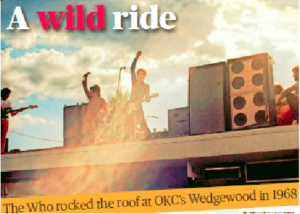
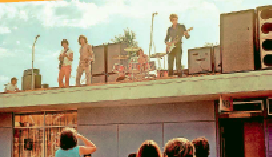
This is a newspaper article of the first concert I went to on Aug. 23, 1968. It was the first tour of the U.S. by the Who, and let’s just say they weren’t filling any stadiums or arena’s at this point. It was a hot, windy day, usual for Oklahoma, and I was enthralled. They had just released “Magic Bus” and was Keith Moon’s birthday. They gave him a cake onstage which he promptly grabbed handfuls of and threw into the audience, of which I was a recipient. They did, in fact, close with “My Generation” and destroyed their equipment. Moon did kick his drum kit off the stage and my friend ended up with a broken finger to prove it. A good time was had by all! Unmentioned in the article was that Roger Daltrey, being from England, had never met an American Indian and wanted to do so. The park’s management didn’t have any workers of that descent, so they had a Mexican worker come over to meet him and Roger was told he was a “real American Indian”. Roger never knew of their deceit and walked away happy in his quest. So here is a recounting of that concert.


Rock bands, such as The Who, and other performers drew fans to Wedgewood Amusement Park. Carl Dunn, rock ‘n’ roll journalist and historian, has the only known photos and video from The Who’s rooftop concert at Wedgewood in Oklahoma City in these rarely seen photographs.

The Tornado, the Wild Mouse, the Calypso and the Roto Jet. These were the names of rides at the Wedgewood Village Amusement Park in northwest Oklahoma City in the summer of 1968. And then came The Who for one of the wildest rides the park had ever seen. On Aug. 23, 1968, The Who climbed atop the roof of the swimming pool pavilion. It was drummer Keith Moon’s 22nd birthday. John Dunning was 15 that summer when local radio DJs announced The Who would play three shows at Wedgewood, one Friday night and a Saturday afternoon and evening show. Dunning and friends anticipated the show for weeks, and then the big day came. Wedgewood was opened in 1958 at NW 63 and Northwest Expressway, and Dunning already had become a fan of The Who. In winter 1967, he saw Herman’s Hermits, Blues Magoos, a 1960s psychedelic band, and The Who at Kiel Auditorium in St. Louis. “It was just incredible to see that in person. I was a big Herman’s Hermit fan, but when I left the show in St. Louis, I wasn’t a Herman’s Hermits fan anymore. I was a Who fan,” Dunning said, taking a moment from a busy afternoon to play the song, “Magic Bus,” on a turntable at his Oklahoma City record store, Trolley Stop Record Shop. Dunning had witnessed Herman’s Hermits play at Wedgewood Village in 1966, when so many people showed up that the band had to be dropped onto the stage by helicopter. In the mid-1960s, The Who was known for the smash hit “My Generation.” Guitarist Pete Townshend was known for smashing guitars, his arm swinging in a windmill downstroke, with loud power chords and lots of feedback. Singer Roger Daltrey was known for twirling a microphone on a cord like a lasso. And it was all set to the beat of Keith Moon’s drumming mojo and John Entwistle’s thumping, string popping bass guitar. In northwest Oklahoma City, the Wedgewood Village pavilion near the Olympic-sized pool had a snack bar, lockers, changing rooms and a flat roof. It would be the stage for The Who. “It made for a great stage for Herman’s Hermits and later The Who, especially The Who,” Dunning said. ‘It was good’ In a 2013 article in The Oklahoman written by longtime music journalist Gene Triplett, Wedgewood Village employee Greg Wells recalled being sent to pick up the band members at Will Rogers World Airport. “(Pete) Townshend had a recorder, and he was real quiet,” Wells recalled. “He was way, way to himself. I guess he had a lot of music goin’ on in his head. (John) Entwistle (bassist) was a regular guy, Moon (drummer) was crazy, and Daltrey was carrying a ditty bag. And as he got off the plane, we started walking down the concourse and he unzipped the bag and pulled out about a four-foot snake and wrapped it around his wrist and his arm and put his thumb in his pocket and walked out with a snake on his arm. And I guess it was a fashion statement, but it was something he did.” The crowd of people at Wedgewood included a lot of teenagers, Dunning said. And the young crowd was a vocal one that Friday night, he added. “Girls back then screamed a lot,” Dunning said. Mike Shannon, managing editor at The Oklahoman, was a 20-year-old University of Oklahoma journalism student from Lindsay who was working in the oil fields as his summer job. Shannon drove on a hot, muggy Friday afternoon with a friend to Wedgewood. The admission was $2 for the show. People rode the rides and looked for shade trees for the 8 p.m. show. The opening band for the Friday night show was local group, The Noblemen. And then The Who took the rooftop stage and opened with “Substitute,” and then blasted into “Can’t Explain.” “Summertime Blues,” an Eddie Cochran cover, and “Shakin’ All Over,” a song from the British rocker Johnny Kidd, were on the set list that night. The encore was“My Generation.” “They played all the songs we knew,” Shannon said. And Shannon recalls the flat birthday cake that was given to Moon, on his 22nd birthday that Friday night. Moon died in 1978. “Keith grabbed a piece of it and then started throwing pieces of it into the audience,” Shannon said, who stood about 60 feet from the rooftop building during the set. Dunning had moved as close as he could get to the building, but not too close. He said he had to stay back about 30 feet to be able to see the band members on the roof. Drumsticks were flying around. He saw Daltrey twirling the microphone. “They were up on the roof, and man, they were killer. It was Keith Moon’s birthday. Those instruments were torn to heck, and Keith was kicking those dang drums off the building, as I recall, though I wouldn’t want to make a sworn statement, but if they didn’t actually come off the roof it sure seemed like it,” Dunning said. “It was wild. … It was good,” Dunning said. Dunning said the images of that show have stayed with him, and he’s been a lifelong fan of The Who.

Carl Dunn Recording history
On Saturday, at both shows, in the audience was Carl Dunn, a 23-year-old Chickasha native and budding rock photographer who then lived in Plano, Texas. Dunn had brought a battery operated, reel-to-reel tape recorder to Wedgewood Village. He made bootleg recordings of both the Saturday afternoon and evening shows. And he also took some of the only known photographs of The Who on the Wedgewood rooftop. “I had seen The Who, and back then, I was really more interested in making recordings,” Dunn said. Dunn, who lives in Whitesboro, Texas, today, visited Oklahoma City this week and remembered making it to see The Who on Saturday for both of those historic shows. Dunn said he regrets missing the Friday night show, but living in Plano, Texas, he didn’t hear about it in time, he said, and he can’t remember exactly how he found out about the Saturday shows, after five decades have now passed. Dunn does recall that Saturday afternoon was more baking than shaking, he said, as the sun and the August heat kept the crowd smaller than had been reported on Friday night. He said on the last song, Roger Daltrey proclaimed, “This is where it all ends.” And the band played “My Generation.” “It was very hot, and there were just a few hundred people that afternoon,” Dunn said.“You didn’t have to worry about any restriction against recording or taking pictures back then.” So he didn’t have to hide his equipment, and he took both color and black-and-white pictures, then stayed around for the evening shows. His bootleg sound recordings of many of the songs caught more clapping than screaming in the background from the crowd. The amusement park in northwest Oklahoma City closed in 1969.
Robert Medley/oklahoman.com

Hits: 62

[Total: 0   Average: 0/5]

Small Faces – Itchycoo Park (1967)

Small Faces - Itchycoo Park (1967) 0815007


Steve Marriott and Ronnie Lane of Small Faces wrote this song, which is about skipping school to hang out at a park. Of course, with the lyrics, “What did you do there? I got high,” it was fairly obvious that they were doing in the park, although the band denied that it was about drugs. Marriott told Creem magazine in 1975:

The thing about ‘Itchycoo Park’ was that the era was wrong, and the word ‘high’ freaked everybody out. All the radio stations. But that song was real. Ronnie Lane and I used to go to a park called Itchycoo Park. I swear to God. We used to bunk off school and groove there. We got high, but we didn’t smoke. We just got high from not going to school.

Yeah, right.

On its release, the BBC immediately banned the song because of overt drug references -- “What did you do there? -- I got high” and “I feel inclined to blow my mind, get hung up, feed the ducks with a bun, They all come out to groove about, Be nice and have fun in the sun.” So Small Faces manager Tony Calder explained the song had an innocent interpretation:

We told the BBC Itchycoo Park was waste ground in the East End which the band had played on as kids. We put the story out at ten and by lunchtime we were told the ban was off.

A number of sources claim the song’s name is derived from the nickname of Little Ilford Park, on Church Road in the London suburb of Manor Park, where Small Faces’ singer and songwriter Steve Marriott grew up. The “itchycoo” nickname is, in turn, attributed to the stinging nettles which grew there. Other sources cite nearby Wanstead Flats (Manor Park end) as the inspiration for the song. Despite all the claims as to which park is the original Itchycoo park, in an interview Steve Marriott has stated that:

It’s Valentine’s Park in Ilford. We used to go there and get stung by wasps. It’s what we used to call it.

The song was one of the first pop singles to use flanging, an effect that can be heard in the bridge section after each chorus. Most sources credit the use of the effect to Olympic Studios engineer George Chkiantz who showed it to the Small Faces regular engineer Glyn Johns; he in turn demonstrated it to the group, who were always on the lookout for innovative production sounds, and they readily agreed to its use on the single. Although many devices were soon created that could produce the same effect by purely electronic means, the effect as used on “Itchycoo Park” was at that time an electro-mechanical studio process. Two synchronised tape copies of a finished recording were played simultaneously into a third master recorder, and by manually retarding the rotation of one of the two tape reels (flanges) using the fingers, a skilled engineer could subtly manipulate the phase difference between the two sources, creating the lush ‘swooshing’ phase effect that sweeps up and down the frequency range. Because the original single version was mixed and mastered in mono, the flanging effect in “Itchycoo Park” is more pronounced in its original mono mix, and is noticeably diluted in the subsequent stereo mix.

The Small Faces were founded in 1965 by members Steve Marriott, Ronnie Lane, Kenney Jones, and Jimmy Winston, although by 1966 Winston was replaced by Ian McLagan as the band’s keyboardist. Lane and Marriott met in 1965 while Marriott was working at the J60 Music Bar in Manor Park, London. Lane came in with his father Stan to buy a bass guitar, struck up a conversation with Marriott, bought the bass and went back to Marriott’s house after work to listen to records. They recruited friends Kenney Jones and Jimmy Winston who switched from guitar to the organ. They rapidly progressed from rehearsals at The Ruskin Arms public house (which was owned by Winston’s parents) in Manor Park, London, to ramshackle pub gigs, to semi-professional club dates. The group chose the name, Small Faces, because of the members’ small physical stature and “A ‘Face’ was somebody special, more than just a snappy dresser, he was Mister Cool.”

Their first out-of-town concert was at a working men’s club in Sheffield. Since the crowd was mainly made up of Teddy boys (a British subculture typified by young men wearing clothes that were partly inspired by the styles worn by dandies in the Edwardian period) and hard-drinking workers, the band were paid off after three songs. Despondent, they walked into the mod-orientated King Mojo Club nearby and offered to perform for free. They played a set that left the local mods wanting more. During a crucial residency at Leicester Square’s Cavern Club, they were strongly supported by Sonny & Cher, who were living in London at the time.

The band signed a management contract with management impresario Don Arden, and they were in turn signed to Decca Records for recording. They released a string of high-energy mod/soul singles on the label. Their debut single was in 1965 with “Whatcha Gonna Do About It”, a Top 20 UK singles chart hit.

What'cha gonna do about it - Small Faces


Marriott and Lane are credited with creating the instrumental to the song, “borrowing” the guitar riff from the Solomon Burke record “Everybody Needs Somebody to Love”.

Solomon Burke - Everybody Needs Somebody To Love


The lyrics to “Whatcha Gonna Do About It” were written by the Drifters band member Ian Samwell (who wrote arguably the first British true rock’n’roll record, “Move It”) and recorded by Cliff Richard and the Drifters, the UK band that would evolve into The Shadows.


By 1966, despite being one of the highest-grossing live acts in the country and scoring many successful singles, including four UK Top 10 chart hits, financially the band had nothing to show for their efforts. After a messy confrontation with the notorious Arden who tried to face down the boys’ parents by claiming that the whole band were using drugs, they broke with both Arden and Decca.

At home in England, their career reached an all-time high after the release of their classic psychedelia-influenced album “Ogdens’ Nut Gone Flake” on 24 May 1968. It is widely regarded as a classic album, and featured an innovative round cover, the first of its kind, designed to resemble an antique tobacco tin. It stayed at No. 1 in the UK Albums Chart for six weeks, but reached only No. 159 in the US. Critics were enthusiastic, and the album sold well, but the band were confronted by the practical problem that they had created a studio masterpiece which was virtually impossible to recreate on the road.

Marriott officially quit the band at the end of 1968, walking off stage during a live New Year’s Eve gig yelling “I quit”. Citing frustration at their failure to break out of their pop image and their inability to reproduce the more sophisticated material properly on stage, Marriott was already looking ahead to a new band, Humble Pie, with Peter Frampton. After Small Faces split, Lane, Jones and McLagan floundered briefly before joining forces with two former members of The Jeff Beck Group, singer Rod Stewart and guitarist Ronnie Wood. This line-up dropped the “Small” tag and became “Faces”.

In 1996, the Small Faces were awarded the Ivor Novello Outstanding Contribution to British Music “Lifetime Achievement” award. On 4 September 2007, a Small Faces and Don Arden commemorative plaque, issued by the London Borough of Westminster, was unveiled in their memory in Carnaby Street. In April 2012, the Small Faces were inducted into the Rock and Roll Hall of Fame.

Hits: 32

[Total: 0   Average: 0/5]

Grand Funk Railroad – I’m Your Captain/Closer To Home (1970)

Grand Funk Railroad - I'm Your Captain/Closer To Home


Mark Farner, guitarist and songwriter, himself does not explicitly state what the song is about, and indeed prefers that listeners be able to use their own imaginations when listening to songs in general. Nor did the other band members have any real idea of what Farner was getting at; Drummer Don Brewer has said, “I think it can mean a lot of different things to a lot of people.”

Mark Farner wrote the lyrics of this song before he wrote the music, which was opposite of how he usually composed most of his songs. He explained to Nightwatcher’s House of Rock:

I had gone to bed and prayed. Our mother had taught us kids to pray the ‘Now I lay me down to sleep,’ so I finished that part of the prayer, and put a P.S. at the end of it, and I asked the Creator to give me a song which would reach and touch the hearts of people that he wanted to touch. With love, because I just felt the love. I just felt for my good friends, my high school buddies who had died in Vietnam. I saw their parents, and I saw their families, and I think that’s what inspired it.

It came in the middle of night to me as words, and I didn’t even realize it was a song, because I write words all the time. In fact, my wife has a file that she has where she’s picked up napkins and notes here and there that have all these words that come out. At least we have a place to start putting them together, like a puzzle. But I grabbed those words in the morning, because I was playing my guitar in the kitchen of the farm. I was sipping on my coffee, had my feet kicked up in the chair, and I had my flattop guitar. As I was strumming the intro chords to ‘I’m Your Captain,’ I went, ‘Hey man, maybe this is a song.’ So I went and got the words, and started constructing the song out of it. I took it to rehearsal that day and the guys said, ‘Man, this song’s a hit.’ And, lo and behold they were right.

Approaching the rest of the band, drummer Don Brewer and bassist Mel Schacher, Farner had the “I’m Your Captain” part of the song fairly completed. The idea of extending it came about as they rehearsed it the first few times. Don Brewer, in a Songfacts interview, explained:

We used to rehearse at a place called The Musicians Union Hall in Flint, Michigan. We used to work all of our stuff out there. Mark came in one day with basically the beginning of the song, the ‘I’m your captain part.’ We always worked out everything with a jam -- he would have an idea, somebody would have an idea for a bass part of whatever, and we’d just kind of work on these things and jam out. For a day or two we worked on this song and it just didn’t go any place, that was about as far as we could get with it.

One day, coming out of a jam that we were working on, we fell into that half time part, and that’s when Mark came up with the lyrics, ‘I’m getting closer to…’ So we had that, and we all felt, ‘Oh man, that’s great, we’ll put that piece together with that, and that’s going to work,’ then we said, ‘What are we going to do from there?’ So we got into the guitar part where it breaks into full time again. Then we had a brainstorming session, ‘What are we going to do for the rest of the song?’

At the time, rock bands had experimented with orchestras, and we said, ‘Let’s put an orchestra on this thing, we’ll just play endlessly, and we’ll get Tommy Baker, our friend down in Cleveland, to write the score for it, and we’ll put an orchestra on it. It was a new thing for us, kind of new for the day -- there hadn’t been too many bands using orchestras. When we recorded the song in Cleveland, we didn’t have the orchestra there, we didn’t know what the final outcome was going to be, we hadn’t even recorded the string arrangements, we just recorded the end of the song on and on and on over and over, knowing they were going to come in and put an orchestra on it later. When we finally heard the song about two weeks later, it just blew us all away. It was a religious experience.

Inspired by groups like The Moody Blues, they came upon the idea of using an orchestra, and hired Tommy Baker, an arranger and trumpet player who was working on the Cleveland television series Upbeat. He suggested they extend the ending so that his orchestral score would have space to develop in, so the band extended the jam on it. Producer Terry Knight brought in the Cleveland Orchestra to record it. The band members never heard the full version until Knight played it for them back in Flint. Farner nearly cried when he heard it, and Brewer has said of their reactions, “We were just like, ‘Wow!'” and “Oh my God, it was magnificent.”

Some stations played an edited version that was cut to about 5 minutes, eliminating most of the fadeout. This truncated version of the song was a modest hit single when first released, but the track achieved greater airplay on progressive FM rock radio stations as they tended to play longer, more involved tracks. It has become a classic rock staple and has appeared on several audience-selected lists as one of the best rock songs of all time. In 1988, the listeners of New York rock station WNEW-FM ranked it the 71st best song of all time, while twenty years later in 2008, New York classic rock station Q104.3’s listeners ranked it the 112th best song of all time and by 2015 listeners of the same station had voted it up to being the 9th best of all time.

We weren’t concerned with FM radio, we knew FM radio could play 7 or 8-minute songs. It wasn’t a matter of being confined to anything, so we knew it could get airplay -- that wasn’t a restriction. Capitol wanted to cut it and do an edited version for a single, and we said, ‘No, you can’t edit that song, just leave it alone.’

In promotion of the song the band bought a 60-foot Times Square billboard advertising Grand Funk’s 1970 “Closer to Home” album that cost an estimated $100,000. The stunt unexpectedly benefited from a New York City workers strike that caused the billboard to stay up several months after it should have been taken down.

Guitarist and singer Mark Farner, drummer Don Brewer and bassist Mel Schacher started 1969 as unknown musician in Flint, Mich., and, by the end of 1971, they had released six albums that incredibly had all gone gold – without the benefit of a hit song. The band was formed as a trio in 1969 by Mark Farner (guitar, vocals) and Don Brewer (drums, vocals), both from a band called Terry Knight and the Pack, and Mel Schacher (bass) from Question Mark & the Mysterians. Knight soon became the band’s manager, as well as naming the band as a play on words for the Grand Trunk Western Railroad, a well-known rail line in Michigan. First achieving recognition at the 1969 Atlanta International Pop Festival I, the band was signed by Capitol Records. After a raucous, well-received set on the first day of the festival, the group was asked back to play at the 1970 Atlanta International Pop Festival II the following year. Patterned after hard-rock power trios such as Cream, the band, with Terry Knight’s marketing savvy, developed its own popular style. In August 1969, the band released its first album titled “On Time”, which sold over one million copies, and was awarded a gold record in 1970. In February 1970, a second album, Grand Funk (or The Red Album), was awarded gold status. Despite critical pans and a lack of airplay, the group’s first six albums (five studio releases and one live album) were quite successful.

Grand Funk Railroad came into being when Brewer and Farner, both struggling to make it as musicians, contacted Terry Knight, the former frontman of their old band the Pack. They were at such a desperate point that they agreed to sign with Knight as their “manager, producer, press spokesman and musical mentor,” even though Farner thought Knight was a chameleon and a con man.

Knight initially had little luck interesting record labels in Grand Funk. He did manage to score them the opening slot at the Atlanta International.  Pop Festival on July 4, 1969, which led to the band getting a deal with Capitol Records. The Capitol deal, in fact, was with Knight’s production company, which Grand Funk was signed to. This arrangement would become more significant later on.

Once described as someone who “fancied himself as the Colonel Tom Parker of the ’70s,” Knight took a very hands-on approach with Grand Funk Railroad. Knight produced their albums, helped write the songs and even designed the album covers. He kept Farner, Brewer and Schacher away from the press and handled the interviews himself. Unlike most managers, Knight didn’t try to befriend rock critics. In fact, he seemed to revel in antagonizing them and he used the negative-to-vicious reviews (Rolling Stone called them the “worst band in the world”) to promote Grand Funk as a the “people’s band.”

Nearly two years to the day from their Atlanta debut, Grand Funk Railroad became the first band since the Beatles to play Shea Stadium — and they sold out Shea in 72 hours, faster than the Beatles did. This crowning achievement, however, also started the cracks that soon derailed Grand Funk Railroad’s meteoric rise to super-stardom.

Knight, however, still saw Grand Funk Railroad as his gravy train as 1971 ended. The band’s sixth album, “E Pluribus Funk”, released that November, reached No. 5 on the Billboard chart, and Grand Funk had sold more than 20 million records in less than three years. In early 1972, Knight met with the band to share his idea to top the Shea Stadium success: a five-night stand at Madison Square Garden. Although Farner, Brewer and Schacher dutifully signed the paperwork for the concerts, they were starting to question Knight’s autocratic control. They griped about their touring and complained about his producing skills and songs he wouldn’t let them record.

Their biggest beef involved money. In early March, the band had found out that Knight, through his production deal with Capitol, was getting 16 percent of the album profits while they were receiving only 6 percent. Knight also had his cut as their manager, as well as a share in the song royalties and had 21 percent of GFR Enterprises, the corporation Knight created to handle Grand Funk Railroad’s business. This didn’t sit right with the trio. They were generating a lot of money but getting only a couple hundred dollars in a weekly stipend from GFR. As Brewer explained to Rolling Stone in 1972, “We wanted to hear what was happening with the money and Terry didn’t give us the right answers. He gave us the runaround.” Knight, meanwhile, believed the guys simply “began to believe their own press.” He told his side to Rolling Stone, explaining that Farner, Brewer and Schacher could have been more involved in their financials and the making their albums, but “they had a Lear jet sitting at the airport the night the “E Pluribus Funk” album was finished.”

Feeling uneasy about Knight, Brewer contacted John Eastman, a respected music business lawyer who also had helped his brother-in-law Paul McCartney go solo from the Beatles. Knight was shocked when he discovered that the group had fired him as manager and backed out of the Madison Square Garden concerts. That’s when the writs hit the band. On March 21, 1972, Knight filed a lawsuit against Eastman, alleging interfered with Knight’s contractual arrangement with Grand Funk. A week later, Knight sued the band for fraud and breach of contract, with his suits adding up to approximately $57 million. Knight later proclaimed on Behind the Music that “if they’d have waited three months, they would have been out of the  contract.” Grand Funk countered with their own $8 million lawsuit against Knight, charging him with defrauding them and misuse of their money. Knight would continue to file suits – one accused the band of trademark infringement and another charged Capitol Records with royalty illegalities. He sued retailers and concert venues that were dealing with Grand Funk. Two sides also played out their cases in the press, taking out ads to state their side of the lawsuits.

Knight’s most notorious move came on Dec. 23, 1972. Grand Funk were scheduled to perform a benefit concert at Madison Square Garden (where Knight had planned to have the band play a series of shows earlier in 1972). Knight arrived before the concert, with sheriff deputies and a court order authorizing the confiscation of the band’s equipment as part of what Knight alleged the band owed him. Fearing a cancellation would cause a riot, a compromise was reached with Knight taking the group’s gear after the show.

The legal battle of the bands eventually resolved in February 1974 with a settlement reached in the 30-plus lawsuits. The band got to keep its full name, Grand Funk Railroad, while Knight got a load of money, publishing rights and the group’s investments. Both Brewer and Farner stated in Behind the Music that they settled because the band wouldn’t have survived if a court fight lasted longer. For his part, Knight proclaimed that he didn’t mind wearing the black hat “as long as I can wear the black hat to the bank.”

Despite the lawsuits’ emotional and financial strain, Grand Funk ironically achieved their greatest popular success after they separated from Knight. The band, which had re-signed with Capitol in 1972, released their signature song “We’re an American Band” in 1973. The song hit No. 1 and their Todd Rundgren-produced album was their highest charter at No. 2. Their next album, Shinin’ On (also produced by Rundgren) spawned another No. 1 hit, a cover of the old Little Eva tune, “The Locomotion.” Another cover, “Some Kind of Wonderful,” reached No. 3 in 1974. But that year’s LP, “All The Girls in the World Beware!!!”, was their last gold album. While Knight might have won the legal battle, he lost the war. The other band he
managed, Bloodrock, also left him in 1972. He was dropped by Capitol, and Brown Bag Records, the label he started in 1972, closed shop by 1974, and Knight basically left show business soon after that. In 2004, Knight was stabbed to death while trying to protect his daughter from her boyfriend.

In 1972, Grand Funk Railroad added Craig Frost on keyboards full-time. Originally, they had attempted to attract Peter Frampton, late of Humble Pie; however, Frampton was not available, due to signing a solo-record deal with A&M Records. The addition of Frost, however, was a stylistic shift from Grand Funk’s original garage-band based rock and roll roots to a more rhythm and blues/pop rock-oriented style.

Grand Funk Railroad - We're An American Band LIVE - 1974


After Grand Funk initially disbanded in 1976, Farner released his first self-titled solo album in 1977, and his second, “No Frills”, in 1978. In 1981, Farner and Don Brewer launched a new Grand Funk line-up with bassist Dennis Bellinger and recorded two albums, “Grand Funk Lives” and “What’s Funk?”. Neither album achieved much critical acclaim; but the single “Queen Bee” was included in the film Heavy Metal and its soundtrack album. After they disbanded a second time in 1983, Brewer went on to tour with Bob Seger’s Silver Bullet Band.

Farner went solo again with 1988’s “Just Another Injustice” on Frontline Records. His third Frontline release was 1991’s “Some Kind of Wonderful”, which featured a revamped faith-inspired version of the Grand Funk classic of the same name. Farner enjoyed success with the John Beland composition “Isn’t it Amazing”, which earned him a Dove Award nomination and reached No. 2 on the Contemporary Christian music charts.

In 1996, Grand Funk Railroad’s three original members once again reunited and played to 250,000 people in 14 shows during a three-month period. In 1997, the band played three sold-out Bosnian benefit concerts. Two years passed before the two remaining members (Brewer, Schacher) recruited some well-regarded players to reform the band. Lead vocalist Max Carl (of 38 Special), former Kiss lead guitarist Bruce Kulick, and keyboardist Tim Cashion (Bob Seger, Robert Palmer) completed the new lineup. Grand Funk Railroad continues to tour.

In 2005, Grand Funk Railroad was voted into the Michigan Rock and Roll Legends Hall of Fame. Due to his heritage, Mark Farner was honored with the Lakota Sioux Elders Honor Mark in 1999. During the concert in Hankinson, North Dakota, a special presentation was held honoring Mark’s Native ancestry and his contributions. Members of the Lakota Nation presented him with a hand-made ceremonial quilt. He has also been honored with the Cherokee Medal of Honor by the Cherokee Honor Society.


(Partial writing credit to Michael Berick/ultimateclassicrock.com)

Hits: 30

[Total: 0   Average: 0/5]

The Saga Of Sleazy: Part 3 – (by Guest Author @Crazy_Eyes)

Editors Note: This is a user-supplied article, which we are grateful for. Music plays such an important place in our lives. Listening to it, playing it, making lyrics a personal memory. If you have a story of how it has affected you, please use the Easy Share tab at the top of this page and let us read it. This contains a glimpse into the real life of a real person and how music has affected them. As such, it contains some content and language that is adult-oriented.

If you want to catch up, here’s Part 1 and Part 2.

So after my runaway friends moved away I finished school and got a job and a woman and we were living together and she got pregnant, so we were going to get married. I had lost touch with that guitar playing kid that was staying in my basement, being busy with life and all. So anyways, one day I come home from work and my fiance and my daughter is gone and so is all of our things, she fucking moved out while I was working and left town. That was fucking crazy man, fucking through me for a loop. Then I find out that she ran off with my little brother. What the fuck. Life sure sucks sometimes, anyways. I got depression going on there for a while, and I was going through the courts trying to get my daughter back and working and really nothing else, just sitting at home feeling sorry for myself.

One day at a gas station filling my tank, there’s that guitar guy that used to live in my basement when he was a runaway. We had always got along great and shit so we get to talking and he says he is having a party at his house tonight and he invites me over. So I figure what the fuck, instead of sitting home alone I decide to go to the party, Wouldn’t you know, his party is like 6 guys and 20 women. I had the time of my life.

Come to find out that he has a party like that damn near every night. So I ended up over there almost every night of the week from then on. I remember he had a girlfriend named Tuesday, and she was hot, but then he broke up with her to go out with this chick named Wednesday. It was that kind of scene. Like falling into a barrel of titties. No matter what you got a nipple in your mouth. Umm, where was I going with this, Oh yeah, so he has these roommates that have a metal band and he is putting together his own band. This was the music shack, a couple of bands living together and a whole bunch of women hanging around. And me. LoL. It was a wild and crazy scene.

That got me out of my depression. Then my ex-fiance comes back to me begging forgiveness and cause of my daughter I take her in. That didn’t last, as you can expect, but life doesn’t come with instructions. So I do my best. But now I have reconnected with my guitar friend and I still go and hang out with him every time he has band practice, it’s the only chance I get to listen to these songs. They gave me a nickname, “Sleazy Snake”, LoL, I don’t know why, but that’s what they called me. Or just “Sleazy” for short. I’ll never forget the one time I brought my girlfriend over there with me, some chick that I knew there calls me “Sleazy” and I could tell by the look in her eye that she was trying to get a rise out of the one I was with. I fell in love with that one. The one who called me “Sleazy”. Only problem was she was dating that guitar player. But he would come over to my house and bring me out to the bars and pick up some chick and bring her back to my apartment to fuck her or whatever, so when he did that I would go to his house and fuck her. What a crazy world, man.

I don’t know why I’m typing all this, maybe to show you that we were pretty damn close friends and I didnt ask him for permission to share these tunes. I figure it’s better to ask forgiveness than ask permission sometimes, and this is one of those times. So here is another song from them, the “Drum Solo Tune”.


Editor Note: The Saga continues. Be sure to tune in next week.

Hits: 29

[Total: 0   Average: 0/5]

Special Holiday Article: Edgar Winter Group – Frankenstein (1973)

Edgar Winter Group - Frankenstein Live 1973


Is there anything musically Edgar Winter hasn’t done? Keyboardist, guitarist, saxophonist, percussionist, producer, singer, composer. Starting out professionally with his older brother Johnny Winter, they were nurtured at an early age by their parents in musical pursuits. Edgar and his brother began performing at an early age. When he was eight years old, the brothers appeared on a local children’s show with Johnny playing ukulele.

The boys’ father sang in a barbershop quartet, in their church choir, and played saxophone in a jazz group. Edgar and Johnny, who’s three years older, began performing together as teens, playing local watering holes like Tom’s Fish Camp before they were old enough to drink. The pair’s early R&B and blues groups included Johnny and the Jammers, the Crystaliers and the Black Plague.

Edgar Holland Winter was born to John Winter II and Edwina Winter on December 28, 1946, in Beaumont, Texas. Both he and his older brother Johnny were born with albinism, and both were required to take special education classes in high school. Winter states,

In school I had a lot of friends. I wore a lot of white shirts to, like, blend in I guess. No one really gave me a hard time about being albino or taking special education classes. Then again, I wasn’t really popular.

In high school, Edgar became fascinated with the saxophone stylings of Julian “Cannonball” Adderley and Hank Crawford, and he began playing alto sax in earnest. As a pre-teen he had played ukulele like his older brother, but by the time he was of college age, Edgar had become competent on keyboards, bass, guitar and drums.

Although he’s often skirted the edges of blues music, at heart Edgar Winter is a blues musician. Edgar Winter has always pushed himself in new directions, synthesizing the rock, blues and jazz melodies he hears in his head. As a consequence, his fan base may not be what it could have been, had he made a conscious effort to stay in a blues-rock mold over the years.

After appearing on Johnny Winter’s first Columbia album “Johnny Winter”, Edgar was signed to Epic Records in 1970. He recorded “Entrance”, his debut album, which featured himself on most of the instruments. After radio success accompanying his brother on “Johnny Winter And”, he formed a large horn ensemble called White Trash. Although it was a short-lived group which broke up in mid-’72, Winter assembled another group to record two more albums for Epic Records, “White Trash” and “Roadwork”. Winter’s single, “Keep Playing That Rock ‘n’ Roll,” reached number 70 on the U.S. rock radio charts, and the album “Roadwork” hit number 23 on the album charts. By the summer of 1972, through constant touring, (and a ready willingness to do interviews, unlike his older brother), Winter formed The Edgar Winter Group in the summer of 1972.

Winter brought together Dan Hartman, Ronnie Montrose, and Chuck Ruff to form The Edgar Winter Group, who created such hits as this number one “Frankenstein” and “Free Ride” (with lead vocals by its writer Hartman). Released in November 1972, “They Only Come Out at Night” peaked at the number 3 position on the Billboard Hot 200 and stayed on the charts for an impressive 80 weeks. It was certified gold in April 1973 by the RIAA, and double platinum in November 1986.

Winter invented the keyboard body strap early in his career, an innovation that allows him the freedom to move around on stage during his multi-instrument high-energy performances.

After “They Only Come Out at Night”, Winter released “Shock Treatment”, featuring guitarist Rick Derringer in place of Ronnie Montrose.

Winter also kept busy doing session work, playing sax on Meat Loaf’s “All Revved Up With No Place to Go”, Dan Hartman’s solo hit “Instant Replay”, Tina Turner’s “Simply the Best” and David Lee Roth’s remake of “Just A Gigolo”, as well as appearing on material by Rick Derringer, Johnny Winter, Ronnie Montrose, Todd Rundgren, Michael McDonald and many others.

Edgar Winter’s live shows consistently receive rave reviews. His music is always evolving and he is a master at stretching his skill and imagination to produce amazing results. He continues to thrill audiences with his live performances, always remaining on the cutting edge of music and style.

Although he’s never matched that kind of commercial radio success again, Winter has continued to tour and record at a prolific pace. He relocated from New York City to Beverly Hills in 1989 to pursue movie score work, which he’s had some success with, most notably with a slightly reworked version of “Frankenstein” for the movie Wayne’s World II.

Hits: 22

[Total: 0   Average: 0/5]

Special Holiday Article: Dickey Lee – Laurie (Strange Things Happen) (1965)

Laurie ( Strange Things Happen )- Dickey Lee -1965


This was written by psychologist Dr. Milton “Mitt” Addington and recorded by Dickey Lee. The song was inspired by a story that ran in a Memphis newspaper in 1964, written by a 15-year-old girl named Cathie Harmon. Dr. Addington credited her and shared his royalties from the song with her.

The original article by Cathie Harmon was possibly inspired by the legend of Resurrection Mary, described as a shy young woman with very cold hands. A number of young men reportedly encountered her at dance parties in Chicago beginning in the 1930s. Escorted or given a ride home, she typically asks to be dropped off at Resurrection Cemetery on Archer Avenue, where she vanishes, asking her escort not to follow her.

In 1939 a man named Jerry Palus met her at the Liberty Grove dance hall and she told him her actual home address; going there the following day, he found an older woman who verified that she had had such a daughter, who had died many years before. Her picture was identical to the girl Jerry had escorted to the graveyard.

MusicFor.Us wishes everyone a safe and happy Halloween. Times have changed, as I have fond memories of hundreds of us children would roam the neighborhood, most homes lavishly decorated with safe treats abounding. Remember the kids today and let’s give them the best experience we can for them just to have fun and try to retain their innocence just a little while longer.

Hits: 15

[Total: 0   Average: 0/5]

The Grass Roots – Midnight Confessions (1968)

The Grass Roots - Midnight Confessions


The story of how The Grass Roots came to be a band is a little complicated.

The Grass Roots story begins in the minds of two talented songwriters of the Los Angeles music scene. P.F. Sloan & Steve Barri were very prolific in writing songs in many genres of rock music. They worked for Dunhill Records, a new label headed by Lou Adler. Dunhill gave them the task of putting together a collection of songs so the record label could have some impact on the budding folk rock trend going on in the year 1965. The duo penned the song “Where Were You When I Needed You” and recorded it for release as a demo to several radio stations. Both Sloan & Barri took part in the recording along with some seasoned studio musicians at Dunhill. The duo became new producers for the label. When the record company received some good feedback about the recording, they started a search to find a band to become The Grass Roots. An audition was held at the Whisky-A-Go-Go in San Francisco. A group was selected to be The Grass Roots.

The San Francisco group selected was comprised of Denny Ellis on rhythm guitar, Willie Fulton on vocals and lead guitar, Joel Larson on drums, and David Stensen on bass. They had all grown up in the San Francisco music scene and had won a recent Battle Of The Bands there. They were all under the age of 18 so their mothers had to sign their recording contracts. The record company had them come to Los Angeles to do some live performances and take part in the recording process. Their first efforts resulted in Dunhill securing for themselves the legal group name of The Grass Roots.

Dunhill continued to develop the group with many live performances and more recording. All the group members moved to LA and lived together in an apartment in Hollywood so they were close to the exploding music scene and studio. They took part in recording sessions that yielded a new version of “Where Were You When I Needed You”, some other Sloan & Barri songs and some covers of recent songs by The Rolling Stones, Simon and Garfunkel, and other songwriters. Dunhill started compiling an album of this material in 1966. It had a simple photo cover that represented the record company’s take on folk rock music. There were no pictures of any group members on the release. The Grass Roots were busy playing many live performances and networking in the LA scene. The group felt that they wanted to go a different direction with their music. They asked to have more input in the recording process and song selection but this was not the formula that Dunhill wanted. The group, minus Larson, decided to return to San Francisco and continued to play live performances until the record company opted to recruit other members in their place.

This left Dunhill scrambling to find another group to be The Grass Roots in early 1967. A solution came in the form of a Los Angeles group called The 13th Floor (not to be confused with the 13th Floor Elevators). They had been a part of the local LA music scene since 1966 and wrote their own compositions as well as playing cover tunes. Creed Bratton played lead guitar, Rick Coonce played drums, Warren Entner sang and played rhythm guitar and Kenny Fukomoto sang and played bass. They sent a demo to Dunhill which received a favorable review. Unknown to the record company, Fukomoto had been drafted into the army. When The 13th Floor received news of a potential contract, they scrambled to find a replacement for their bass player. They went to the local musicians union and saw a posting by Rob Grill as a bass player and vocalist. Grill auditioned for the group and was immediately recruited.

Dunhill offered the group an opportunity to take over The Grass Roots name and they went right into the recording studio and put together two songs for their first single release. They recorded a song that they had been playing called “Let’s Live For Today” and fuzzy garage rocker that Entner self-composed titled “Depressed Feeling” as the flip side. The group learned the recording process and toured all over the country. The group composed material reflected the band growing as force in the LA music scene over the prior years. All four members collaborated to create some interesting music that reflected the times very well. As it turned out, the groups output shifted away from folk rock and into a pop soul orientation based upon the horn arrangements in “Midnight Confessions” as the primary reason for the songs popularity. To some listeners the psychedelic organ sequence that is predominant throughout the song could have lead the group to a harder rock sound. That path was not taken by the decision makers. Sloan left Dunhill to pursue a solo career. Barri shifted to an emphasis on production.

The lineup of members has changed several times over the years, a version of The Grass Roots are still making appearances. The most recognisable member of the group that recorded this song, Rob Grill – lead vocals, bass, songwriter -- died in 2011.

The original recording of “Midnight Confessions” was a demo by the Evergreen Blues Band, whose manager – Lou Josie – wrote the song. Josie is a songwriter and guitarist from Ohio whose credits include “Hey Harmonica Man” by Stevie Wonder, “Soul Finger” by the Bar-Kays and “We Can Make Music” by Tommy Roe.

Evergreen Blues Band - Midnight Confessions


The lyrics describe a man who is infatuated with a married woman, knows he can never have her, and is relegated to confessing his love for her audibly, but alone. The song appears to be a musical dramatization of the midnight confession of the Reverend Arthur Dimmesdale’s love for Hester Prynne in the classic 1850 Nathaniel Hawthorne novel “The Scarlet Letter”.

The demo contained a horn section and caught the attention of Record producer/engineer Steve Barri, who was looking to produce a song for The Grass Roots that was a “West Coast” version of a Motown-style production. The Grass Roots version was produced/engineered by Steve Barri with the horn sections arrangement by Jimmie Haskell. The song was recorded by the group of LA studio-musicians known as the Wrecking Crew, as were all Grass Roots songs; the band only added vocals later but performed their songs in concert. Musicians on the recording included John Audino, Bud Childers, and Anthony Terran on trumpet, Richard Hyde, Harold Diner, and Edward Kusby on trombone, Plas Johnson on sax, Don Randi on piano, Larry Knechtel on organ, Hal Blaine on drums, Emil Richards on percussion, Mike Deasy and Lyle Ritz on guitar.

This was the biggest hit for The Grass Roots. They also hit the US Top 10 with “Let’s Live For Today” and “Sooner Or Later”.

Grass Roots - Let's Live For Today (color)


This is a re-worked version of an Italian pop song that became a hit stateside when it was recorded with English lyrics. Even more confusing, the original Italian song was written and recorded by a British band.

The Rokes released their English version in the UK, which was quickly followed by a cover by “The Living Daylights”. The Rokes version got the attention of the American label Dunhill Records, which had their act The Grass Roots record it. This became the American hit version of the song.

The Rokes were from England, but caught on in Italy, where they moved their operations. They began writing songs with Italian lyrics, including one called “Piangi Con Me,” which translates to “Weep With Me.” The song was translated into English and given the new title of “Passing Thru Grey”. However, the song’s publisher in Britain, Dick James Music, was unhappy with the lyrics of “Passing Thru Grey” and decided that they should be changed. Michael Julien, a member of the publisher’s writing staff, was assigned the task of composing new words for the song and it was his input that transformed it into “Let’s Live for Today”.

As well as being popular with domestic American audiences, “Let’s Live for Today” also found favor with young American men serving overseas in the Vietnam War, as music critic Bruce Eder of the Allmusic website has noted:

Where the single really struck a resonant chord was among men serving in Vietnam; the song’s serious emotional content seemed to overlay perfectly with the sense of uncertainty afflicting most of those in combat; parts of the lyric could have echoed sentiments in any number of letters home, words said on last dates, and thoughts directed to deeply missed wives and girlfriends.

Over their multi-member career, The Grass Roots achieved two gold albums, one gold single and charted singles on the Billboard Hot 100 a total of 21 times. Among their charting singles, they achieved Top 10 three times, Top 20 three times and Top 40 eight times. They have sold over 20 million records worldwide. In December 2015 they were inducted into the American Pop Music Hall of Fame.

Hits: 52

[Total: 0   Average: 0/5]

Celebrating the connections.

Privacy Preference Center

Necessary

Advertising

Analytics

Other

Scroll Up