Category Archives: 40s

T-Bone Walker – Call It Stormy Monday But Tuesday Is Just as Bad (1947)

T-Bone Walker - Call It Stormy Monday


The importance and influence of Aaron Thibeaux “T-Bone” Walker cannot be understated. If you listen to the Blues, Rock and Roll, Rock, or even Jazz, this man has had a major influence since the late 1940’s. And this song of his is one reason most of us know about him. Since one of us here at MusicFor.us, who is also an extremely accomplished guitarist and performing artist, has already written an article about T-Bone I will refer you to that article to learn about him. The information about T-Bone starts part-way down the page at his Play Guitar website. Go ahead and read that, I’ll wait.

Now that you know a little about T-Bone, let’s take a look at this classic that has influenced many artists and the music you’ve listened to since then. Let’s start with just the name of the song. “Call It Stormy Monday But Tuesday Is Just As Bad” is what was printed on the label of his original release. No parenthesis, as many articles submit.
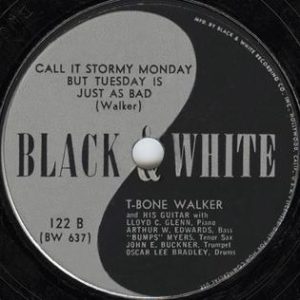
 

Black & White Records released “Call It Stormy Monday But Tuesday Is Just As Bad” in November 1947. Due to its length, and the first change to the title, “Call It Stormy Monday (But Tuesday Is Just as Bad)” is shortened to “Call It Stormy Monday” or most often “Stormy Monday”. Confusingly, it is also sometimes referred to as “Stormy Monday Blues”, the same title but different song, as the 1942 song by Billy Eckstine and Earl Hines. According to T-Bone Walker, he specifically gave his song the longer name to set it apart. However, trouble ensued when other artists began recording it using these shortened names. Walker blamed Duke Records owner Don Robey for giving it the wrong title for his artists, including Bobby “Blue” Bland’s 1962 rendition, which appeared as “Stormy Monday Blues”. Bland’s version, which was an R&B and pop chart hit, was subsequently copied by other artists, who also used the incorrect title. Bland introduced a new arrangement with chord substitutions, which was later used in many subsequent renditions. His version incorrectly used the title “Stormy Monday Blues” and as a result, Walker lost out on royalties when his song was misnamed  and the payments were forwarded to Eckstine, Hines, and Crowder.

Stormy Monday Blues by Bobby Blue Bland 1962


Walkers original composition and recording took place in Hollywood, California, and was produced by Black & White’s Ralph Bass. There are conflicting accounts about the recording date for “Call It Stormy Monday But Tuesday Is Just as Bad”. In an interview, Walker claimed that he recorded the song in 1940 “just before the war” (the U.S. entered World War II December 7, 1941), but that it was not released because of war-time material restrictions. Journalist Dave Dexter, who worked for Capitol Records in the early 1940s, believed that Walker recorded it for Capitol before the Eckstine/Hines song (March 1942), but that it was not released because of the unavailability of shellac and the recording ban. However, Walker’s first single as a band leader, “Mean Old World”, which was recorded in July 1942, was released in 1945 by Capitol. One sessionography places the recording of “Stormy Monday” on September 13, 1947, during his third session for Black & White Records. Blues writer Jim O’Neal noted that blues discographies do not show a recording date before 1947.

“Stormy Monday” was performed in a “club combo” or West Coast-blues style with a small back-up band. The style, as heard in “Driftin’ Blues” (one of the biggest hits of the 1940s), evokes a more intimate musical setting than the prevailing jump-blues dance-hall style. Accompanying Walker is pianist Lloyd Glenn, bassist Arthur Edwards, drummer Oscar Lee Bradley, and horn players John “Teddy” Bruckner (trumpet) and Hubert “Bumps” Myers (tenor saxophone).

A key feature of the song’s instrumentation is Walker’s prominent guitar parts, including the extensive use of ninth chords, which gives the song its distinctive sound.

Author Aaron Stang explained:

The real sound of this riff is based on starting each 9th chord a whole step (2 frets) above and sliding down. If we were to analyze this movement, the first chord is technically a 13th chord resolving down to a 9th chord.

Guitarist Duke Robillard (founded the band Roomful of Blues and was a member of the Fabulous Thunderbirds) added:

The guitar chord line, it’s a little guitar ninth chord figure. That was a unique thing and it became T-Bone’s signature. And that chord line seems to have grabbed everybody because everybody plays it with that line in it. And it’s almost like a law, that you have to, when you play ‘Stormy Monday.’

Walker also plays twelve bars of single-string guitar solo, which writer Lenny Carlson has described as “remain[ing] largely in the middle register, but it contains some gems, particularly in the use of space, phrasing, and melodic development”. The placement of a guitar as the prominent, lead instrument was also a notable “first”, primarily due to T-Bone pioneering the use of an electric guitar and amplification which allowed the guitar to take center-stage when it had been previously relegated to only a rhythm instrument in the backing instrumentation.

The song is also significant in that it opened up, and crossed over, the traditional Blues of Black artists (commonly called “race records” at the time) and exposed and invited White audiences into the genre. The lyrics perfectly capture the essence of the blues and what it strives to portray. “They call it stormy Monday, but Tuesday’s just as bad. Wednesday’s worse, and Thursday’s also sad.” These lyrics outline what every working-class individual, regardless of race, has to deal with week after week.

Walker’s legacy spans many years and he influenced some of our favorite players like Hendrix, Chuck Berry, the Allman Brothers, Stevie Ray Vaughan, and B.B. King, who said that “Stormy Monday was his inspiration for getting an electric guitar.” He “thought Jesus Himself had returned to Earth playing electric guitar”.

B.B. King - Stormy Monday (Live)


Later audiences were probably made aware of this song in 1971 when the Allman Brothers released their famed 1971 album “At Fillmore East”. As the title indicates, the recording took place at the New York City music venue Fillmore East, which was run by concert promoter Bill Graham. It was recorded over the course of three nights in March 1971 and features the band performing extended jam versions of songs, and this was one of them. “At Fillmore East” was the band’s artistic and commercial breakthrough, and has been considered by some critics to be one of the greatest live albums in rock music. At 10 minutes and 39 seconds, it takes T-Bones original, adds the arrangement of Bobby “Blue” Bland’s version, to another new height.

The Allman Brothers Band - Stormy Monday ( At Fillmore East, 1971 )


Other great blues versions include Albert King with Stevie Ray Vaughan (“In Session” 1983, a must listen blues album), John Mayall and the Blues Breakers on their album featuring Eric Clapton, and played by Cream at their ‘Reunion Concert’ in 2005 released as “Live At Royal Albert Hall”.


In 1983, T-Bone Walker’s original “Call It Stormy Monday But Tuesday Is Just As Bad” was inducted into the Blues Foundation Blues Hall of Fame in the “Classic of Blues Recording — Single or Album Track” category. Writing for the foundation, Jim O’Neal called it “one of the most influential records not only in blues history, but in guitar history”. In 1991, it was inducted into the Grammy Hall of Fame which “honor recordings of lasting qualitative or historical significance”. The song was included as one of the 500 Songs That Shaped Rock and Roll by the Rock and Roll Hall of Fame in 1995. The U.S. National Recording Preservation Board selected the song in 2007 for inclusion in the Library of Congress’ National Recording Registry of “sound recordings that are culturally, historically or aesthetically significant”. T-Bone is also included on Rolling Stone’s 100 Greatest Guitarists list at number 67.

Hits: 47

[Total: 1   Average: 5/5]

Billie Holiday – God Bless The Child (1941)

This is just one example of one of the greatest Jazz singers to have ever performed and recorded. In her autobiography “Lady Sings the Blues” Holiday indicated an argument with her mother over money led to the song. She states that during the argument her mother said “God bless the child that’s got his own.” The anger over the incident led her to turn that line into a starting point for a song.

In his 1990 book Jazz Singing, Will Friedwald indicates it as “sacred and profane” as it references the Bible while indicating that religion seems to have no effect in making people treat each other better. The lyrics refer to an unspecified Biblical verse: “Them that’s got shall have, them that’s not shall lose, so the Bible says, and it still is news. . . . “.

There are volumes of information about Billie Holiday, and it would be a disservice for me to try and give any more than a very brief overview of one of the most respected jazz singers who ever performed. It would be well worth one’s time to explore all the available information about her to discover what a truly rare talent she had.

Born Eleanora Fagan on April 7, 1915 to an unwed young mother, they were abandoned by her father shortly after her birth. By 9 years old she was in juvenile court because of truancy, and sent to a Catholic reform school. Raised by several different family members for most of her childhood, she was frequently in and out of terrible experiences. But fate would intervene and, at 17 years old in 1932, she began singing in clubs. Becoming noticed for her vibrant and passionate singing voice, she found her way to working with some of the biggest names in Swing and Jazz over the years: Benny Goodman,  Teddy Wilson, Count Basie, Artie Shaw, Ella Fitzgerald.

She made her last appearances and recordings in early 1959. Having made well over 100 recordings, she died on July 17 the same year. She left the world a legacy unrivalled and influenced artists ever since.

I’ll leave you with one more example of her immense talent, a song which is still covered by many.

Hits: 38

[Total: 0   Average: 0/5]

When was the first rock and roll record?

The simple answer? There was no “first”.

Musical styles have always been an evolution, a progression. The various styles and genres have always been layers built on previous expressions and added to, subtracted from, and slightly modified from other’s visions. There have been noticeable instances that ushered in a new, more distinct direction. Some of that evolution could be: “Blues” for raw emotion and the dominant guitar, “Gospel for uplift and abandon, and “Jump/Swing” for rhythm and rebellion.

Let’s start with the term “Rock and Roll” and then look at some contenders for the title of First Rock and Roll Record:

As for the origins of the term “rock ‘n’ roll”: according to the State of Ohio, which erected a plaque in commemoration, it was popularized by the DJ Alan Freed, who, from 1951, played the music on his “Moondog House Rock ‘n’ Roll Party” radio show. But the term has history going back long before Freed’s days. In 1933 the Boswell Sisters performed, on film, a song called “Rock and Roll”; in a stylized maritime setting, the three singers sit aboard a mocked-up boat that is rocking and rolling — though this is just one big visual euphemism: the term’s origins are sexual.

In 1922, for instance, blues singer Trixie Smith sang, simmeringly, “My Man Rocks Me (With One Steady Roll)”.

But “rock ‘n’ roll” had connotations that were sacred, too. In a 1910 recording, the black vocal harmony group the Male Quartette sing about “rocking and rolling/in the arms of Moses”.

The 1951 hit Rocket 88 from Jackie Brenston and His Delta Cats is considered by many to be the first rock ’n’ roll record. Brenston was a saxophonist, the Delta Cats a R&B band led by Ike Turner; together they created an explosive song that is considered by many historians of popular music to be the first rock ‘n’ roll record. Among the factors that have led to the singling out of “Rocket 88” is the fuzzy guitar sound, achieved thanks to a damaged loudspeaker (pop history is littered with damaged speakers: see The Kinks’ “You Really Got Me”).


But was “Rocket 88” actually the first rock ‘n’ roll record? It’s tempting to reduce musical history to a series of key “moments” but in truth it is a process, and “Rocket 88” was only the latest in a series of recordings that took the structure of the 12-bar blues and, both figuratively and literally, electrified it.

Even if “Rocket 88” wasn’t the first rock ‘n’ roll record, it marks a turning point: it’s about a car, the coveted Oldsmobile Rocket 88. Boogie-woogie is the sound of a train running along the tracks, a connection made explicit in Louis Jordan’s 1946 hit “Choo Choo Ch’Boogie”


(“Take me right back to the track, Jack”) but, by the 1950s, black Americans were moving north, earning better money and buying cars. “Rocket 88” is a song about mobility, with the car also serving as a metaphor for sexual prowess.

That song’s immediate antecedents were the “jump blues” or “jump‘n’jive” songs of players such as Chris Powell and Louis Jordan.

Check out Jordan’s “Caldonia”:


from 1945 (and don’t get distracted by the subplot involving Jordan being attacked by his wife with a knife). The roots of rock ‘n’ roll are clearly audible: the bassline, the beat, the energy. The bassline in all these songs, played on an upright bass, is a direct descendant of the left-hand in boogie-woogie piano, the blues-based form that became a craze in the 1930s and 1940s, popularised by players such as Albert Ammons, Pete Johnson and Meade Lux Lewis. This music emerged from the logging camps of Texas and Louisiana and has been dated back as far as the 1870s; these camps would have had a shed, a supply of drink and a piano. There were even pianos aboard the trains carrying workers from one camp to the next.

“That’s All Right, Mama” – Arthur “Big Boy” Crudup (1946)


In 1940, Arthur Crudup was reportedly living in a packing crate near an L train station in Chicago, playing songs on the street for tips. Things got better for him as the decade went on, and he landed a recording contract that led to a career as a well-known blues singer and songwriter. In 1946, Crudup recorded his song “That’s All Right, Mama.”

Though it wasn’t a hit at the time, it stands as a convincing front-runner for rock ‘n’ roll’s ground zero. With a tight combo of guitar, upright bass and drums bashing out accompaniment behind Crudup’s raw, powerful voice, it sounds a decade ahead of its time. There’s even a wild guitar solo, prefaced by Crudup shouting, “Yeah, man.” Very rock ‘n’ roll. And the last thirty seconds of the record pick up steam with the kind of unhinged energy that would become an essential element of all great rock records. Soon, Crudup was being called “the Father of Rock ‘n’ Roll.” As shown in the video, Elvis Presley played rhythm guitar on this and eight years later Elvis Presley did a cover record of it for his first single.

“Rock the Joint” – Jimmy Preston & His Prestonians


“Rock the Joint”, also known as “We’re Gonna Rock This Joint Tonight”, was recorded by various proto-rock and roll singers, notably Jimmy Preston and Bill Haley. Preston’s version has been cited as a contender for being “the first rock and roll record”, and Haley’s is widely considered the first rockabilly record. The song’s authorship is credited to Harry Crafton, Wendell “Don” Keane, and Harry “Doc” Bagby.

This song was recorded in 1947 by R & B artist Roy Brown titled “Good Rocking Tonight”.


Brown had originally offered the tune to raspy-voiced singer Wynonie “Mr. Blues” Harris, but Harris turned it down. After Brown had a hit with it, Harris reconsidered, cutting a version that upped the ante. Bouncing boogie woogie piano, honking tenor sax, drums and handclaps accenting the backbeat, and Harris shouting “Hoy, hoy, hoy!” – it all adds up to a raucous glimpse into the future. Again, a young Elvis Presley was listening. In 1954, Elvis released his version of the song. He was also watching Harris’s stage moves included pelvic jabs, lip curl and evangelical wavings of his arms and hands. All would become part of Elvis’s stage persona.

Louis Jordan – Saturday Night Fish Fry (1949)


This huge hit from 1949 (it was one of the first “race” records to cross over to the national charts, although the very popular Jordan had already had earlier crossover hits) combined a lively jump rhythm, call-and response chorus and double-string electric guitar riffs that

Chuck Berry would later admit “To my recollection, Louis Jordan was the first one that I hear play rock and roll.” “Saturday Night Fish Fry” was first recorded by Eddie Williams and His Brown Buddies, which featured the talk-singing vocals of the tune’s composer, New Orleans born Ellis Walsh. The act had recently had a number 2 R&B hit with the song “Broken Hearted”, and “Saturday Night Fish Fry” was intended to be the band’s followup.

However, the acetate for the Williams band version found its way to Louis Jordan’s agent and as Williams later recalled, “They got theirs out there first.” However, Jordan also reconfigured the song, taking a refrain that had been intermittent in Wiliam’s version—”And it was rockin’, it was rocking, you never seen such scuffling and shuffling ’til the break of dawn”—and refocusing it as the recording’s hook, singing it twice after every other verse. The Jordan band also dropped the shuffling rhythm of the Eddie Williams original, accelerating the pace into a raucous, rowdy jump boogie-woogie arrangement.

As I said there is no “first” Rock and Roll record, but these are certainly worth noting as participants in what was to become labeled as such. This subject has and is to be discussed for quite a while and the best that can be done is to look at history and enjoy the recordings and artists that ushered in a significant era of expression in music. I invite and look forward to everyone to add to the discussion.

Aside from it’s birth, now that is undoubtedly here I think Neil Young put it well – “Rock and Roll will never die”. And that is a prime reason for this site.

Thanks to knkx.org, Mentalfloss.com, and others for their contributions.

Hits: 91

[Total: 1   Average: 5/5]