Bo Diddley – I’m A Man (1955)

Bo Diddley - I Am A Man


This was recorded with one of the most acclaimed blues groups in history: Little Walter Jacobs on harmonica, Jimmy Rogers on guitar, Elga Edmonds (also known as Elgin Evans) on drums, and Otis Spann on piano. The band recorded a series of blues classics during the early 1950s, some with the help of the bassist and songwriter Willie Dixon.

Known as the “father of modern Chicago blues”, Muddy Waters’ influence was tremendous, not just on blues and rhythm and blues but on rock and roll, hard rock, folk music, jazz, and country music. His use of amplification is often cited as the link between Delta blues and rock and roll. He is one of the legends of the Blues, having known and played with other artists revered by Blues fans ever since.

As his history is well-documented, I will just give an overview of his life and encourage all to search out the details.

Born McKinley Morganfield in a cabin on the Stovall Plantation near Clarksdale, Mississippi around 1913 -1915, by age 17 was playing the guitar and the harmonica, emulating the local blues artists Son House and Robert Johnson. His grandmother, Della Grant, raised him after his mother died shortly after his birth. Grant gave him the nickname “Muddy” at an early age because he loved to play in the muddy water of nearby Deer Creek. “Waters” was added years later, as he began to play harmonica and perform locally in his early teens.

He had his first introduction to music in church:

I used to belong to church. I was a good Baptist, singing in the church. So I got all of my good moaning and trembling going on for me right out of church.

By the time he was 17, he had purchased his first guitar.

I sold the last horse that we had. Made about fifteen dollars for him, gave my grandmother seven dollars and fifty cents, I kept seven-fifty and paid about two-fifty for that guitar. It was a Stella. The people ordered them from Sears-Roebuck in Chicago.

His first known recording was in 1941 when Alan Lomax went to Stovall, Mississippi, on behalf of the Library of Congress to record various country blues musicians.

He brought his stuff down and recorded me right in my house, and when he played back the first song I sounded just like anybody’s records. Man, you don’t know how I felt that Saturday afternoon when I heard that voice and it was my own voice. Later on he sent me two copies of the pressing and a check for twenty bucks, and I carried that record up to the corner and put it on the jukebox. Just played it and played it and said, ‘I can do it, I can do it.’

In 1943, Muddy Waters headed to Chicago with the hope of becoming a full-time professional musician. Big Bill Broonzy, then one of the leading bluesmen in Chicago, had Muddy Waters open his shows in the rowdy clubs where Broonzy played. This gave Muddy Waters the opportunity to play in front of a large audience.

In 1944, he bought his first electric guitar and then formed his first electric combo. He felt obliged to electrify his sound in Chicago because, he said:

When I went into the clubs, the first thing I wanted was an amplifier. Couldn’t nobody hear you with an acoustic.

Two years later, in 1946, he recorded some songs for Columbia Records, with an old-fashioned combo consisting of clarinet, saxophone and piano; Muddy Waters’ name was not mentioned on the label. Later that year, he began recording for Aristocrat Records, a newly formed label run by the brothers Leonard and Phil Chess, which later became Chess Records. By 1948, his first recordings “I Can’t Be Satisfied” and “I Feel Like Going Home” became hits, and his popularity in clubs began to take off.

The rest, as is said, is history. His discography is extensive and represents his pioneering of bringing the Delta Blues to his new brand of electric Chicago Blues.

Now, back to “I’m A Man”.

“I’m a Man” was released as the B-side of “Bo Diddley”, his first single in April 1955. The single became a two-sided hit and reached number one in the Billboard R&B chart. It was inspired by Muddy Waters’ 1954 song “Hoochie Coochie Man”, also written by Willie Dixon.

Muddy Waters - Hoochie Coochie Man ( Chess 1954)


The song makes reference to hoodoo folk magic elements and makes novel use of a stop-time musical arrangement. This musical device is commonly heard in New Orleans jazz, when the instrumentation briefly stops, allowing for a short instrumental or vocal solo before resuming. It became one of Waters’ most popular and identifiable songs and helped secure Dixon’s role as Chess Records’ chief songwriter. The stop-time riff was “soon absorbed into the lingua franca of blues, R&B, jazz, and rock and roll”, according to musicologist Robert Palmer, and is used in several popular songs. When Bo Diddley adapted it for “I’m a Man”, it became one of the most recognizable musical phrases in blues.

Bo Diddley modified the song’s signature riff for his March 1955 song “I’m a Man”. He reworked it as a four-note figure, which is repeated for the entire song without a progression to other chords. Music critic and writer Cub Koda calls it “the most recognizable blues lick in the world”.

Muddy Waters, not to be outdone, responded two months later with an answer song to “I’m a Man”, titled “Mannish Boy”, partly as a jab at Diddley as he was younger and had “borrowed” his riff. Waters recalled:

Bo Diddley, he was tracking me down with my beat when he made ‘I’m a Man’. That’s from ‘Hoochie Coochie Man.’ Then I got on it with ‘Mannish Boy’ and just drove him out of my way.

Emphasizing the origin of Bo Diddley’s song, Waters sticks to the original first eight-bar phrase from “Hoochie Coochie Man” and includes some of the hoodoo references.

Muddy Waters - Mannish Boy (Audio)


Many British bands have covered “I’m A Man”, including The Who, Jeff Beck, Eric Clapton and The Yardbirds, Jimmy Page and The Yardbirds, among many others.

Two of the more well known versions in the US were by the Spencer Davis Group and Chicago. This was the final Spencer Davis Group release to feature Steve Winwood, who left to form Traffic.

Spencer Davis Group - I'm a Man


Chicago’s cover arrangement features an extended percussion and drum section with a total run time of 7 minutes and 40 seconds, and is based around the distortion-heavy blues-rock guitar of Terry Kath, the drumming of Danny Seraphine, the bass of Peter Cetera, the soaring Hammond organ of Robert Lamm and the horn players periodically switching over to auxiliary percussion instruments, such as claves, cowbell, maracas, and tambourine. Kath, Cetera and Lamm each sing a verse apiece (not singing the lyrics as they were originally written, but as they misheard and/or revised them).

Chicago ~ I'm a Man [studio version]


Bo Diddley’s original “I’m a Man” is ranked number 369 on Rolling Stone magazine’s list of The 500 Greatest Songs of All Time. In 2012 the song, along with the self-named A-side song “Bo Diddley”, was added to the Library of Congress’s National Recording Registry list of “culturally, historically, or aesthetically important” American sound recordings. In 2018, “I’m a Man” was inducted into the Blues Foundation Blues Hall of Fame as a “classic of blues recording”.

Hits: 40

[Total: 0   Average: 0/5]

Eddie Cochran – Summertime Blues (1958)

“Summertime Blues” was written by Eddie Cochran and his good friend, songwriter, and future manager Jerry Capehart who had helped him get a record deal. Capehart explained the inspiration for this song :

There had been a lot of songs about summer, but none about the hardships of summer.

They wrote the song in 45 minutes. It was recorded on March 28, 1958 at Gold Star Recording Studios in Hollywood, California. With this song, Cochran was established as one of the most important influences on rock and roll in the 1950s, both lyrically and musically.

Eddie Cochran, only 19 years old when he recorded this, sang both the vocal and bass vocal (the “work-a-late” portions, Cochran’s tribute to the Kingfish character from the Amos and Andy television series), played all the guitar parts, and added the hand clapping with Sharon Sheeley, his girlfriend and future fiancée. She was a young (age 17) songwriter herself, having written Ricky Nelson’s #1 hit “Poor Little Fool”. She really wanted to help Eddie on his record, but had trouble getting the rhythm. Eddie helped her out by showing her how to clap. Connie ‘Guybo’ Smith played the electric bass and Earl Palmer drums.

Here he is on Town Hall Party television program shortly after he recorded the song. Town Hall Party was a country music radio and television show broadcast in Southern California.

Summertime Blues- Eddie Cochran


Cochran was born October 3, 1938. His parents were from Oklahoma, and he always said in interviews that his parents had some roots in Oklahoma. He took music lessons in school but quit the band to play drums. Also, rather than taking piano lessons, he began learning guitar, playing country and other music he heard on the radio.

He quickly moved on to the popular Rockabilly style. Rockabilly is one of the earliest styles of rock and roll music, dating back to the early 1950s in the United States, especially the South. As a genre it blends the sound of Western musical styles such as country with that of rhythm and blues. Other important influences on rockabilly include western swing, Boogie-woogie, jump blues, and electric blues.

In July 1956, Eddie Cochran’s first “solo artist” single was released by Crest Records. It featured “Skinny Jim”, now regarded as a rock-and-roll and rockabilly classic. In the spring of 1956, Boris Petroff asked Cochran if he would appear in the musical comedy film “The Girl Can’t Help It”. Cochran agreed and performed the song “Twenty Flight Rock” in the movie. In 1957 Cochran starred in his second film, “Untamed Youth”, and he had yet another hit, “Sittin’ in the Balcony”, one of the few songs he recorded that was written by other songwriters (in this case John D. Loudermilk).

Eddie Cochran - Skinny Jim


Another aspect of Cochran’s short but brilliant career is his work as backup musician and producer. In a session for Gene Vincent in March 1958 he contributed his trademark bass voice, as heard on “Summertime Blues”. Gene Vincent was an American musician who pioneered the styles of rock and roll and rockabilly. His 1956 top ten hit with his Blue Caps, “Be-Bop-A-Lula”, is considered a significant early example of rockabilly. He was inducted into the Rock and Roll Hall of Fame and the Rockabilly Hall of Fame. Here he appears on the same Town Hall Party show.

Gene Vincent - Be-Bop-A-Lula


It was “Be Bop A Lula,” in fact, that John Lennon was playing at the 1967 garden party where he first met Paul McCartney, and it was Cochran’s “Twenty Flight Rock” that Paul taught John to play that same afternoon, shortly after being invited to join Lennon’s Quarrymen. At least one Beatle, George Harrison, saw Eddie Cochran in Liverpool during his final tour, and both his guitar-playing and his stage persona made a strong impression.

He was standing at the microphone and as he started to talk he put his two hands through his hair, pushing it back. And a girl, one lone voice, screamed out, ‘Oh, Eddie!’ and he coolly murmured into the mike, ‘Hi honey.’ I thought, ‘Yes! That’s it—rock and roll!’

In early 1959 two of Cochran’s friends, Buddy Holly and Ritchie Valens, along with the Big Bopper, were killed in a plane crash while on tour. Cochran’s friends and family later said that he was badly shaken by their deaths, and he developed a morbid premonition that he also would die young. He was anxious to give up life on the road and spend his time in the studio making music, thereby reducing the chance of suffering a similar fatal accident while touring. Financial responsibilities, however, required that he continue to perform live, and that led to his acceptance of an offer to tour the United Kingdom with Gene Vincent in 1960.

Gene Vincent was traveling alongside Eddie Cochran in the cab to London after what would prove to be Cochran’s final performance. Also in the cab were tour manager Patrick Thompkins and Eddie’s fiancée Sharon Seeley. On Saturday, April 16, 1960, at about 11.50 p.m., while on tour in the United Kingdom, 21-year-old Cochran was involved in a traffic accident in a taxi travelling through Chippenham, Wiltshire, on the A4. The speeding taxi blew a tire, the driver lost control, and the vehicle crashed into a lamppost on Rowden Hill. Cochran, who was seated in the centre of the back seat, threw himself over his fiancée Sharon to shield her and was thrown out of the car when the door flew open. He was taken to St Martin’s Hospital, in Bath, where he died of severe head injuries at 4:10 p.m. the following day. She survived as did Gene Vincent, however he would break a leg and walk with a limp for the rest of his life, but beyond that, the only serious injuries among the passengers were Eddie Cochran’s.

The list of known artists that have covered “Summertime Blues”, and played it in concerts, is extremely long. Just some of them include Joan Jett and the Blackhearts, the Rolling Stones, Bruce Springsteen, Van Halen, Tom Petty, Rod Stewart, T. Rex, Cliff Richard, the Beach Boys, the Beatles, Led Zeppelin, the White Stripes, the Sex Pistols, Sid Vicious, Rush, Simple Minds, George Thorogood, Guitar Wolf, Paul McCartney, Alan Jackson, the Move, David Bowie, Jimi Hendrix, Johnny Hallyday and U2.

Two notable, and well known, versions were by The Who (on their 1970 standout “Live At Leeds” album) and Blue Cheer (early pioneers of what would become the Metal genre) in 1968.

The Who ~ Summertime Blues


Blue Cheer - Summertime Blues


“Summertime Blues” is listed as number 74 on Rolling Stone magazine’s 500 Greatest Songs of All Time. In 1987, Cochran was inducted into the Rock and Roll Hall of Fame. His pioneering contribution to the genre of rockabilly has also been recognized by the Rockabilly Hall of Fame. On September 27, 2010, the mayor of Bell Gardens, California, declared October 3, 2010, to be “Eddie Cochran Day” to celebrate the famous musician who began his career when living in that city.

Hits: 31

[Total: 0   Average: 0/5]

Legendary Chicago ‘West Side Sound’ Blues Man Otis Rush Passes Away

Legendary Chicago blues guitarist Otis Rush, whose passionate, jazz-tinged music influenced artists from Carlos Santana and Eric Clapton to the rock band Led Zeppelin, died Saturday, September 29, 2018, at the age of 84, his longtime manager said. He is survived by his wife Masaki Rush, eight children and numerous grandchildren and great grandchildren

He was a key architect of the Chicago “West Side Sound” in the 1950s and 1960s, which modernized traditional blues to introduce more of a jazzy, amplified sound. Rush succumbed to complications from a stroke he suffered in 2003, manager Rick Bates said.

His contributions to the Blues, and the influence he had on Rock, has and will echo through the years. He has recorded a catalog of music that contains many songs that are now considered blues classics, and influenced many Rock artists that followed. He was placed at Number 53 on Rolling Stone‘s list of the 100 Greatest Guitarists.

Rush was born in Philadelphia, Mississippi in 1935 and began teaching himself the guitar at age eight. He moved to Chicago in 1949 and was inspired to pursue music full time after seeing Muddy Waters live. Catapulted to international fame in 1956, Rush released his first, and most successful single, “I Can’t Quit You Baby.” Along with its chart success, Led Zeppelin famously covered the cut on their 1969 debut album.

Otis Rush I Can't Quit You Baby


Rush recorded with a revolving cast of musicians that included Ike Turner, Big Walter Horton, Little Walter and Little Brother Montgomery. His output also featured classic cuts such as “My Love Will Never Die,” “All Your Love (I Miss Loving)” (later covered by John Mayall) and “Double Trouble” (Stevie Ray Vaughan later named his band after that track). His direct influence continued on to many Rock artists including John Mayall, Mike Bloomfield, Led Zeppelin,  Peter Green and Eric Clapton, among countless others.


Rush won a Grammy for Best Traditional Blues Recording in 1999 for “Any Place I’m Going,” and he was inducted into the Blues Foundation Hall of Fame in 1984. The Jazz Foundation of America honored Rush with a Lifetime Achievement Award on April 20, 2018 “for a lifetime of genius and leaving an indelible mark in the world of blues and the universal language of music.”


Hits: 36

[Total: 0   Average: 0/5]

The Spencer Davis Group – Gimme Some Lovin’ (1966)

The Spencer Davis Group - Gimme Some Lovin', original US mono mix, 45 single


“Gimme Some Lovin'” was written by Spencer Davis, Steve Winwood, and his brother Muff Winwood, although solely credited to “Steve Winwood” on the UK single label. Steve Winwood was just 17 years old when he wrote this song and was one of the first songs he wrote.

The basic riff of the song was borrowed from the Homer Banks song “(Ain’t That) A Lot of Love”, written by Banks and Willia Dean “Deanie” Parker.

Homer Banks - A Lot of Love


As recalled by bassist Muff Winwood, the song was conceived, arranged, rehearsed in just half an hour. At the time, the group were under pressure to come up with another hit, following the relatively poor showing of their previous single, “When I Come Home”, written by Jamaican-born musician Jackie Edwards, who had also penned their earlier number one hits, “Keep On Running” and “Somebody Help Me”.

The Spencer Davis Group - Keep On Running(live)


The band auditioned and rejected other songs Edwards offered them, and they let the matter slide until, with a recording session looming, manager Chris Blackwell took them to London, put them in a rehearsal room at the Marquee Club, and ordered them to come up with a new song.

Muff Winwood:

We started to mess about with riffs, and it must have been eleven o’clock in the morning. We hadn’t been there half an hour, and this idea just came. We thought, bloody hell, this sounds really good. We fitted it all together and by about twelve o’clock, we had the whole song. Steve had been singing ‘Gimme, gimme some loving’ -- you know, just yelling anything, so we decided to call it that. We worked out the middle eight and then went to a cafe that’s still on the corner down the road. Blackwell came to see how we were going on, to find our equipment set up and us not there, and he storms into the cafe, absolutely screaming, ‘How can you do this?’ he screams. Don’t worry, we said. We were all really confident. We took him back, and said, how’s this for half an hour’s work, and we knocked off ‘Gimme Some Lovin’ and he couldn’t believe it. We cut it the following day and everything about it worked. That very night we played a North London club and tried it out on the public. It went down a storm. We knew we had another No. 1.

In 1966, “Gimme Some Lovin'” reached number two in the UK and number seven in the US. The original UK version, which is the ‘master’ take of the song, differs in several respects from the version subsequently released in the US.

The Spencer Davis Group - Gimme Some Lovin'. Stereo


This UK release was slower, lacking the ‘response’ backing vocals in the chorus, some percussion, and the “live-sounding” ambience of the US single. These additional overdubs (which were performed by some of the future members of Traffic), and the ‘tweaking’ of the recording’s speed to create a brighter sound, were the work of producer Jimmy Miller, who remixed the song for its US release. (The US version has more often been used on reissue CDs, even those coming from Europe.) The single features the sound of the Hammond B-3 organ, which became one of the most recognizable organ riffs in rock. Winwood also wrote the song on the instrument, which explains why it is so prominent in the mix (especially the version released in the US).

In America, the first release of this song was by The Jordan Brothers, which was a rock band from the Philadelphia area.

The Jordan Brothers Gimme Some Lovin'


Frank Jordan explained to the Forgotten Hits newsletter:

Artists back in the 50’s and 60’s relied heavily on the record company’s people to come up with a hit for them. This was the case with The Jordan Brothers’ band. Upon receiving a phone call from the people at our record company in New York, we packed up our instruments and, along with our father, we went to the Big Apple. The people at our company played a ‘demo’ or demonstration of the song ‘Gimme Some Lovin” for us to hear and approve. We all agreed that we liked the song and agreed to record it. Little did we know that it was the actual 8-track tape we listened to containing Steve Winwood’s vocal, organ, a lead guitar, bass guitar and drums. The other remaining tracks were open for any additional accompaniment. We did not know this at the time or how our record company got hold of the original recording. We may never know. Or how the other record company that recorded the other tracks on it got a hold of it. We learned the song, recorded it on that same trip and it was released in three major cities in the US. So, we did have the first release in the US and the record took off immediately. It boasted huge sales in three major cities which would make the Spencer Davis version seem like it was a cover. The Spencer Davis version was enhanced with more instrumentation and background voices which gave it somewhat of a ‘soul sound,’ a term used back then for a sound produced at Motown records which was very popular at the time. The Spencer Davis version was released and it got immediate attention. It didn’t take long for it to take over our version and cover it.

The Spencer Davis Group was formed in 1963 in Birmingham when Welsh guitarist Spencer Davis recruited vocalist, guitarist, and organist Steve Winwood and his bass playing brother Muff Winwood. The group was completed with Pete York on drums. They were originally called the Rhythm and Blues Quartette, but was renamed after the group’s namesake because he was the only one who enjoyed doing interviews.

Spencer was the only one who enjoyed doing interviews, so I [Muff Winwood] pointed out that if we called it the Spencer Davis Group, the rest of us could stay in bed and let him do them.

The group’s first professional recording was a cover version of “Dimples”; at the end of 1965 they gained their first number one single with “Keep On Running”.

Steve Winwood left to form Traffic in 1967; his brother, Muff, moved into the music industry as A&R man at Island Records.

Moving to America in 1970, Spencer Davis went on to forge a solo career, forming an acoustic blues band. By the mid-’70s Spencer worked at Island Records (his group’s label) as a record company executive, personally helping to further the profiles of artists like Robert Palmer and Bob Marley. In the early 80’s Spencer was head of A&R for a Hollywood-based independent label and the itch to play in a band again was coming back. That’s when he made his next album, “Crossfire”, with guests like Dusty Springfield, Flo and Eddie, and Booker T. Jones. In mid 80’s, Spencer was back on the road with his own band, touring America, Europe and the Middle East. Playing with Pete York (the original drummer), plus other British rock legends. He continues touring and recording currently.

“Gimme Some Lovin'” is ranked number 247 on the Rolling Stone magazine’s list of The 500 Greatest Songs of All Time.

Hits: 40

[Total: 0   Average: 0/5]

Marty Balin, founding member of Jefferson Airplane/Starship, passes away at age 76.

Jefferson Airplane co-founder Marty Balin has died. He was 76. His cause of death at this time is unknown. Balin’s family confirmed his sudden death on Facebook writing, “With a heavy heart we share this sad news.” His wife, Susan Joy Balin, was by his side.

The Grammy-nominated musician died in Tampa, Florida, while en route to a nearby hospital, spokesman Ryan Romensko said.

In addition to his wife Susan, Marty is survived by his daughters Delaney Buchwald and Jennifer Buchwald with ex-wife Karen Deal.

Born Martyn Jerel Buchwald, Balin was a struggling folk guitarist on the San Francisco scene when he formed a band with Paul Kantner after meeting the 12-string guitarist at a hootenanny. They met up with guitarist Jorma Kaukonen, bassist Jack Casady, drummer Skip Spence and singer Signe Toly Anderson and cut their 1966 debut LP Jefferson Airplane Takes Off. They developed a strong following around the budding San Francisco rock scene, but became nationwide superstars in 1967 when Anderson left the group and was replaced by Grace Slick.

Balin co-wrote five songs on their breakthrough LP Surrealistic Pillow , including “Comin’ Back to Me” and album opener “She Has Funny Cars,” and his tenor voice became a key component of their signature sound. He played with the group at all of their most famous gigs, including the 1967 Human Be-In in San Francisco’s Golden Gate Park, The Monterey Pop Festival, Woodstock and Altamont. At the latter gig, Balin was brutally beaten by the Hells Angels after he dove into the audience to help an audience member in distress. “I woke up with all these boot marks all over my body,” he told Relix in 1993. “I just walked out there. I remember Jorma saying, ‘Hey, you’re a crazy son of a bitch.’”

Jefferson Airplane - Comin' Back To Me


Marty had a historic career as Rock and Roll Hall of Fame inductee, Grammy Lifetime Achievement Award recipient, and platinum and gold solo artist.


We here at MFU wish his family and friends tranquility during this time of sadness and loss, and thank Marty for the joy he gave so many in his life.

Hits: 15

[Total: 0   Average: 0/5]

Crosby, Stills, Nash & Young – Ohio (1971)

On May 4, 1970, National Guardsmen squared off against anti-war demonstrators on the campus of Ohio’s Kent State University. The student protest was sparked by President Richard Nixon’s announcement on April 30 that U.S. troops would invade Cambodia, escalating the already unpopular war in Vietnam.

The deadly confrontation that followed would become known as the Kent State Massacre, and was immortalized in one of rock’s greatest protest songs, “Ohio” by Crosby, Stills, Nash & Young.

The day after Nixon’s Cambodia speech, a few storefronts in the town of Kent were trashed by protesters, and cops used tear gas to disperse the crowd. On May 2, Ohio Governor James Rhodes called in the Guard to restore order. That evening, a Reserve Officer Training Corps (ROTC) building was set on fire as students cheered; guardsmen responded with tear gas and arrested many demonstrators.

A large protest on the university Commons was planned for May 4. As a few thousand students and spectators gathered, undergraduate John Filo grabbed his camera and headed towards the crowd. Filo, who worked at the Kent State photo lab, hoped to catch a few compelling images of the event.

When protesters refused an order to either disperse or face arrest, guardsmen fired tear gas at the crowd. Many students fled the scene, and the Guardsmen followed them to a football field, where the students pelted the soldiers with rocks.

Shortly after noon, the Guardsmen moved back up a hill, as if to retreat. But when they reached the top, they turned and opened fire on the students with their M1 rifles. In just 13 seconds, anywhere from 61 to 67 rounds were fired and four students lay dead; nine more were injured.

Although these are the physical facts that most agree on, it’s at this point that the reason why the Guardsmen fired becomes clouded in controversy.

The adjutant general of the Ohio National Guard told reporters that a sniper had fired on the guardsmen, which remains a debated allegation.

Many guardsmen later testified that they were in fear for their lives, which was questioned partly because of the distance between them and the students killed or wounded.

There is also a well documented account of Terry Norman, who was photographing protesters that day for the FBI and the campus police. He carried a loaded .38-caliber Smith & Wesson Model 36 five-shot revolver in a holster under his coat for protection. Though he denied discharging his pistol, he previously has been accused of triggering the Guard shootings by firing to warn away angry demonstrators, which the soldiers mistook for sniper fire.

There is an audiotape made by Terry Strubbe, a Kent State student who put a reel-to-reel tape recorder in his dorm window on May 4, 1970 to capture the sounds of the antiwar protest unfolding below. The audiotape has been analyzed by forensic audio expert Stuart Allen. Allen, president and chief engineer of the Legal Services Group in Plainfield, N.J., worked with a copy obtained from Yale University’s Kent State archives. When he re-analyzed and enhanced the section later, he picked up details of the yelling and what sounded like gunfire. He compared the acoustic signatures to his library of weapon sounds to determine that it was a .38-caliber revolver.

He said he can’t determine whether there is any connection between the incident and the volley of Guard rifle fire that follows approximately 70 seconds later.

Allen said:

I’m looking solely at the contents of the tape, To deduce a conclusion as to cause and effect, I’m not in a position to do that. This should go to the Department of Justice.

So there does exist some questions that will probably never be answered completely to everyone’s satisfaction. Did Terry Norman fire shots that prompted the Guardsmen to fire in response? Was Norman just a photographer hired by the FBI, or was he an employee of theirs and incite the actions deliberately? According to FBI reports, one part-time student, Terry Norman, was already noted by student protesters as an informant for both campus police and the Akron FBI branch.

We do know that, undeniably, when the shooting stopped, 4 students lay dead.

Of the four students killed, only Allison Krause and Jeffrey Miller were part of the demonstration. Sandra Scheuer and William Schroeder were walking to class when they were gunned down.

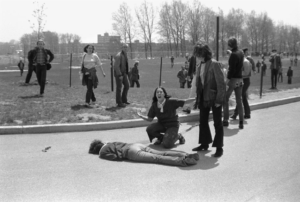
The iconic photograph of 14-year old Mary Ann Vecchio kneeling over the corpse of Jeffrey Miller would bring the Vietnam War home to America and win Kent State photojournalism student John Filo the Pulitzer Prize.


Filo told Annenberg Digital News:

Blood was just pumping out of his body, on the hot asphalt. I could see the tension building in this girl and finally she let out with the scream, and I sort of reacted to the scream and shot that picture.

Days later, David Crosby handed Neil Young a copy of Life magazine that featured Filo’s photo. Until then, CSNY were known for the gentle lyrics and intricate harmonies in songs like “Our House” and “Teach Your Children.” But Crosby told VH1 that Filo’s photo inspired the raw emotions of “Ohio”:

That girl leaning over the other kid in a pool of blood, and a look of, ‘Whaaa? What? How could this have happened?’ You know it’s shock … grief.

Neil Young recalled:

Crosby came and had the magazine with the Kent State killings. I had heard it on the news, what had happened, but Crosby always had a way of bringing stuff into focus.

Young disappeared into the woods with his guitar. When he returned a few hours later, he’d written “Ohio.”

Bandmate Graham Nash recalled in MusicRadar:

Crosby called me up and said he’d booked a studio, Neil just wrote this song, it’s f—ing fantastic. Get down here.’ Neil played me ‘Ohio,’ and it was ‘Holy f— – fantastic.’ We recorded it in an hour and a half.

The B-side, Stephen Stills’ “Find the Cost of Freedom,” was recorded in a half-hour and the master was sent to Atlantic Records president Ahmet Ertegun.  Nash remembered.:

We mixed it, gave him the two-track and said, ‘Ahmet, we want this out now,’ Ahmet put up an argument, but we were firm. Twelve days later, we put it out in a single sleeve with a copy of the Constitution that had four bullet holes on it.

“The mood was just very intense,” engineer Bill Halverson related on his website. “They were bent on getting it right and were on a mission.”

Though Young would later write “Rockin’ in the Free World,” which criticized President George H.W. Bush, and “Southern Man,” which skewered that region’s racism, “Ohio” would be the singer’s first protest song.

Young, a Canadian, explained in the liner notes of his Decade anthology:

It’s still hard to believe I had to write this song, It’s ironic that I capitalized on the death of these American students. Probably the biggest lesson ever learned at an American place of learning.

Explicit lyrics like “Tin soldiers and Nixon’s coming … Soldiers are gunning us down … Four dead in Ohio” would get the song banned on some mainstream AM stations but airplay on FM and underground radio would make “Ohio” a Top 20 hit. Crosby wrote in the liner notes of the CSN collection:

For me, ‘Ohio’ was a high point of the band, a major point of validity. There we were, reacting to reality, dealing with it on the highest level we could – relevant, immediate. It named names and pointed the finger.

On May 4, 1997, Crosby, Stills & Nash attended a commemoration of the shootings at the Kent State campus. Graham Nash stated:

Four young men and women had their lives taken from them while lawfully protesting this outrageous government action, We are going back to keep awareness alive in the minds of all students, not only in America, but worldwide… to be vigilant and ready to stand and be counted … and to make sure that the powers of the politicians do not take precedent over the right of lawful protest.

At the end of the ceremony, the trio performed “Ohio” to an enthusiastic crowd. David Crosby told the Akron Beacon Journal:

The students stood up for their God-given right to protest, and they got slaughtered for it, Those people were expressing their constitutional right of assembly and were attacked for it, and they’ve never been apologized to.

The President’s Commission on Campus Unrest issued its findings in a September 1970 report that concluded that the Ohio National Guard shootings on May 4, 1970, were unjustified. The report said:

Even if the guardsmen faced danger, it was not a danger that called for lethal force. The 61 shots by 28 guardsmen certainly cannot be justified. Apparently, no order to fire was given, and there was inadequate fire control discipline on Blanket Hill. The Kent State tragedy must mark the last time that, as a matter of course, loaded rifles are issued to guardsmen confronting student demonstrators.

Eight of the guardsmen were indicted by a grand jury. The guardsmen claimed to have fired in self-defense, a claim that was generally accepted by the criminal justice system. In 1974 U.S. District Judge Frank J. Battisti dismissed civil rights charges against all eight on the basis that the prosecution’s case was too weak to warrant a trial.

Civil actions were also attempted against the guardsmen, the state of Ohio, and the president of Kent State. The federal court civil action for wrongful death and injury, brought by the victims and their families against Governor Rhodes, the President of Kent State, and the National Guardsmen, resulted in unanimous verdicts for all defendants on all claims after an eleven-week trial. The judgment on those verdicts was reversed by the Court of Appeals for the Sixth Circuit on the ground that the federal trial judge had mishandled an out-of-court threat against a juror.

On remand, the civil case was settled in return for payment of a total of $675,000 to all plaintiffs by the state of Ohio (explained by the State as the estimated cost of defense) and the defendants’ agreement to state publicly that they regretted what had happened.

Hits: 42

[Total: 0   Average: 0/5]

Sly & The Family Stone – Thank You (Falettinme Be Mice Elf Agin) (1969)

It is difficult to focus on a group of artists that have had so many well-known hits with just one example. This is just one of their many number 1 songs they accomplished.

Sly & The Family Stone Thank You (Falettinme Be Mice Elf Agin) HQ Audio


An obvious tongue-in-cheek mondegreen title for “Thank You For Letting Me Be Myself Again”, it exemplifies the happiness and fun Sly and the Family Stone approached in their music. In 1971, Sly told Rolling Stone magazine:

If there was anything to be happy about, then everybody’d be happy about it. If there were a lot of songs to sing, then everybody got to sing. If we have something to suffer or a cross to bear – we bear it together.

Those words – a rare, lucid moment for Stone in that era – encapsulated the group’s arc up until that point: from the rosy optimism of their Summer of Love debut through their hit song era and into the cynicism of that early Seventies moment. The band would bear it together, until they couldn’t anymore.

Sly Stone (Sylvester Stewart) was born in Dallas, Texas to parents who encouraged musical expression in the household. Along with his siblings Freddie, Rose, and Vaetta, they formed the The Stewart Four.

While attending high school, Sylvester and Freddie joined student bands. One of Sylvester’s high school musical groups was a doo-wop act called The Viscaynes, then under the name “Danny Stewart”.

In 1966, renamed Sly Stone formed a band called Sly & the Stoners, which included acquaintance Cynthia Robinson on trumpet. Around the same time, Freddie founded a band called Freddie & the Stone Souls, which included Gregg Errico on drums, and Ronnie Crawford on saxophone. At the suggestion of Stone’s friend, saxophonist Jerry Martini, Sly and Freddie combined their bands, creating Sly and the Family Stone in November 1966.

Since both Sly and Freddie were guitarists, Sly appointed Freddie the official guitarist for the Family Stone, and taught himself to play the electronic organ. Sly also recruited Larry Graham to play bass guitar. The group was now “set in Stone”, so to speak, only adding Rose Stone a little later as a vocalist and a keyboardist. Rose’s brothers had invited her to join the band from the beginning, but she initially had been reluctant to leave her steady job at a local record store.

Sly and the Family Stone became the poster children for a particularly San Francisco sensibility of the late Sixties: integrated, progressive, indomitably idealistic. Their music, a combustible mix of psychedelic rock, funky soul and sunshine pop, placed them at a nexus of convergent cultural movements, and in turn, they collected a string of chart-topping hits.

In early 1968 the group reluctantly provided the single “Dance to the Music”. It became a widespread ground-breaking hit, and was the band’s first charting single. I’ll let you look up the studio recording but this live version shows just how much funky fun they had playing their music.

Dance to the music Sly & the Family Stone on soul train LIVE


What followed is indeed music history. Many more chart topping hits were to come. In late 1968, Sly and the Family Stone released the single “Everyday People”, which became their first No. 1 hit.

Sly & The Family Stone - Everyday People (Audio)


“Everyday People”, from their “Stand!” album, was a protest against prejudice of all kinds and popularized the catchphrase “different strokes for different folks”. Being a band that fused the sounds of soul and funk with psychedelic music, they were one of the first racially diverse bands to embrace the social issues faced in the 1960’s America, attempting to bring some compassion to those turbulent times. The lyrics for the band’s songs were often pleas for peace, love, and understanding among people. These calls against prejudice and self-hate were underscored by the band’s on-stage appearance. Caucasians Gregg Errico and Jerry Martini were members of the band at a time when integrated performance bands were virtually unknown. A risky venture at any time for a band seeking fame, but proved to be well received by both White and Black audiences alike.

The success of “Stand!” secured Sly and the Family Stone a performance slot at the landmark Woodstock Music and Art Festival. They performed their set during the early-morning hours of August 17, 1969; their performance was said to be one of the best shows of the festival. They performed another of their hits “Higher And Higher”.

Sly & The Family Stone - Higher And Higher (live 1969) HD 0815007


With the band’s new-found fame and success came numerous problems. Relationships within the band were deteriorating; there was friction in particular between the Stone brothers and Larry Graham (bassist). With the influx of hard drugs and egos, it doomed Sly & The Family Stone, which soon imploded in the mid ’70s leaving Sly Stone as the sole founding member.

After a short, troubled period, Sly reemerged and attempted to return to the spotlight, with new musicians in tow. Instead of the optimistic, rock-laced soul that had characterized the Family Stone’s 1960s output, the new album “Riot Goin’ On” was urban blues, filled with dark instrumentation, filtered drum machine tracks, and plaintive vocals representing the hopelessness Sly and many other people were feeling in the early 1970s.

In the mid 1970’s through the 1980’s, Sly made sporadic attempts at new music, but he never regained his chart-topping interest. His live appearances became ever more erratic and disheartening. At various concerts:

He exited the stage he told the audience near the front of the stage that he would return. He did return, but only to tell the crowd that the police were shutting down the show. While many blamed Stone for this incident, others believed that the promoter was at fault.

He left the stage after saying to the audience that “when waking up this morning he realized he was old, and so he needed to take a break now”. He did the same again one day later.

He played a 22-minute set and ventured offstage, telling the crowd “I gotta go take a piss. I’ll be right back.” He never returned.

On August 18, 2009, The Guardian reported that a forthcoming documentary, “Coming Back for More” by Dutch director Willem Alkema, claims Stone is homeless and living off welfare while staying in cheap hotels and a campervan. The film alleges that Stone’s former manager, Jerry Goldstein, cut off his access to royalty payments following a dispute over a ‘debt agreement’, forcing Stone to depend on welfare payments. On September 25, 2011, Alkema wrote in the New York Post that Stone was homeless and living in a van in the Crenshaw neighborhood of Los Angeles, although a subsequent report by Roger Friedman of Showbiz411 stated that Stone is not homeless, and lives in the van by choice. Reports have followed that, due to this information becoming public, fans and friends have reached out and helped Sly to get back on his feet. But his legacy remains and his musical history will remain one of the significant contributions to popular music.

Sly and the Family Stone were inducted into the Rock and Roll Hall of Fame in 1993. The original members of the Family Stone were in attendance, except Sly. Just as the band took the podium to receive their awards, Sly suddenly appeared. He accepted his award, made some very brief remarks (“See you soon”), and disappeared from public view. In December 2001, Sly and the Family Stone were awarded the R&B Foundation Pioneer Award. Two Family Stone songs, “Dance to the Music” and “Thank You (Falettinme Be Mice Elf Again)”, are among The Rock and Roll Hall of Fame’s 500 Songs that Shaped Rock and Roll. In 2004, Rolling Stone magazine ranked them 43rd on their list of the 100 Greatest Artists of All Time.

Hits: 21

[Total: 0   Average: 0/5]

Deep Purple – Hush (1968)

Originally named The Roundabout (a “supergroup” where the band members would get on and off, like a musical roundabout), was the start of the group who would later rename to Deep Purple, from Ritchie Blackmore suggesting a new name: “Deep Purple”, named after his grandmother’s favourite song written by pianist Peter DeRose in 1933 as a piano composition. The Deep Purple version was included on their first album and recorded with the band’s original lineup (Ian Paice, Jon Lord, Ritchie Blackmore, Nick Simper, Rod Evans) which didn’t include lead singer Ian Gillan, who joined in 1969, replacing Rod Evans. Session musician Barry Bailey (who later became the lead guitarist for the Atlanta Rhythm Section) plays guitar on the track. Shortly after the successful release of this song, Deep Purple was booked to support Cream on their Goodbye tour.

It was a cohort of producer Joe Meek, Rod Freeman, who taught Deep Purple this song. Keyboardist Jon Lord recalled to Mojo magazine January 2009:

Initially we thought it’s a bit too disco, or whatever the word was then. But Ritchie (Blackmore) said it would work if we toughened it up a bit. The whacka thing on the organ was something I started doing in (his previous band) The Artwoods. I played it almost like a set of conga drums. The rhythm of Hush is like a samba.

When Steve Morse joined Deep Purple on guitar in 1994, he pushed to bring the song back to their live shows, which they did.

We have a big improv section in there and it’s just a great feel from beginning to end for me, And the lyrics are not even lyrics. It’s just ‘Na nana na na na nananana.’ It’s the most basic tune in the world, but to me Deep Purple got on the map as a hard rock band from doing that version of ‘Hush.’ So I love that. And we stretch that out pretty far live.

The chorus begins “Hush, hush, I thought I heard her calling my name”, Joe South adapted the song from an old African American spiritual, which included the line: “Hush I thought I heard Jesus calling my name.”

“Hush” was written by American composer and musician Joe South for recording artist Billy Joe Royal, a friend of Joe South. Joe was a prominent session musician and songwriter.

In December 2015,  Deep Purple were announced as 2016 inductees into the Hall of Fame, with the Hall stating: “Deep Purple’s non-inclusion in the Hall is a gaping hole which must now be filled”, adding that along with fellow inductees Led Zeppelin and Black Sabbath, the band make up “the Holy Trinity of hard rock and metal bands.” The band was officially inducted on 8 April 2016.

The song is a fan favorite, but Gillan kept it off live setlists when he was in the band, since he wasn’t the original singer.

Hits: 39

[Total: 0   Average: 0/5]

The Platters – The Great Pretender (1955)

This was the first ever Doo Wop #1 in the USA, and it also made The Platters the first R&B vocal group to have a #1 on the Pop charts. The music was not known as “Doo Wop” at the time -- it was categorized as Rock or R&B. Around 1970, Gus Gossert, who was an oldies DJ on WCBS in New York City, started using the term “Doo Wopp” to describe this type of music. Gossert didn’t come up with the term however -- a record collector named Stan Krause did, who helped produce Gossert’s shows and gave him song information to use on the air.

The Platters - The Great Pretender - HD (1955)


That was Alan Freed who introduced them, who was  commonly referred to as the “father of Rock ‘n’ Roll”. Alan was the music promoter and DJ who introduced the term “Rock ‘n’ Roll” into common public use.

Before any success or recognition, in 1952, the original group consisted of Alex Hodge, Cornell Gunter, David Lynch, Joe Jefferson, Gaynel Hodge.

By 1953, The Platters original members David Lynch (second tenor) and Alex Hodge (baritone), added Tony Williams (tenor), and Herb Reed (bass), and were signed by manager Buck Ram to Federal Records. Ram made the addition of female vocalist Zola Taylor. Ram had originally met the Platters while they were working as parking lot attendants.

What changed their fortunes boils down to one very important name: their mentor, manager, producer, songwriter, and vocal coach, Buck Ram. Ram took a standard doo wop vocal group and turned them into stars — one of the most enduring and lucrative groups of all time.

After getting them out of a contract with Federal Records, Ram placed them with the burgeoning national independent label Mercury Records (at the same time he brought over the Penguins following their success with “Earth Angel”), automatically getting them into pop markets through the label’s distribution contacts alone. Then Ram started honing in on the group’s strengths and weaknesses. The first thing he did was put the lead-vocal status squarely on the shoulders of lead tenor Tony Williams. Williams’ emoting power was turned up full blast with the group (now augmented with Zola Taylor) working as very well-structured vocal support framing his every note.

The group quickly became a pop and R&B success, eventually earning the distinction of being the first black act of the era to top the pop charts. Considered the most romantic of all the doo wop groups, hit after hit came tumbling forth in a seemingly effortless manner: “Only You”, “My Prayer”, “Twilight Time”,  (Jerome Kern’s)”Smoke Gets in Your Eyes,” and “Harbor Lights”.

The Platters - Only You (And You Alone) (Original Footage HD)

The Platters - Smoke Gets In Your Eyes


Ram had the Platters record “Only You” during their first session for Mercury. Released in the summer of 1955, it became the group’s first Top Ten hit on the pop charts and topped the R&B charts for seven weeks. The follow-up, “The Great Pretender”, with lyrics written in the washroom of the Flamingo Hotel in Las Vegas by Buck Ram, exceeded the success of their debut and became the Platters’ first national #1 hit. “The Great Pretender” was also the act’s biggest R&B hit, with an 11-week run atop that chart. In 1956, the Platters appeared in the first major motion picture based around rock and roll, Rock Around the Clock, and performed both “Only You” and “The Great Pretender”.

The Platters also differed from most other groups of the era because Ram had the group incorporated in 1956. Each member of the group received a 20% share in the stock, full royalties, and their Social Security was paid. As group members left one by one, Ram and his business partner, Jean Bennett, bought their stock, which they claimed gave them ownership of the “Platters” name. A court later ruled, however, that a sham was used by Mr. Ram to obtain ownership in the name “Platters”, and the issuance of stock to the group members was “illegal and void” because it violated California corporate securities law.

In 1961, Williams struck out on his own. By the decade’s end, the group had disbanded, with various members starting up their own version of the Platters. Decades of competing versions ensued, until original member Herb Reed finally won a series of court cases. Reed, who died in 2012, restarted the group and patterned them on the original, and a version is still touring currently.

The original (successful) group was inducted into the Rock and Roll Hall of Fame in 1990 and into the Vocal Group Hall of Fame in its inaugural year of 1998. In 2004, “The Great Pretender” was voted 360th greatest song of all time by Rolling Stone.


Hits: 41

[Total: 0   Average: 0/5]

Site Progress Report.

It is that time again. It has been yet another month.

Well, if we ask WordPress then it tells us that we had fewer visitors than we had the previous month – but still a ton of people. There were just about 1700 people. The total number of visits (people visit more than once) is proportionally close to the previous month.

Meh… It happens and it’s not a big deal – ’cause quite a few people do visit. These numbers also aren’t dreadfully accurate. My much better numbers tell me that we’re doing better than that – and actually had nearly 2000 unique visitors for the last complete calendar month – and look to be on target to do much the same for the month of September.

(It’d be so much easier to do these on the 1st.)

We’ve had some user submitted content and we’ve had a number of people show personal interest in the site. That’s more important than total numbers.

But, just so you know, my stats plugin for WordPress kind of lies – and I think it’s a caching issue – again. I haven’t debugged it. That probably explains the large discrepancy. AWStats is probably the more accurate of the two.

If you feel like writing something topical, don’t be shy. We’ll give it an audience. We just put stuff here. You decide what to do with it. If you want to add to the pile, go ahead!

At the end of the day, the site is coming along better than expected. It gets pretty good traffic and that’s all you folk’s doing.

Trivia: We’ve had IP addresses from 47 countries that have come to visit us. (I suspect a number of them are VPN address and I know quite a few are abuse addresses that try to harm the server.)

So, that’s a site update. We’re doing fine – thanks to you. If you’re not yet involved, jump on in – the water’s warm!

Hits: 37

[Total: 1   Average: 2/5]

Celebrating the connections.

Privacy Preference Center

Necessary

Advertising

Analytics

Other

Scroll Up