Charlie Ryan / Commander Cody, 1972: Hot Rod Lincoln - Bill Kirchen, Fender Telecaster
Now that you’ve read along and know the story, let’s watch them playing it with a few added enhancements.
Commander Cody & His lost Planet Airmen - Hot Rod Lincoln 1974
“Hot Rod Lincoln” was written by singer-songwriter Charlie Ryan in 1955. It was written as an answer song to Arkie Shibley’s 1951 hit “Hot Rod Race”.
HOT ROD RACE No 1 by Arkie Shibley
It describes a race in San Pedro, Los Angeles between two hot rod cars, a Ford and a Mercury, which stay neck-and-neck until both are overtaken by “a kid in a hopped-up Model A”. “Hot Rod Lincoln” is sung from the perspective of this third driver, whose own hot rod is a Ford Model A body with a Lincoln-Zephyr V12 engine, overdrive, a four-barrel carburetor, 4:11 gear ratio, and safety tubes. Safety tubes were made by Goodyear. They had a second inner tube inside the main inner tube. If you had a blow out the car would settle slowly on the inner tube that still had air and you could control the car. They were harder to mount than regular inner tubes.
Ryan’s original rockabilly version was released in 1955 through Souvenir Records under the artist name Charley Ryan and the Livingston Bros.
Hot Rod Lincoln #1 - Charlie Ryan & The Livingston Brothers
Ryan based the description of the eponymous car on his own hot rod, built from a 1948 12-cylinder Lincoln chassis shortened two feet, with a 1930 Ford Model A body fitted to it. Ryan raced his hot rod against a Cadillac sedan driven by a friend in Lewiston, Idaho, driving up the Spiral Highway (former U.S. Route 95 in Idaho) to the top of Lewiston Hill; he incorporated elements from this race in his lyrics to “Hot Rod Lincoln”, but changed the setting to Grapevine Hill (a long, nearly straight grade up Grapevine Canyon to Tejon Pass, near the town of Gorman, California) to fit it within the narrative of “Hot Rod Race”.
Was there really a “hot-rod Lincoln?” Yes and no. Actually, it was a rebuilt car with the body of a Model “A” coupe set into the frame of a 1941 Lincoln, along with a “hopped-up” Lincoln engine block. However, at the time of this song’s writing, Ryan built a second car, this time with a chop-shop melding of a 1930 Model “A” Ford coupe and a wrecked 1948 Lincoln. It is this second restored car with which has Ryan toured.
Commander Cody and His Lost Planet Airmen, who were a Country-Rock group formed at the University of Michigan, never intended to be a famous band. They have devoted themselves body and soul to country music and old-time rock and roll. But that devotion is not an easy thing to stick to in the Midwest where, chances are, you associate that type of music with the greasers at the drive-in who love to vamp on longhairs and inevitably wind up becoming cops. And it was even harder in 1967 when everyone was just getting into acid and revolution and high-powered MC5 music and all the other things that have put Ann Arbor and Detroit on the map.
“We didn’t think of appealing to anybody,” says the Commander. “We were just having a good time, picking and playing and making a few dollars on the side. It was when the psychedelic ballrooms were starting to be big. We played the Grande Ballroom in Detroit on the same bill with Canned Heat so, naturally, the audience hated us, booed us, you know.”
Formed in 1967, the group’s founder was George Frayne IV (alias Commander Cody) on keyboards and vocals. The classic lineup was “Billy C.” Farlow on vocals and harmonica; John Tichy on guitar and vocals; Bill Kirchen on lead guitar; Andy Stein on saxophone and fiddle; Paul “Buffalo” Bruce Barlow on bass guitar; Lance Dickerson on drums; Steve Davis (a.k.a. the West Virginia Creeper) on steel guitar.
Frayne is also an artist. He received a Bachelor’s degree in design from the University of Michigan in 1966 and a Master’s degree in Sculpture and Painting from the Rackham School of Graduate Studies of the University of Michigan in 1968. He taught at University of Michigan and the University of Wisconsin-Oshkosh, and has had his art exhibited at numerous shows.
The band broke up and reformed several times over the years, and as of 2016, Commander Cody was still touring with some old and new members making up the Airmen.
The original line-up released one other well-known song.
Emerson, Lake & Palmer? Why this piece instead of one of the more popular and commercially successful songs like “Lucky Man”, “From The Beginning”, or “Still You Turn Me On”? Well, it’s because you might not be as interested in one of my favorite pieces from them, which we’ll listen to a little further down. So I picked this rockin’ “appetizer” from the same album to get you in here.
Emerson, Lake & Palmer - Nut Rocker
You may want to grab a snifter of fine brandy, a choice cigar, and a velvet sleeping jacket, because we’ll end up getting all classical up in here.
But first, let’s see where this first track came from. In 1959 a group of session musicians, Earl Palmer, René Hall and Plas Johnson, worked as the house band at Rendezvous Records. You’ve heard them on many songs from the 1960’s, but don’t know it. They alone would take another article, but I’ll leave it to you to look them up on your own if interested.
After recording a successful rock version of “In the Mood” in 1960, they took on the name of B. Bumble and the Stingers so they could release more classically-inspired records. Their second such recording was “Nut Rocker”.
B.Bumble & The Stingers - Nut Rocker
Let’s not stop there. The original composer of this piece was Pyotr Ilyich Tchaikovsky, yes Tchaikovsky, for his two-act ballet called “The Nutcracker Suite”. It was given its premiere at the Mariinsky Theatre in Saint Petersburg on Sunday, 18 December 1892. You may be familiar with some of the tunes from that as they are usually played around Christmas time.
Tchaikovsky Nutcracker Suite - 2 'March' * Volker Hartung & Cologne New Philharmonic Orchestra
Classical music is usually a grouping of extended musical pieces woven together inspired by a concept of emotions or events. Is the re-imagined version of this song an example of the beginnings of what has become known as Progressive (Prog) Rock? It may just be.
As I mentioned, this song is a step to a song you may even less familiar with. The Emerson, Lake & Palmer version of this song was the encore of their live recording of a concert performed at the Newcastle City Hall (a concert hall located in Newcastle upon Tyne, England). The album was called “Pictures at an Exhibition”, as the rest of the album contained movements from the suite of ten pieces (plus a recurring, varied Promenade) of the same name composed for piano by Russian composer Modést Petróvich Músorgskiy (later known as Mússorgsky) in 1874.
Mussorgsky based his musical material on drawings and watercolours by artist, architect, and designer Viktor Hartmann, who produced mostly during his travels abroad. Locales include Italy, France, Poland, Russia, and Ukraine. Today most of the pictures from the Hartmann exhibition are lost, making it impossible to be sure in many cases which Hartmann works Mussorgsky had in mind.
The suite is Mussorgsky’s most famous piano composition and has become a showpiece for virtuoso pianists. It has become further known through various orchestrations and arrangements produced by other musicians and composers, with Maurice Ravel’s arrangement being by far the most recorded and performed.
The final piece of Mussorgsky’s symphony was titled “The Bogatyr Gates (In the Capital in Kiev)”. The title of this movement is commonly translated as “The Great Gate of Kiev” and sometimes as “The Heroes’ Gate at Kiev”.
Mussorgsky - Great Gate of Kiev (Богатырские ворота), Amazing performance!!!!
Hartmann considered the Great Gate of Kiev to be his best work. The gate exists only as a painting finished in 1869 depicting a plan for a city gate in Kiev. Tsar Alexander II had held a competition for the design of a great gate to commemorate his survival of the assassination attempt on him in 1866, but the project was cancelled. Maybe the Tsar was kind of squeamish about publicly remembering his own murder plot?
Raise, or refill, that brandy snifter, and settle in for about 10 more minutes. We can now get to the actual track I had mentioned. Here is Emerson, Lake & Palmer’s live performance of “The Great Gate of Kiev” recorded in 1974 at California Jam. Not only do you get a great musical performance of the piece, but some of the most notable theatrical moments performanced on stage.
ELP / The Great Gates of Kiev / 1974 California Jam
Greg Lake composed and added lyrics for the piece, befitting the mood of the movement.
Come forth, from love’s spire
Born in life’s fire,
Born in life’s fire.
Come forth, from love’s spire
In the burning, all are [of our] yearning,
for life to be.
And in pain there will [must] be gain,
New Life!Stirring in, salty streams
And dark hidden seams
Where the fossil sun gleams.They were, sent from [to] the gates
Ride the tides of fate
Ride the tides of fate.
They were, sent from [to] the gates,
In the burning all are [of our] yearning,
For life to be.There’s no end to my life,
No beginning to my death:
Death is life.
Keith Emerson was known for his theatrics and, most notably, his synthesizers. He had a close relationship with Dr. Robert Moog as he was inventing his instruments. The beast shown in the video was the Advanced Moog Modular System IIIc (incl. ribbon controller with several ‘theatrical’ effects). That may be a future article all to itself.
You may now retire back to your chambers and your own selections of music, but now you are hopefully just a little more cultured. But, please, Keep On Rockin’ in the Free World.
On October 12, 1492, Christopher Columbus landed in the New World. Though most of the States don’t actually take the day off, most do recognize it as a day of official recognition. It is recognised that the recognition and history of Columbus is controversial, and a discussion may be in order. But this isn’t intended to be the best place for that.
For some States, Columbus Day can be a fairly big ordeal. In others, they don’t even give the kids a day off and the State offices remain open. It’s on the list of Federal Holidays but not everyone gets to take the day off!
Because of the whimsical nature of the way the holiday is celebrated, we thought we’d bring you something different. There aren’t actually a whole lot of songs that have to do with Columbus Day, but we have one that you may not be familiar with and may enjoy learning about.
You can listen, and I’ll tell you about the artist and song!
The Story of Reuben Clamzo and His Strange Daughter in the Key of A
The full name of this song is a mouthful. It is The Story of Reuben Clamzo and His Strange Daughter in the Key of A. The artist’s name is Arlo Guthrie, and you may know him from his Alice’s Restaurant. This song was first released in 1978 on the Rehashed 4:20 Sampler album.
You may also know his father, Woody Guthrie -- one of the most distinguished figures in American Folk music. If you aren’t aware that you know him, he’s the author of the famous song This Land is Your Land.
One of the things that makes that song remarkable is that Woody chose to place the song into the public trust, by releasing it into the public domain and relinquishing all of his ownership rights. It has since gone on to be covered by many people and has historically been quite popular.
Arlo Guthrie was born on July 10, 1947. He was actually born in New York, but has mostly made Massachusetts his home for most of his adult life. His song Massachusetts is officially recognized as the State Folk Song.
Arlo is best known for writing about his life and observations, often in the form of some protest, though with a touch of satire and humor. You can tell that he was heavily influenced by his father and his father’s friends.
If you’re familiar with the Alice’s Restaurant song, you should know that that’s more-or-less truthful, including his bout with the law and their attempt to draft him for Vietnam. What you may not know is that the little catchy chorus was actually a radio jingle/commercial for a restaurant that was, in fact, known as Alice’s Restaurant.
Either way, this song is a mix of absurdity and humor. It’s whimsical, just like the varied ways the States of the Union celebrate the holiday. It’s a fun little diddy that you’re quite unlikely to know and this is an excellent day to share it with you.
If you’re interested in learning more about Arlo, you can click the above link to the Wikipedia article. He has a lot more than just Alice’s Restaurant. He has other many other gems, ranging from songs about drug laws to experiencing the American Midwest. On top of that, you can also see him in concert, as he’s still performing.
We here at MFU would like to thank you for your patronage and hope you have a safe and happy Columbus Day. Please, do feel free to leave your comments!
If you’re interested in what we do, see the About This Project page. If you’d like to contribute, you can Register and then we will set your permissions to that of “contributor.” If you’d like to contribute without registering, you can use our Easy Share link and submit your material for review! If you’d like email notifications to know when we publish new articles (every day, around 16:30 Eastern), just enter a working email address in the “Subscribe” section in the top right!
Rolling Stone ranked “Tangled Up in Blue” as #68 on their list of The 500 Greatest Songs of All Time. The Telegraph (a UK newspaper since 1855) has described the song as
The most dazzling lyric ever written, an abstract narrative of relationships told in an amorphous blend of first and third person, rolling past, present and future together, spilling out in tripping cadences and audacious internal rhymes, ripe with sharply turned images and observations and filled with a painfully desperate longing.
“Tangled Up in Blue” is one of five songs on the “Blood on the Tracks” album that Dylan initially recorded in New York City in September 1974 and then re-recorded in Minneapolis in December that year; the later recording became the album track and single.
According to novelist Ron Rosenbaum, Bob Dylan once told him that he’d written “Tangled up in Blue”, after spending a weekend immersed in Joni Mitchell’s 1971 album Blue. “Tangled Up in Blue” is one of the clearest examples of Dylan’s attempts to write “multi-dimensional” songs which defied a fixed notion of time and space. Dylan was influenced by his recent study of painting and the Cubist school of artists, who sought to incorporate multiple perspectives within a single plane of view. As Neil McCormick (a British music journalist, author and broadcaster) remarked in 2003:
A truly extraordinary epic of the personal, an unreliable narrative carved out of shifting memories like a five-and-a-half-minute musical Proust.
In a 1978 interview Dylan explained this style of songwriting:
What’s different about it is that there’s a code in the lyrics, and there’s also no sense of time. There’s no respect for it. You’ve got yesterday, today and tomorrow all in the same room, and there’s very little you can’t imagine not happening.
The lyrics are at times opaque, but the song seems to be (like most of the songs on the album) the tale of a love that has, for the time being, ended, although not by choice; the last verse begins:
So now I’m goin’ back again, I got to get to her somehow…
and ends
We always did feel the same, We just saw it from a different point of view, Tangled up in blue.
Dylan continually re-worked the lyrics even after the album was released; the version on his live album Real Live (and throughout the ’84 Europe tour) has radically different lyrics. In the first studio version (NYC sessions, September ’74) and often in live performances he has sung some of the verses from a third-person perspective (usually “he was laying in bed,” but sometimes even “she was laying in bed”), as opposed to the first-person point of view in the Blood on the Tracks version, and would mix the two. Dylan has said that the version recorded on the 1984 Real Live album is the best. I’m not sure this is that version, but still a great live version.
On May 4, 1970, National Guardsmen squared off against anti-war demonstrators on the campus of Ohio’s Kent State University. The student protest was sparked by President Richard Nixon’s announcement on April 30 that U.S. troops would invade Cambodia, escalating the already unpopular war in Vietnam.
The deadly confrontation that followed would become known as the Kent State Massacre, and was immortalized in one of rock’s greatest protest songs, “Ohio” by Crosby, Stills, Nash & Young.
The day after Nixon’s Cambodia speech, a few storefronts in the town of Kent were trashed by protesters, and cops used tear gas to disperse the crowd. On May 2, Ohio Governor James Rhodes called in the Guard to restore order. That evening, a Reserve Officer Training Corps (ROTC) building was set on fire as students cheered; guardsmen responded with tear gas and arrested many demonstrators.
A large protest on the university Commons was planned for May 4. As a few thousand students and spectators gathered, undergraduate John Filo grabbed his camera and headed towards the crowd. Filo, who worked at the Kent State photo lab, hoped to catch a few compelling images of the event.
When protesters refused an order to either disperse or face arrest, guardsmen fired tear gas at the crowd. Many students fled the scene, and the Guardsmen followed them to a football field, where the students pelted the soldiers with rocks.
Shortly after noon, the Guardsmen moved back up a hill, as if to retreat. But when they reached the top, they turned and opened fire on the students with their M1 rifles. In just 13 seconds, anywhere from 61 to 67 rounds were fired and four students lay dead; nine more were injured.
Although these are the physical facts that most agree on, it’s at this point that the reason why the Guardsmen fired becomes clouded in controversy.
The adjutant general of the Ohio National Guard told reporters that a sniper had fired on the guardsmen, which remains a debated allegation.
Many guardsmen later testified that they were in fear for their lives, which was questioned partly because of the distance between them and the students killed or wounded.
There is also a well documented account of Terry Norman, who was photographing protesters that day for the FBI and the campus police. He carried a loaded .38-caliber Smith & Wesson Model 36 five-shot revolver in a holster under his coat for protection. Though he denied discharging his pistol, he previously has been accused of triggering the Guard shootings by firing to warn away angry demonstrators, which the soldiers mistook for sniper fire.
There is an audiotape made by Terry Strubbe, a Kent State student who put a reel-to-reel tape recorder in his dorm window on May 4, 1970 to capture the sounds of the antiwar protest unfolding below. The audiotape has been analyzed by forensic audio expert Stuart Allen. Allen, president and chief engineer of the Legal Services Group in Plainfield, N.J., worked with a copy obtained from Yale University’s Kent State archives. When he re-analyzed and enhanced the section later, he picked up details of the yelling and what sounded like gunfire. He compared the acoustic signatures to his library of weapon sounds to determine that it was a .38-caliber revolver.
He said he can’t determine whether there is any connection between the incident and the volley of Guard rifle fire that follows approximately 70 seconds later.
Allen said:
I’m looking solely at the contents of the tape, To deduce a conclusion as to cause and effect, I’m not in a position to do that. This should go to the Department of Justice.
So there does exist some questions that will probably never be answered completely to everyone’s satisfaction. Did Terry Norman fire shots that prompted the Guardsmen to fire in response? Was Norman just a photographer hired by the FBI, or was he an employee of theirs and incite the actions deliberately? According to FBI reports, one part-time student, Terry Norman, was already noted by student protesters as an informant for both campus police and the Akron FBI branch.
We do know that, undeniably, when the shooting stopped, 4 students lay dead.
Of the four students killed, only Allison Krause and Jeffrey Miller were part of the demonstration. Sandra Scheuer and William Schroeder were walking to class when they were gunned down.
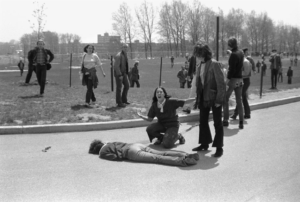
The iconic photograph of 14-year old Mary Ann Vecchio kneeling over the corpse of Jeffrey Miller would bring the Vietnam War home to America and win Kent State photojournalism student John Filo the Pulitzer Prize.
Filo told Annenberg Digital News:
Blood was just pumping out of his body, on the hot asphalt. I could see the tension building in this girl and finally she let out with the scream, and I sort of reacted to the scream and shot that picture.
Days later, David Crosby handed Neil Young a copy of Life magazine that featured Filo’s photo. Until then, CSNY were known for the gentle lyrics and intricate harmonies in songs like “Our House” and “Teach Your Children.” But Crosby told VH1 that Filo’s photo inspired the raw emotions of “Ohio”:
That girl leaning over the other kid in a pool of blood, and a look of, ‘Whaaa? What? How could this have happened?’ You know it’s shock … grief.
Neil Young recalled:
Crosby came and had the magazine with the Kent State killings. I had heard it on the news, what had happened, but Crosby always had a way of bringing stuff into focus.
Young disappeared into the woods with his guitar. When he returned a few hours later, he’d written “Ohio.”
Bandmate Graham Nash recalled in MusicRadar:
Crosby called me up and said he’d booked a studio, Neil just wrote this song, it’s f—ing fantastic. Get down here.’ Neil played me ‘Ohio,’ and it was ‘Holy f— – fantastic.’ We recorded it in an hour and a half.
The B-side, Stephen Stills’ “Find the Cost of Freedom,” was recorded in a half-hour and the master was sent to Atlantic Records president Ahmet Ertegun. Nash remembered.:
We mixed it, gave him the two-track and said, ‘Ahmet, we want this out now,’ Ahmet put up an argument, but we were firm. Twelve days later, we put it out in a single sleeve with a copy of the Constitution that had four bullet holes on it.
“The mood was just very intense,” engineer Bill Halverson related on his website. “They were bent on getting it right and were on a mission.”
Though Young would later write “Rockin’ in the Free World,” which criticized President George H.W. Bush, and “Southern Man,” which skewered that region’s racism, “Ohio” would be the singer’s first protest song.
Young, a Canadian, explained in the liner notes of his Decade anthology:
It’s still hard to believe I had to write this song, It’s ironic that I capitalized on the death of these American students. Probably the biggest lesson ever learned at an American place of learning.
Explicit lyrics like “Tin soldiers and Nixon’s coming … Soldiers are gunning us down … Four dead in Ohio” would get the song banned on some mainstream AM stations but airplay on FM and underground radio would make “Ohio” a Top 20 hit. Crosby wrote in the liner notes of the CSN collection:
For me, ‘Ohio’ was a high point of the band, a major point of validity. There we were, reacting to reality, dealing with it on the highest level we could – relevant, immediate. It named names and pointed the finger.
On May 4, 1997, Crosby, Stills & Nash attended a commemoration of the shootings at the Kent State campus. Graham Nash stated:
Four young men and women had their lives taken from them while lawfully protesting this outrageous government action, We are going back to keep awareness alive in the minds of all students, not only in America, but worldwide… to be vigilant and ready to stand and be counted … and to make sure that the powers of the politicians do not take precedent over the right of lawful protest.
At the end of the ceremony, the trio performed “Ohio” to an enthusiastic crowd. David Crosby told the Akron Beacon Journal:
The students stood up for their God-given right to protest, and they got slaughtered for it, Those people were expressing their constitutional right of assembly and were attacked for it, and they’ve never been apologized to.
The President’s Commission on Campus Unrest issued its findings in a September 1970 report that concluded that the Ohio National Guard shootings on May 4, 1970, were unjustified. The report said:
Even if the guardsmen faced danger, it was not a danger that called for lethal force. The 61 shots by 28 guardsmen certainly cannot be justified. Apparently, no order to fire was given, and there was inadequate fire control discipline on Blanket Hill. The Kent State tragedy must mark the last time that, as a matter of course, loaded rifles are issued to guardsmen confronting student demonstrators.
Eight of the guardsmen were indicted by a grand jury. The guardsmen claimed to have fired in self-defense, a claim that was generally accepted by the criminal justice system. In 1974 U.S. District Judge Frank J. Battisti dismissed civil rights charges against all eight on the basis that the prosecution’s case was too weak to warrant a trial.
Civil actions were also attempted against the guardsmen, the state of Ohio, and the president of Kent State. The federal court civil action for wrongful death and injury, brought by the victims and their families against Governor Rhodes, the President of Kent State, and the National Guardsmen, resulted in unanimous verdicts for all defendants on all claims after an eleven-week trial. The judgment on those verdicts was reversed by the Court of Appeals for the Sixth Circuit on the ground that the federal trial judge had mishandled an out-of-court threat against a juror.
On remand, the civil case was settled in return for payment of a total of $675,000 to all plaintiffs by the state of Ohio (explained by the State as the estimated cost of defense) and the defendants’ agreement to state publicly that they regretted what had happened.
In 1999, “Midnight Train to Georgia” was inducted into the Grammy Hall of Fame. It currently ranks #432 on Rolling Stone’s 500 Greatest Songs of All Time.
The song was originally written and performed by Jim Weatherly under the title “Midnight Plane to Houston”, which he recorded on Jimmy Bowen’s Amos Records.
“It was based on a conversation I had with somebody… about taking a midnight plane to Houston,” Weatherly recalls. “I wrote it as a kind of a country song. Then we sent the song to a guy named Sonny Limbo in Atlanta and he wanted to cut it with Cissy Houston (mother of Whitney and aunt of singers Dionne and Dee Dee Warwick)… he asked if I minded if he changed the title to “Midnight Train to Georgia”. And I said, ‘I don’t mind. Just don’t change the rest of the song.'”
Weatherly, at a program in Nashville, said he was the quarterback at the University of Mississippi, the NFL didn’t work out for him, so he was in LA trying to write songs.
He was in a Rec football league with Lee Majors and called Majors one night. Farrah Fawcett answered the phone and he asked what she was doing. She said she was “taking the midnight plane to Houston” to visit her family.
He thought that was a catchy phrase for a song, and in writing the song, wondered why someone would leave LA on the midnight plane – which brought the idea of a “superstar, but he didn’t get far.”
Weatherly’s publisher forwarded the song to Gladys Knight and the Pips, who followed Houston’s lead and kept the title “Midnight Train to Georgia.” In her autobiography, “Between Each Line of Pain and Glory”, Gladys Knight wrote that she hoped the song was a comfort to the many thousands who come each year from elsewhere to Los Angeles to realize the dream of being in motion pictures or music, but then fail to realize that dream and plunge into despair.
“Nobody’s Fault but Mine” is a gospel song that has been recorded by many musicians over the years. The first known recording of this song was by American gospel blues musician Blind Willie Johnson in 1927, titled “It’s Nobody’s Fault but Mine”.
In an interview, Jimmy Page explained:
“Robert Plant came in one day and suggested that we cover it, but the arrangement I came up with was nothing to do with the Blind Willie Johnson original. Robert may have wanted to go for the original blues lyrics, but everything else was a totally different kettle of fish.”
Led Zeppelin biographer George Case adds “Page was likely more mindful of John Renbourn’s 1966 acoustic take than Blind Willie Johnson’s”.
Lyrically, “Nobody’s Fault but Mine” has been called “Led Zeppelin’s ‘Hell Hound on My Trail'”, another Robert Johnson 1937 Delta blues song tells of a man trying to stay ahead of the evil which is pursuing him, but it does not address the cause or lasting solution for his predicament.
In Blind Willie Johnson’s “It’s Nobody’s Fault but Mine”, the problem is clearly stated: he will be doomed, unless he uses his abilities to learn (and presumably live according to) biblical teachings.
Led Zeppelin retain Blind Willie’s admission that he ultimately is to blame, but add Robert Johnson’s sense of despair. However, they shift the focus from religion to one “relevant to the Zeppelin lifestyle of the day”.
Their lyrics include “that monkey on my back”, a commonly used reference to addiction, and “the devil he told me to roll, how to roll the line tonight”; to overcome, Plant concludes “gonna change my ways tonight”. “For Robert [Plant] and perhaps the others, it was a sort of exorcism”.
“Nobody’s Fault but Mine” follows a “call-and-response method of dramatic construction”. Page’s slide guitar intro has been described as like “a supersonic 1970s interpretation of Johnson’s beautiful slide guitar technique”.
Page triple-tracked his guitar intro; playing one guitar an octave higher than the others and using a phaser. Plant adds a blues-style harmonica solo mid-song. Drummer John Bonham and bassist John Paul Jones maintain the rhythm of the song, adding some syncopated accents during repetitions of the introductory phrase.
“Lola” is a song written by Ray Davies and ranked number 422 on “Rolling Stone’s 500 Greatest Songs of All Time” as well as number 473 on the “NME’s 500 Greatest Songs Of All Time” list.
Ray Davies has claimed that he was inspired to write “Lola” after Kinks manager Robert Wace spent a night in Paris dancing with a transgender woman. Davies said of the incident, “In his apartment, Robert had been dancing with this black woman, and he said, ‘I’m really onto a thing here.’ And it was okay until we left at six in the morning and then I said, ‘Have you seen the stubble?’ He said ‘Yeah’, but he was too pissed [intoxicated] to care, I think”.
Drummer Mick Avory has offered an alternate explanation for the song’s lyrics, claiming that “Lola” was partially inspired by Avory’s frequenting of trans bars in west London. Avory said, “We used to know this character called Michael McGrath. He used to hound the group a bit, because being called The Kinks did attract these sorts of people. He used to come down to Top of the Pops, and he was publicist for John Stephen’s shop in Carnaby Street. He used to have this place in Earl’s Court, and he used to invite me to all these drag queen acts and transsexual pubs. They were like secret clubs. And that’s where Ray [Davies] got the idea for ‘Lola’. When he was invited too, he wrote it while I was getting drunk”.
Despite claims that the song was written about a supposed date between Ray Davies and Candy Darling, Davies has since claimed this rumour to be false, saying that the two only went out to dinner together and that he had known the whole time of Darling’s gender identity.
In his autobiography, Dave Davies said that he came up with the music for what would become “Lola”, noting that brother Ray added the lyrics after hearing it. In a 1990 interview, Dave Davies stated that “Lola” was written in a similar fashion to “You Really Got Me” in that the two worked on Ray’s basic skeleton of the song, saying that the song was more of a collaborative effort than many believed.
Initial recordings of the song began in April 1970, but, as the band’s bassist John Dalton remembered, recording for “Lola” took particularly long, stretching into the next month. During April, four to five versions were attempted, utilizing different keys as well as varying beginnings and styles.
In May, new piano parts were added to the backing track by John Gosling, the band’s new piano player that had just been auditioned. Vocals were also added at this time. The song was then mixed during that month. Mick Avory remembered the recording sessions for the song positively, saying that it “was fun, as it was the Baptist’s [John Gosling’s] first recording with us”.
The guitar opening on the song was produced as a result of combining the sound of a Martin guitar and a vintage Dobro resonating guitar. Ray Davies cited this blend of guitar sounds for the song’s unique guitar sound.
The song features Jim Gordon on drums, as does the bulk of the Pretzel Logic album. The guitar solo is by Jeff “Skunk” Baxter who would soon go on to join The Doobie Brothers. It is the most successful single for Steely Dan. It peaked at #4 on the Billboard Hot 100 in the summer of 1974.
According to a 2006 interview, the Rikki of the title is Rikki Ducornet, a New York writer and artist. Steely Dan co-front Donald Fagen met her while both were attending Bard College, a small liberal arts school located in Annandale-on-Hudson, New York. Ducornet said they met at a college party, and even though she was both pregnant and married at the time, he gave her his number, although not in the same context as the song. Ducornet was intrigued by Fagen and tempted to call him, but she decided against it.
Victor Feldman’s flapamba (a rare and unusual instrument that is a variant of the marimba) introduction to the song, which opens the album, is cut from the original ABC single version. The MCA single reissue (backed with “Pretzel Logic”) includes the flapamba intro but fades out just before the actual end of the track. The introductory riff is an almost direct copy of the intro of Horace Silver’s jazz classic “Song for My Father”.
The original band line-up featured lead vocalist and guitarist Steve Marriott from The Small Faces, vocalist and guitarist Peter Frampton from The Herd, former Spooky Tooth bassist Greg Ridley and a 17-year-old drummer, Jerry Shirley, from The Apostolic Intervention.
The song, a Steve Marriott composition released in 1972, bemoans being arrested for possession of small quantities of illegal drugs, including cocaine; Durban poison, a potent strain of marijuana, and Red Lebanese and Black Nepalese, two types of hashish. “New Castle Brown” is often mistaken as a reference to Newcastle Brown Ale but actually refers to heroin also known as “Brown” or “Smack”. The song refers to Borstal – “some seeds and dust, and you got Borstal”- referring to Borstal Prison and its borstal ilk – any manner of a British juvenile gaol (British for jail). (Most lyrics listings get this wrong, and say “buzzed on” or “bust on”.) Marriott has said that inspiration for the title came from a Humphrey Bogart/James Cagney movie he saw on TV, where Bogart plays a prisoner who gets sent to “30 days in the hole.” Marriott may have been referring to the 1938 movie Angels With Dirty Faces, although that line is never uttered in the film. It’s also possible that the film was Somebody Up There Likes Me, a 1956 movie where Paul Newman is threatened with the “30 days in the hole.”
Pie guitarist Clem Clempson (who had replaced the original guitarist Peter Frampton) has said it is one of the tracks he would most like his career to be remembered by. But the predominant group personality shown through by the song is Marriott’s; so much so that for example when years later Clempson was asked about efforts to reform the group without Marriott, he simply declaimed, “It’s a waste of time.”
Their first major hit was “I Don’t Need No Doctor”, a 1966 R&B song, on their album “Performance Rockin’ the Fillmore” released in 1971.
Steve Marriott joined the newly formed Humble Pie after he left The Small Faces, who were founded in 1965 by members Steve Marriott, Ronnie Lane, Kenney Jones, and Jimmy Winston, although by 1966 Winston was replaced by Ian McLagan as the band’s keyboardist.
While they were well known in England, they became noted in the U.S. with the release of two songs in particular: “Tin Soldier” and “Itchycoo Park”. “Tin Soldier” was originally written by Marriott for British soul singer P.P. Arnold but decided to keep it for his own. Here’s a television version by The Small Faces with her:
Steve’s unmistakable vocals had the hint of their other hit “Itchycoo Park” released in 1967.
The song was one of the first pop singles to use flanging, an effect that can be heard in the bridge section after each chorus. Most sources credit the use of the effect to Olympic Studios engineer George Chkiantz who showed it to the Small Faces regular engineer Glyn Johns; he in turn demonstrated it to the group, who were always on the lookout for innovative production sounds, and they readily agreed to its use on the single.
After a long career and a hard life of fame, drugs, and alcohol abuse (which he partially recovered from), at about 6:30 am on 20 April 1991, a passing motorist saw the roof of Marriott’s cottage ablaze and called the fire brigade. It was reported that four fire engines were needed to put out the fire. Steve was found deceased in the bedroom.
In September 2007 Marriott, along with the other members of the Small Faces and manager Don Arden, were honoured with a plaque unveiled in Carnaby Street.
We use cookies to ensure that we give you the best experience on our website. If you continue to use this site we will assume that you are happy with it.Ok